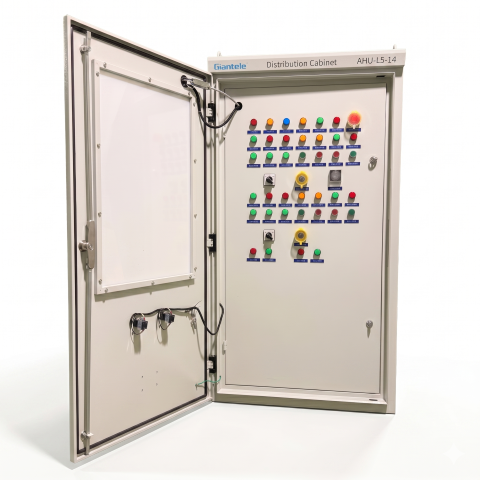

Key Takeaways
- Custom VFD panel fabrication is priced from the duty, never from the drive rating.
- A bypass starter exists for the day the drive fails, not for normal running.
- A sealed starter box is a gasket problem. A sealed drive panel is a heat problem.
- The drawing set and the terminal plan decide whether the panel can be repaired.
- Labels are machined into the assembly, not stuck on at dispatch.
Custom VFD panel fabrication looks like a drive in a box until you open the file. Most of the work is a schedule, a drawing set, a label plate and a test record. VFD panels are bought on those four items, not on the drive nameplate.
A custom panel cannot be quoted from a kilowatt rating
A shop can price a drive from its power rating in one afternoon. It cannot price the panel around that drive from the same number.
The shell, the cooling, the busbar and the terminals all follow from the duty. Ask a fabricator what it needs before quoting, and listen to the list.
The good ones ask for full load amps, starts per hour and ambient temperature. They also ask for the length of the cable run to the motor.
Those four numbers set the heat load, the contactor rating, the gland plate and the output filter. A 90 kW drive on a 200 m cable needs a reactor. The same drive on a 15 m cable does not.
| What you supply | What it fixes in the panel | What a guess costs |
|---|---|---|
| Full load amps | Breaker, contactor and overload rating | A drive that trips on a hot afternoon |
| Starts per hour | Contactor duty and the cooling margin | Welded contacts in year three |
| Cable run to the motor | Output reactor or dv/dt filter | Motor winding failure on a long run |
| Ambient and altitude | Derating, filtered fan or air conditioner | A panel that runs at its own limit |
| Control voltage and signals | Transformer and the terminal plan | A control section rebuilt on site |
Altitude is the fifth input and the one most often missed. Above 1000 m a drive derates, so a panel sized at sea level runs hot in Addis Ababa or Bogota.
A power control panel manufacturer that quotes from a questionnaire is telling you how the works thinks. One that quotes from a price list is telling you the same thing.
How do motor starters work when a drive already starts the motor
A starter is a contactor and an overload. It connects the motor to the supply, and it trips when the current stays too high for too long.
A drive does both of those jobs and adds speed control. So the starter inside a drive panel is not there for normal running.
It is there for the afternoon the drive fails. A plant cannot wait three weeks for a replacement board from another continent.
In a bypass panel the contactor sits in parallel with the drive. Move the selector and the motor runs direct, at fixed speed, on the same overload.
The interlock is the whole engineering. Mechanical and electrical, so the two paths can never close at the same time.
Most motor starters in a drive panel are bought for that one afternoon. Price the bypass as insurance, not as hardware.
A fixed speed load needs neither a drive nor a bypass. A fan that always runs flat out is cheaper with a starter and a damper.
A starter box and a VFD panel are not the same purchase
A motor starter enclosure is sized by the cable and by the wall it hangs on. A drive panel is sized by the heat, and the gap shows up in the first quotation.
Both can carry the same IP number and behave nothing alike. A sealed starter box makes almost no heat. A sealed drive panel makes a great deal of it.
So a starter box in a washdown bay is a gasket question. Add a drive and it becomes a cooling question, and the gasket now fights the fan.
Check the enclosure figure before the drive figure. A panel quoted with no cooling calculation was priced as a starter box with extra parts.
The drive is one column of the panel
Six drives in one shell are six small panels, not one big one. Each drive needs a breaker, a contactor, an overload, a reactor and a set of terminals.
Then the shared parts arrive. An incoming section, a control transformer, a 24 V supply, a signal terminal block, and a filtered fan.

Three layers, and they do not mix
The rule behind that layout is separation. Nothing in the power layer is allowed to cross the control layer, not even a signal cable.
That is the difference between a VFD panel board and a plate with drives bolted to it. The board has a fault level, a busbar and a schedule.
Skipping the shared section still gives you a working ac drive control panel. It will simply be impossible to test and expensive to extend.
A sump pump controller is a level device with a box around it
The drive is the least interesting part of a sump pump controller. The logic decides when the pump runs, and the logic is two floats and a relay.
A stop float, a start float and a high level alarm. Add a seal fail probe if the pump has one, and an hour meter for the maintenance log.
Duty and standby is where most of the value sits. Two pumps alternate on every cycle, so neither wears out three years before the other.
Pump energy falls by roughly 20 to 40 percent. That happens when the duty point is trimmed by speed, not by a throttle valve.
That is the number a treatment works buys. A controller with a drive and no rotation logic captures very little of it.
Pumping is the largest electrical load in most treatment works. The IEA tracks industrial demand growth, and every new pump adds to it.
Municipal plants in Nairobi and Ho Chi Minh City run four or five pumps on one controller. The panel is judged on the rotation, not on the drive.
The terminal plan is the sheet that gets skipped
Five documents make a build file. A single line diagram, a schematic per motor, a layout, a bill of materials and a terminal plan.
Add the wire numbering rule and the set is complete. Electrical panel design without that rule is assembled from memory.
I have opened panels where the schematic stops at the terminal block. Field wiring was never drawn, so every site had to invent its own.
Good industrial electrical control panels are recognisable by the terminal plan. Every core carries the same number at both ends.
Electrical control panel design is not a drawing exercise. It is a decision about what the next person needs when the panel fails at two in the morning.
A works that runs under ISO 9001 hands over the revision history with the panel. One that does not will make it up as it goes.
Warning labels carry the rating, not the logo
Electrical panel warning labels belong to the assembly. They are not a sticker pack added at dispatch.
Four plates do the work. The rating plate carries the IP number and the IEC 61439 reference. The danger label sits at the incoming, and the tag number goes on every plate.
 Warning triangle
Every door gets the same treatment
The triangles on these doors mark the incoming and the drive sections. The red tags hold a unit that has not passed its routine test.
Neither is decoration. One tells a fitter where the voltage is, the other tells the works not to ship.
Stickers curl in a washdown bay. Engraved plates and laser marked polyester survive it, and a curled label is a finding on any audit.
The duty label per way matters more than the large one on the door. A fitter needs to know which starter feeds which pump before touching anything.
Print the tag number on the plate and on the drawing. A panel that cannot be matched to its drawing cannot be maintained.
Speed lives in the drive, logic lives in the PLC
Someone has to decide where the logic lives. When nobody decides, it lives in both places, and the panel becomes impossible to support.
Keep it to four wires and the split stays clean. Run, fault, reference and common. Everything else is a protocol, and protocols change with every generation of hardware.
Automated control systems that reach into the drive for every setting are hard to support. Replace one drive and the logic has to be rebuilt.
 Mimic panel
The door tells the operator what the program knows
Indicator lamps and meters on the door repeat the state of the plant. They are wired from the same signals the PLC reads.
That redundancy is cheap. It is also the reason an operator can run the room during a network outage.
Hand-off-auto belongs on the door, not in the program. An operator who cannot stop a pump without a laptop will find a way that defeats the interlock.
That is what a proper industrial automation and control layer buys. The panel keeps working while one device is swapped.
Frequently asked questions
How does a motor starter work in a panel that already has a drive?
It runs in parallel, as a bypass. The contactor and overload connect the motor straight to the supply when the drive is isolated. The two paths are interlocked so only one can close. The motor then runs at fixed speed until the drive returns.
Do we need a bypass on every VFD panel?
No. A bypass earns its place when the load cannot stop, such as a sewage pump or a process fan. On a conveyor that can wait, the money is better spent on a spare drive. Ask what the plant does for three weeks without that motor.
What drives the price of a sump pump controller?
The logic, not the drive. Float switches, a seal fail input, alternation and a high level alarm add hours. Together they cost more engineering than a small drive. A controller built around one float is cheap to buy and expensive to live with.
How long does custom VFD panel fabrication take?
Six to twelve weeks from approved drawings, and the drawings are the variable. A set approved in week one with a full motor schedule releases the works immediately. A set that arrives as a single line diagram spends a month in questions before steel is cut.
Which IP rating should a drive enclosure have?
IP54 covers most indoor plant rooms and stops dust and splashing water. Washdown areas need IP65 and a stainless or painted finish that survives the chemicals. Outdoor sites need a canopy and a drain as well, because a gasket alone will not keep a monsoon out.
Can a shop fabricate from our own drawings?
Yes, and it is the fastest route when the drawings are complete. Send the terminal plan and the bill of materials with them. A shop that has to redraw your set will charge for the redraw and will own the errors that follow.
Are warning labels included in a panel build?
They should be, and they should be priced as plates rather than stickers. Ask for the label schedule with the quotation. If it is missing, the labels will be ordered the week before dispatch, from whatever the printer has in stock.
Final thoughts
Custom VFD panel fabrication is a document set that happens to end in steel. The schedule, the drawings, the labels and the test record are the product. Ask for all four before you compare two prices.
Send the motor schedule with the enquiry
Give us the motor list, the duty and the site conditions. We will come back with the drawings we would build from and the panel we would quote.
Contact Giantele