Suppliers answer an IoT question with a feature list. A sub distribution board is small, so the useful question is narrower: what can it report, how many points will you use, and who proves the data. Compare distribution panel boards on the point list, not the brochure.
Key takeaways
- The point list decides the price of connectivity on a sub distribution board, not the brand of the module.
- An electric board panel with twenty ways needs three or four monitored points, not twenty.
- A module needs rail space, a supply and a route for the data cable. Reserve all three on the drawing.
- Split-core current transformers let you retrofit a live board, but the shutdown still has to be planned.
- Ask for the register map and one real export file before you place the order.
Why a sub distribution board is the awkward end of a connected plant
A main board earns monitoring. A sub distribution board sits downstream, feeds a handful of lighting and small power circuits, and has no instrument compartment, no current transformers and a single feeder. Connectivity is a decision about which points are worth paying for, not about picking a platform.
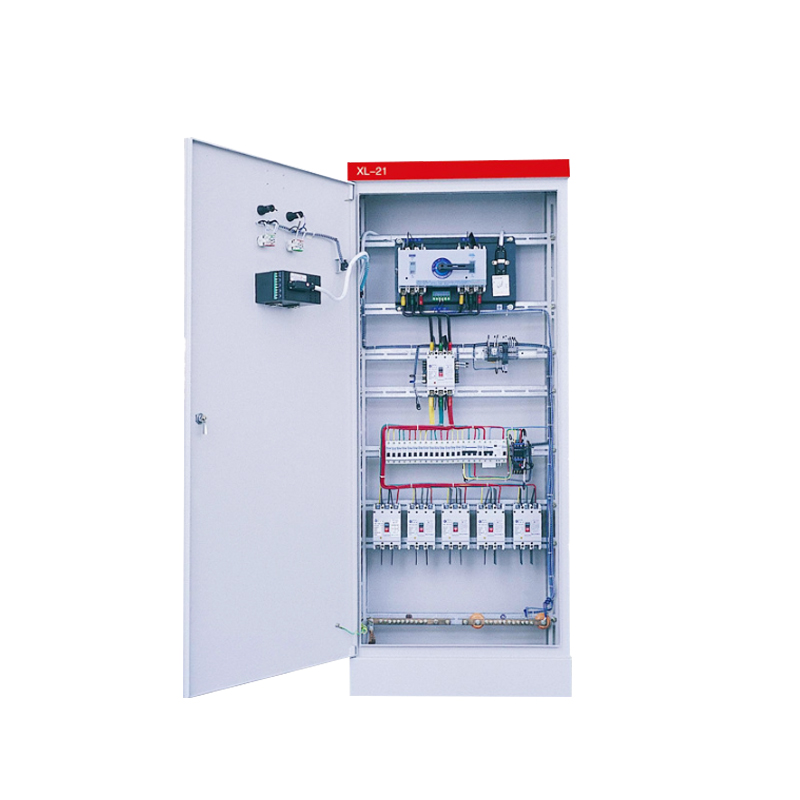
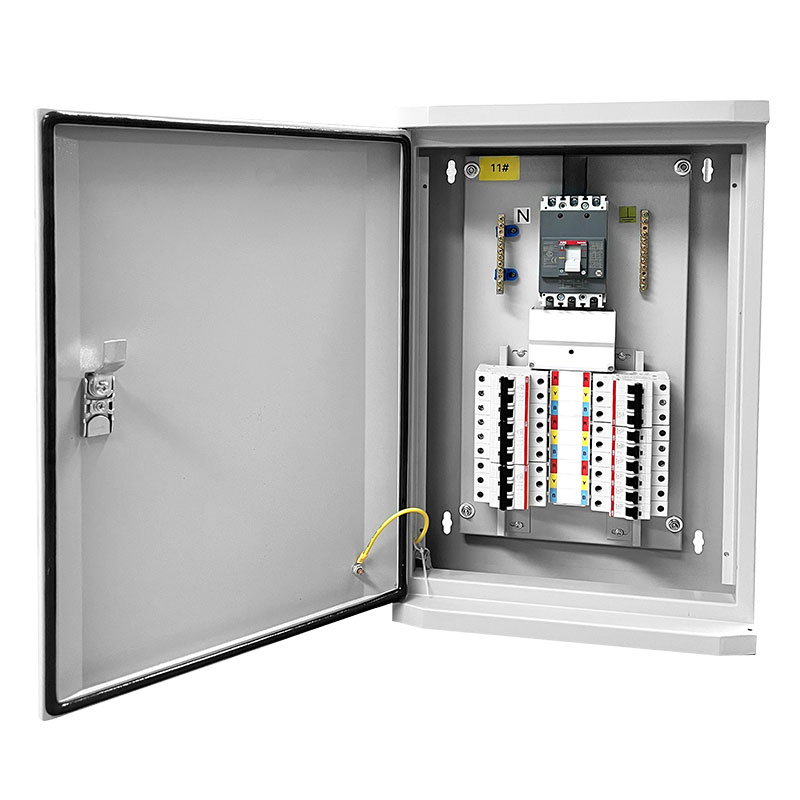
Most electric panel boxes sold into tenant areas carry one incoming device and eight to twenty outgoing ways. Nobody sizes that board for a data cable. The enclosure is shallow, the rail is full, and the neutral bar sits where the module would go.
A fixed lv panel has more room, but the rail still gets reserved for devices rather than for a module.
A smaller electric board panel earns its points differently. You will not meter every lighting circuit. You will meter the incoming supply and the few ways that carry real load. The case is not fashion: the International Energy Agency tracks where load keeps moving.
Fix the point list before you compare suppliers
Write the point list first. It is one page listing what you want to read from the board, in engineering units, with the update rate. Suppliers price against that list. Without it, two quotes look identical, and the cheaper one returns board totals instead of the per-way data you assumed.
A workable list for a board this size has three tiers. The incoming supply, the six to eight heavily loaded ways, and one temperature point if the board sits in a hot room. Anything below 16 A rarely repays the cost of a point.
Builders quote per point, not per board. A monitored point costs roughly a third of the metering device price again once you add the transformer, the wiring and the labour. A fifteen-way board with three monitored ways is a different product from the same board with fifteen.
Order a board for electrical panel assembly with the list attached. The builder can then reserve the rail length before the sheet metal is cut. The same logic applies when you specify a distribution power panel for a tenant area.
| Position | Report it | Why it earns its cost |
|---|---|---|
| Incoming breaker | Yes | Board energy and load trend, the figure a tenant disputes |
| The six to eight largest ways | Yes | Locates the load that trips the feeder before the trip |
| Lighting ways below 16 A | No | The point costs more than any decision it supports |
| Terminal or busbar temperature | Above 250 A only | Heat is how a loaded board fails |
| Earth and door continuity | No | Test it at the annual inspection instead |
How the data leaves a board that has no spare space
Three routes leave a small board. A wired bus linked from board to board, a gateway inside the largest board, or a retrofit node that clips onto the outgoing conductors. Each costs differently and each fails differently. The wired route is the one most plants under-estimate.
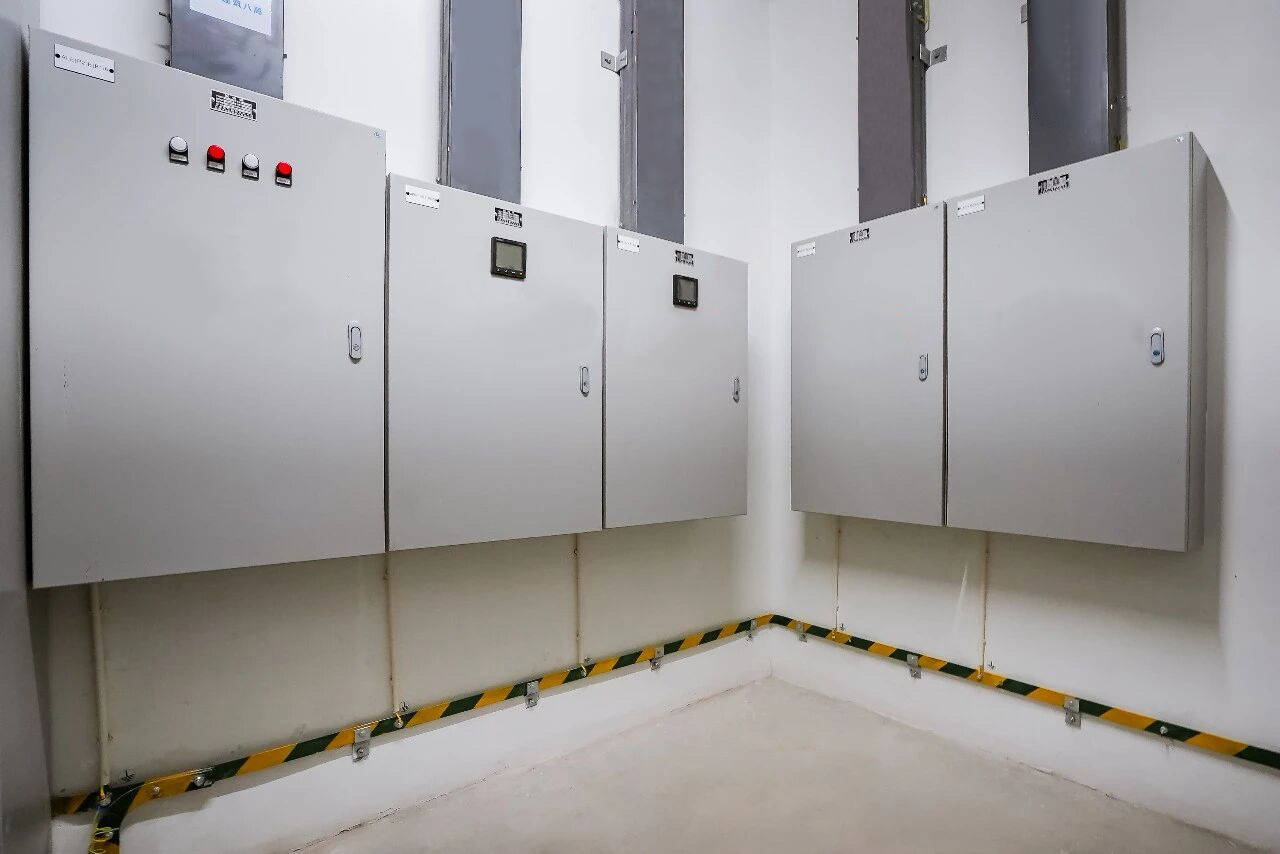
Local indication is not connectivity. Door lamps and analogue meters show a value to whoever opens the cover. Nobody opens a distribution electrical panel in a riser cupboard on a night shift. If the number matters, it has to leave the enclosure.
Well-made electrical panel boards leave that room. The module needs rail space and a supply. On a board fed from a room lighting circuit, a trip removes your monitoring with the lights. So take the supply from the incoming side, not from a way you also want to measure.
Leave a spare 20 mm of rail and a knock-out for the data cable. An electricity panel built with those two provisions accepts a module later at a fraction of the cost of a field modification.
 Where the data starts
Door-mounted meters show a value to whoever opens the cover.
The module needs rail space beside the incomer, plus a supply that survives a lighting trip.
Retrofitting a board that is already in service
A retrofit is possible without replacing the board. Split-core current transformers clip around existing conductors, so you never break the circuit. The shutdown is what you cannot avoid: the module needs a supply, a data cable and a commissioning window, and a live plant room leaves little space.
Most boards in this size range keep 25 to 40 mm of clear space behind the cover. A split-core transformer for a 100 A way is about 40 mm wide. Measure before you buy, because the cover clearance decides the transformer you can use.
The same routine works on a low voltage power distribution lineup, where the boards sit in one room and can share a single cable route.
Plan the outage. Two hours per board is realistic for a clean retrofit with a tested module, longer if the panel schedule is out of date. In textile plants across Vietnam and Indonesia, retrofits run board by board through a planned shutdown rather than during production.
 Retrofit on a live rail
The outgoing conductors are already there. A split-core transformer clips around them without cutting the cable.
The cover clearance, not the transformer rating, decides what fits.
How many boards can share one connection
One wired bus carries more boards than most plants expect. On a 9,600 baud link, twenty to thirty devices on one twisted pair is normal. The limits are physical rather than protocol: total cable length, address space, and what happens when somebody unplugs a board to work on it.
Address every board before it leaves the workshop. An address set on site with a laptop becomes a duplicate the first time a board is swapped, and one duplicate takes the whole segment down, not one board.
Decide what a dropped board means on your screen. It should read as offline, not freeze the last figure. Ask for that behaviour in writing, because plenty of gateways show yesterday's number in today's colour.
Wire the bus in one direction where you can. A ring looks tidy on a drawing, but a single break leaves every downstream board talking to nothing. On a site with low voltage switchboards spread over twenty rooms, that can mean a morning spent opening doors one at a time.
Twenty boards on one segment is a fair ceiling for the fleet of boards electrical engineers call LV assemblies. A larger site usually splits the bus by floor. The data from every board still lands in the same view, beside the main distribution cabinet that feeds them all.
What to ask a supplier to prove
Ask for documents, not adjectives. A supplier who fits modules to a sub distribution board will hand over a register map, a drawing and one real export file without hesitation. A reseller sends a catalogue page. The difference shows up in the first week after handover.
Two of the checks sit outside the supplier. IEC 61439 defines how the assembly is type tested, and ISO 9001 covers the quality system behind the build. Neither one proves the data layer works, but a builder without both is a risk.

Five things worth asking for
Frequently asked questions
Can any sub distribution board be connected to a network?
Do I need to meter every outgoing way?
Which protocol should I ask for?
Can monitoring be added without a shutdown?
How much does connectivity add to the board price?
Who owns the data, and how do I get it out?
Is wireless acceptable on a sub board?
What do suppliers mean by IoT connectivity?
Final thoughts
Connectivity is a wiring and addressing job, not a brand choice. Fix the point list, reserve the rail, then ask what the supplier will prove. Send Giantele your point list and we return an arrangement showing where the module sits and how the cable leaves the board.
Specifying a board for monitoring?
Send the point list and the incomer rating. We return a general arrangement marking the module position, the reserved rail length, the current transformer space and the data cable route. The drawing and the quote then match.