IEC 61439 low voltage switchgear is not one product. It is a family of type-tested assemblies: main switchgear panels, distribution boards, motor control centers, ATS panels, VFD panels, APFC panels, and capacitor banks. If you are an EPC contractor or electrical wholesaler sourcing across multiple countries, understanding what each assembly does — and ordering the full IEC 61439 lineup from one supplier — saves months of coordination and thousands in freight consolidation.
The IEC 61439 standard from the International Electrotechnical Commission defines design verification, temperature rise limits, short-circuit withstand, and dielectric requirements. Part 2 covers power switchgear and controlgear assemblies — fully type-tested in an accredited lab. Part 3 covers distribution boards — design-verified for lighter applications. The IEEE references the same testing philosophy for North American markets. When your specification says IEC 61439-2, you are asking for a lab-tested assembly, not a calculated one.
Tier 1: The main LV switchgear — fixed or withdrawable
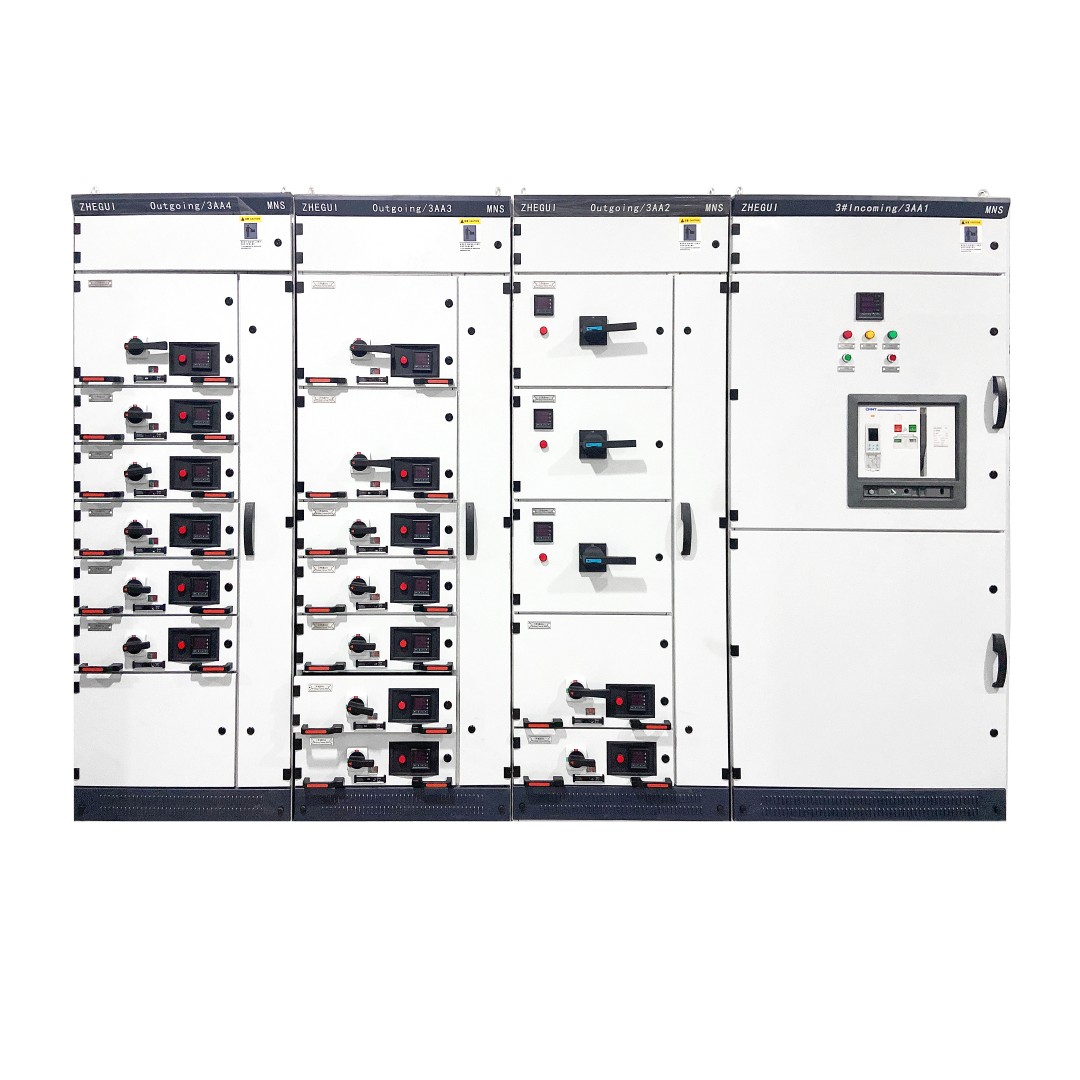
The main switchgear panel is where incoming power from the transformer meets your building. You choose between fixed panels like GGD and GCK, or withdrawable panels like MNS and GCS. Fixed panels cost 30 to 40 percent less and take up less floor space — 600mm cabinet width versus 800mm for withdrawable. In a 30-panel lineup, that saves 6 meters. For commercial buildings, hotels, and residential towers, fixed is almost always the right choice. Withdrawable makes sense for hospitals and data centers where you cannot tolerate downtime for breaker maintenance.
Short-circuit ratings go from 65kA for most commercial projects to 100kA for industrial sites close to large transformers. Busbar current ratings span 400A to 6300A. Silver-plated copper busbar with insulated supports is what you want — it runs 20 years at full load without degradation. The enclosure should be powder-coated steel at IP54 minimum, compartmentalized to Form 2b or higher. Every panel ships with the IEC 61439-2 type-test certificate from an accredited lab. If the supplier cannot produce it, walk away.
Tier 2: Distribution and control — MCC, ATS, VFD, and distribution boards
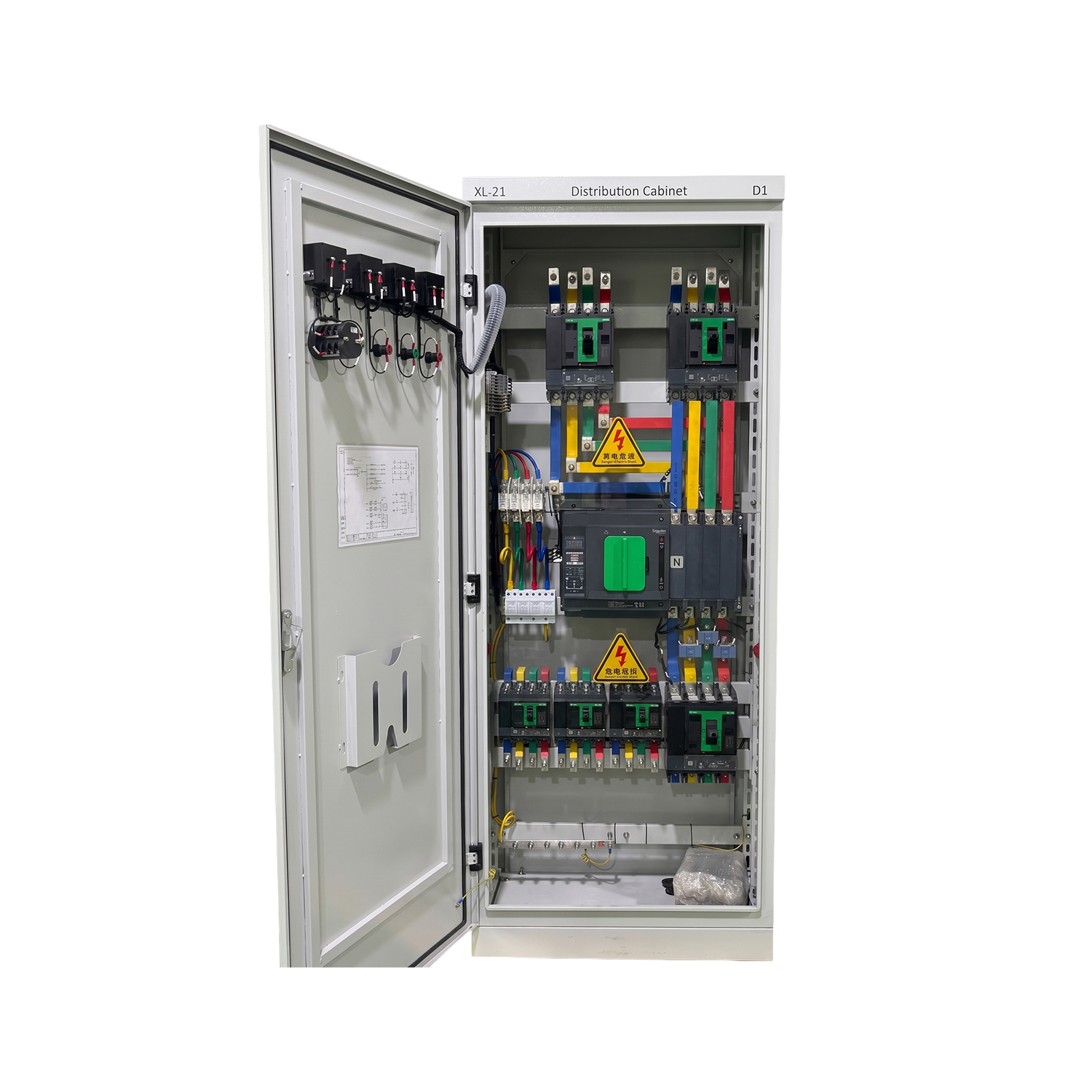
Downstream from the main switchgear, you need equipment to distribute power and control motors. A motor control center groups motor starters, contactors, and overload relays in one cabinet for pumps, chillers, and air handling units. An ATS panel switches critical loads between utility and backup generator within 10 to 30 seconds of grid failure. A VFD panel controls motor speed by varying frequency and voltage, reducing inrush current and saving energy on part-load operation.
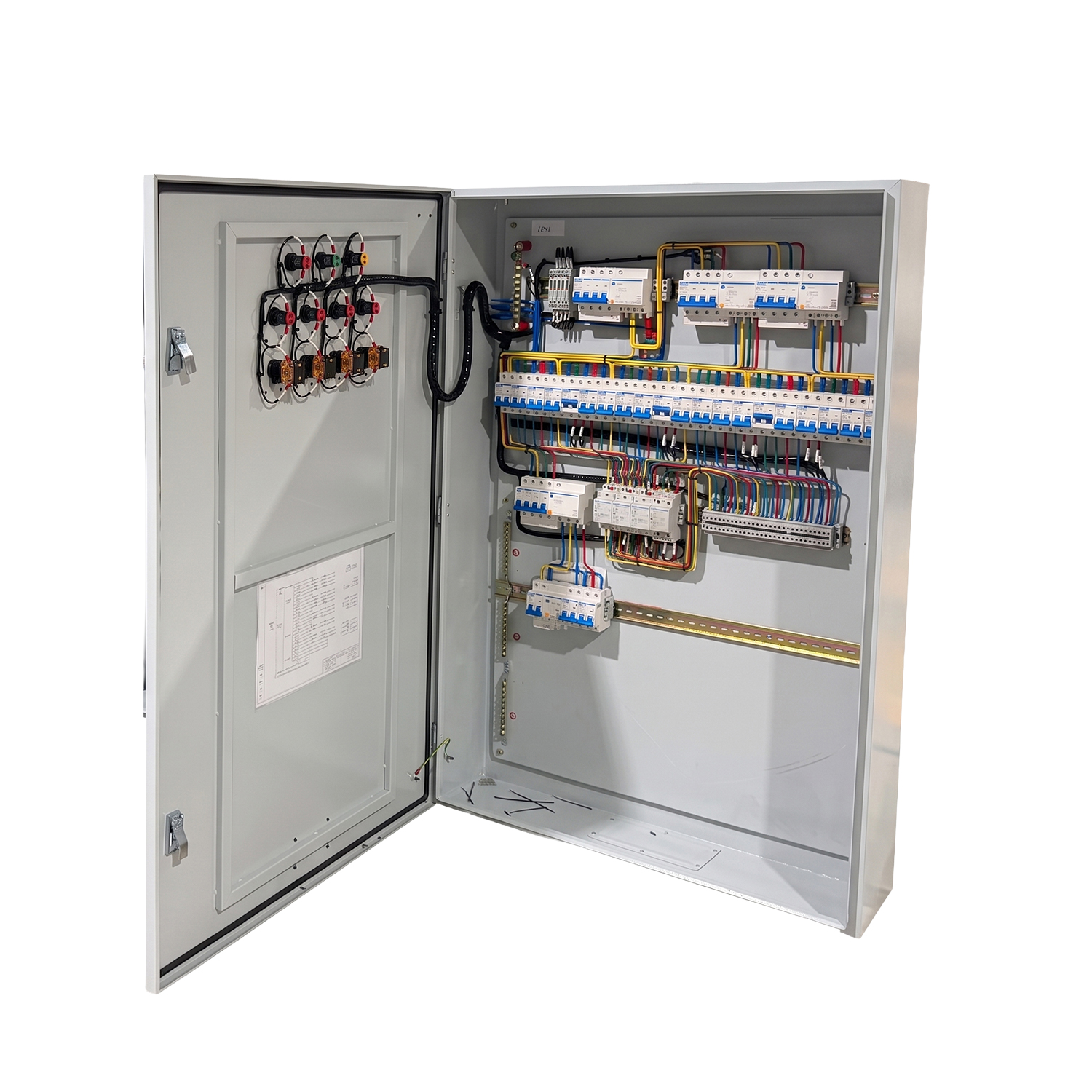
A power distribution board handles everything else — lighting, socket outlets, small HVAC equipment. It is the workhorse that sits on every floor of a commercial building. The key with Tier 2 equipment is short-circuit coordination. The breakers in the MCC, ATS, and distribution board must cascade correctly with the main switchgear upstream. One supplier doing the entire coordination study eliminates the finger-pointing you get when three vendors each blame the other for a coordination failure.
A 20-story office building might have one main switchgear on the ground floor, an MCC for the chiller plant in the basement, an ATS panel for emergency lighting, VFD panels for the HVAC air handlers, and distribution boards on every fourth floor. That is seven or eight separate assemblies. Order them from one factory and they arrive on the same container, with one set of test reports and one commissioning schedule. Order them from three factories and you become a logistics coordinator instead of a project manager.
Tier 3: Power quality — APFC panels, capacitor banks, and SVG
If your motor load exceeds 200kW, you almost certainly need power factor correction. An APFC panel monitors reactive power in real time and switches capacitor banks to maintain a target power factor — typically 0.95 or above. Without it, your utility adds a reactive power penalty to every bill, which for a large facility can run into thousands of dollars per month. The APFC panel pays for itself within 12 to 18 months.
A capacitor bank is the core component inside the APFC panel — the physical capacitors that provide leading reactive power. For sites with heavy VFD or UPS loads, add detuned reactors to protect the capacitors from harmonic overload. For dynamic loads that change every few cycles, a static var generator responds in under 5ms — no contactor wear, no switching transients. The power quality lineup sits at the end of your IEC 61439 assembly chain, connected to the same busbar and tested under the same quality system.
Why one supplier for the full IEC 61439 lineup changes everything
Most electrical rooms today are sourced from three or four suppliers. The switchgear comes from one factory. The MCC comes from another. The APFC panel comes from a third. Each supplier submits their own drawings. Each does their own testing. Each ships on their own schedule. And when something does not fit — the MCC busbar rating does not match the switchgear outgoing breaker, or the APFC controller cannot communicate with the same BMS protocol — nobody takes responsibility.
One factory building the full IEC 61439 lineup eliminates this. Same busbar fabrication. Same enclosure welding. Same powder coating line. One short-circuit coordination study covering every panel. Test reports ship as one package with matching serial numbers. One container, one bill of lading, one project manager to call when something changes. For projects in Africa, the Middle East, or Southeast Asia, where container freight and customs clearance are major cost items, consolidation alone saves five figures. A 20,000 square meter factory with 200 people building 500-plus units a month has the capacity to handle your complete electrical room package.
How to spec and order a complete IEC 61439 LV lineup
Start with your single-line diagram. Then work through this checklist:
- Main incomer: fixed (GGD/GCK) or withdrawable (MNS/GCS). Fixed is cheaper and smaller. Withdrawable adds hot-swap capability. Most commercial buildings use fixed.
- Busbar rating: size for 5-year load projection. Going from 2500A to 4000A later means replacing the entire lineup.
- Short-circuit level: get the available fault current from your transformer data sheet. A 1600kVA at 6 percent impedance delivers about 38kA at the secondary.
- Motor loads: count motors above 5kW. That determines MCC size and whether each motor needs a soft starter or VFD.
- Backup power: if you have a generator, add an ATS panel sized for critical loads.
- Power factor: run a load study. Motors above 200kW almost always trigger utility penalties. Add an APFC panel.
- Enclosure IP: IP42 for conditioned indoor rooms. IP54 for unconditioned spaces. IP65 for outdoor or coastal.
- Compliance: CE plus destination certifications. SASO, SNI, GOST — specify at quoting, not after production.
Send the checklist with your single-line diagram. The quote should address every item. If the supplier skips the short-circuit study or busbar calculation, move on. A properly spec'd IEC 61439 lineup runs 20 years or more with routine inspection. An improperly spec'd one gives you problems on day one. Send us your single-line diagram — we reply with a full technical proposal and compliance documentation within 48 hours.