


Introduction
The power distribution board is the backbone of every electrical system. It receives incoming power from the supply source and divides it into individual protected circuits, ensuring that energy reaches every load safely and under control. Whether it takes the form of a wall-mounted electric panel box in a commercial office, a floor-standing switchboard in a manufacturing plant, or a ruggedized distribution cabinet on an outdoor industrial site, this equipment defines the safety ceiling and operational reliability of the entire installation.
Choosing the wrong board carries consequences that extend well beyond the equipment itself. Undersized boards overheat and trip repeatedly. Non-compliant assemblies create liability under international safety regulations. Boards specified without regard for the site environment fail years ahead of their design life. This guide provides a systematic, decision-by-decision framework so that engineers, project managers, and procurement professionals can select the right distribution board with confidence — from the very first load calculation through to supplier qualification.

Step 1: Define Your Project's Electrical Load Profile
Every correct board selection begins with an accurate understanding of the electrical demand the system must serve.
Total Connected Load vs. Realistic Demand Load
The total connected load is the arithmetic sum of every electrical consumer's rated wattage within the installation. In practice, not all loads operate simultaneously at full capacity, so engineers apply a demand factor to calculate the realistic peak draw. This figure — the demand load — is what the power distribution panel must be rated to handle continuously. Overestimating leads to unnecessary cost; underestimating creates a board that runs at the edge of its thermal limits during peak hours.
Determining Amperage Rating and Breaking Capacity
With the demand load established, the next step is selecting the correct current rating (Amperage) for the low voltage power distribution board. A standard safety margin of 20% above the peak demand load prevents the board from operating at its thermal ceiling under normal conditions. Breaking capacity — the maximum fault current the switch panel can safely interrupt— must also exceed the maximum prospective short-circuit current available at the point of installation. A board with insufficient breaking capacity cannot safely clear a fault, which makes it a direct hazard.
Circuit Count and Spare Way Planning
A properly engineered distribution board always includes headroom. Reserving 25% to 30% of the total circuit ways for future expansion means that machinery additions, new lighting zones, or increased process loads can be integrated without replacing the board entirely. For industrial projects with phased build-outs, this spare capacity is not optional — it is an essential part of the design specification.
Step 2: Match Voltage, Phase, and Frequency to Your Supply
A power distribution board that does not match the site's supply parameters creates inefficiencies at best and dangerous conditions at worst.
Choosing Between Single-Phase and Three-Phase Configurations
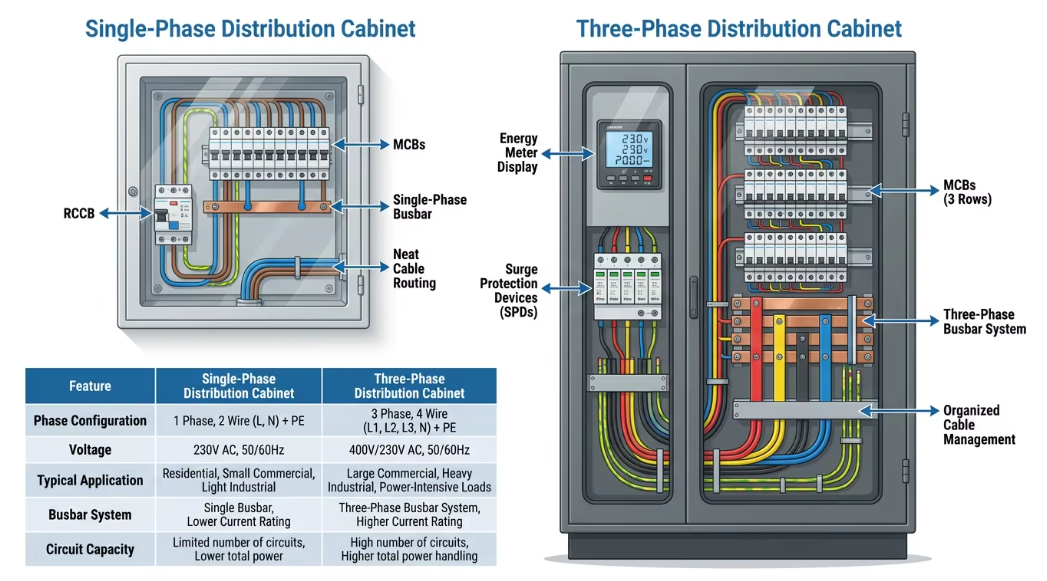
Single-phase distribution panels serve residential properties and light commercial buildings where loads are predominantly lighting, small appliances, and office equipment. Three-phase switchboards are the standard for industrial environments, where motors, compressors, HVAC systems, and process machinery demand balanced, high-power supply across all three phases. Specifying a single-phase board for a three-phase application forces the system to operate outside its design envelope from day one. For high-demand industrial projects, pairing the right switchboard configuration with purpose-built low voltage switchgear ensures the entire distribution system operates within its verified performance envelope.
Voltage Rating: Matching the Grid Standard
Every component inside a low voltage power distribution board — busbars, circuit breakers, terminals, and enclosures — must be rated for the nominal supply voltage of the local grid. In IEC-standard markets, this is typically 230V for single-phase systems and 400V for three-phase. Components under-rated for the actual voltage face accelerated insulation breakdown, while over-rating beyond actual site conditions inflates cost without adding meaningful safety margin.
Frequency Compliance: 50Hz vs. 60Hz
Frequency compliance is a frequently overlooked specification. The internal components of a distribution cabinet, particularly motors driving cooling fans and frequency-sensitive protective relays, must be specified for the correct supply frequency — 50Hz in most of Europe, Asia, Africa, and the Middle East, and 60Hz in North America. Operating frequency sensitive components outside their designed range shortens service life and can cause malfunction.
| Category | 50Hz | 60Hz |
| Standard Regions | Europe, Asia, Africa, Middle East, Australia | North America, Parts of South America, Japan (partially) |
| Nominal Voltage (Single-Phase) | 220V / 230V | 110V / 120V |
| Nominal Voltage (Three-Phase) | 380V / 400V | 208V / 480V |
| Motor Synchronous Speed (2-pole) | 3,000 RPM | 3,600 RPM |
Step 3: Ensure Full IEC Standards Compliance
Standards compliance is not a bureaucratic formality — it is the engineering foundation upon which the safety of every person who interacts with the installation depends.
IEC 61439: The Global Benchmark for Low Voltage Assemblies
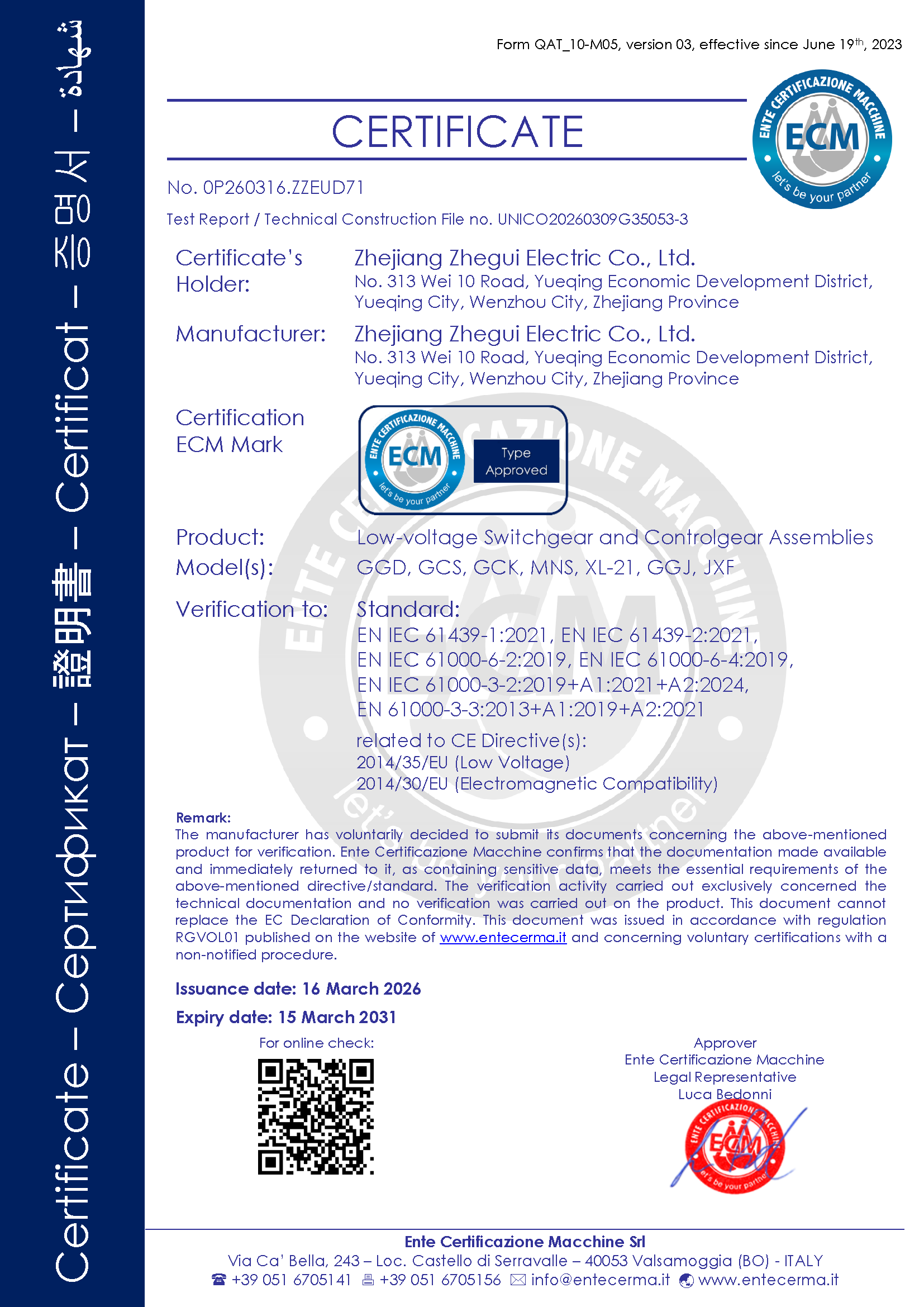
IEC 61439 is the internationally recognized standard governing the design, verification, and performance of low-voltage switchgear and controlgear assemblies, including every type of power distribution board covered in this guide. Compliance with IEC 61439 confirms that the assembly has been verified for thermal performance, dielectric strength, mechanical endurance, and short-circuit withstand capability under defined test conditions. For procurement teams operating in global markets, IEC 61439 certification provides a consistent, universally recognized quality baseline. Giant Electric's low voltage power distribution board solutions are designed and verified to meet this global standard across a full range of industrial and commercial applications.
Short-Circuit Withstand: Surviving the Worst-Case Fault
A fault on a low voltage distribution network can drive thousands of amperes through the distribution cabinet in a fraction of a second. The short-circuit withstand rating specifies the maximum fault current the enclosure, busbars, and internal components can endure without structural failure or fire. Selecting an industrial power distribution panel rated for themaximum available fault current at the point of supply is a site-specific safety imperative — not a generic specification to be applied uniformly across all projects.
Protective Device Coordination: MCBs, RCCBs, and SPDs
Within a compliant electric panel box, three categories of protective devices must be selected and coordinated to deliver layered, selective protection. Miniature Circuit Breakers (MCBs) isolate individual circuits under overload or short-circuit conditions. Residual Current Circuit Breakers (RCCBs) detect earth leakage currents at levels capable of causing cardiac arrest and disconnect power within milliseconds. Surge Protection Devices (SPDs) clamp transient overvoltages caused by lightning strikes or switching events before they can damage sensitive downstream equipment. A well-coordinated switch panel ensures each protective layer operates selectively — clearing only the faulted circuit without unnecessarily tripping healthy circuits.
Step 4: Specify for Your Site Environment
The operating environment determines the physical construction of the distribution cabinet and is just as critical as the electrical specification.
Ingress Protection (IP) Ratings: Matching Enclosure to Environment
The Ingress Protection (IP) rating, defined under IEC 60529, specifies the degree to which the distribution board enclosure resists the intrusion of solid particles and liquids. An IP31-rated electric panel box is appropriate for a clean, temperature controlled indoor plant room. An IP54-rated unit handles dusty or splash-prone industrial interiors. Outdoor installations exposed to rain, wash-down hoses, or coastal spray require IP65 or higher. Specifying an insufficient IP rating is one of the most common causes of premature distribution equipment failure in industrial and infrastructure projects.
Enclosure Material Selection for Harsh Environments
Standard cold-rolled steel meets the requirements of most indoor power distribution panels. However, coastal environments, offshore platforms, chemical processing facilities, and food manufacturing plants demand stainless steel (typically 316 grade) or high-impact, UV-stabilized thermoplastic enclosures. Material selection directly governs the service life of the distribution cabinet in aggressive environments, making it a lifecycle cost decision as much as a technical one.
Mounting Format: Wall-Mounted Panels vs. Floor-Standing Switchboards
The installation format governs both the physical footprint and the power capacity ceiling of the system. Compact wall-mounted distribution panels are the practical choice for small commercial and light industrial applications. High-density industrial installations require floor-standing switchboards that can house larger busbar systems, more protective devices, and integrated cable management. Some large projects deploy a hierarchical architecture: a primary floor-standing low voltage power distribution board at the main intake, feeding subsidiary wall-mounted distribution panels distributed across individual production zones or building floors. For large infrastructure projects where power enters the site at medium voltage, the upstream medium voltage switchgear selection is equally critical — it defines the fault level that the downstream low voltage power distribution board must be rated to withstand.
Step 5: Plan for Operational Flexibility and Long-Term Scalability
A power distribution board represents a long-term capital investment. Decisions made during specification directly affect operational costs and flexibility for the entire asset life.
Modular Design: Simplifying Maintenance and Upgrades
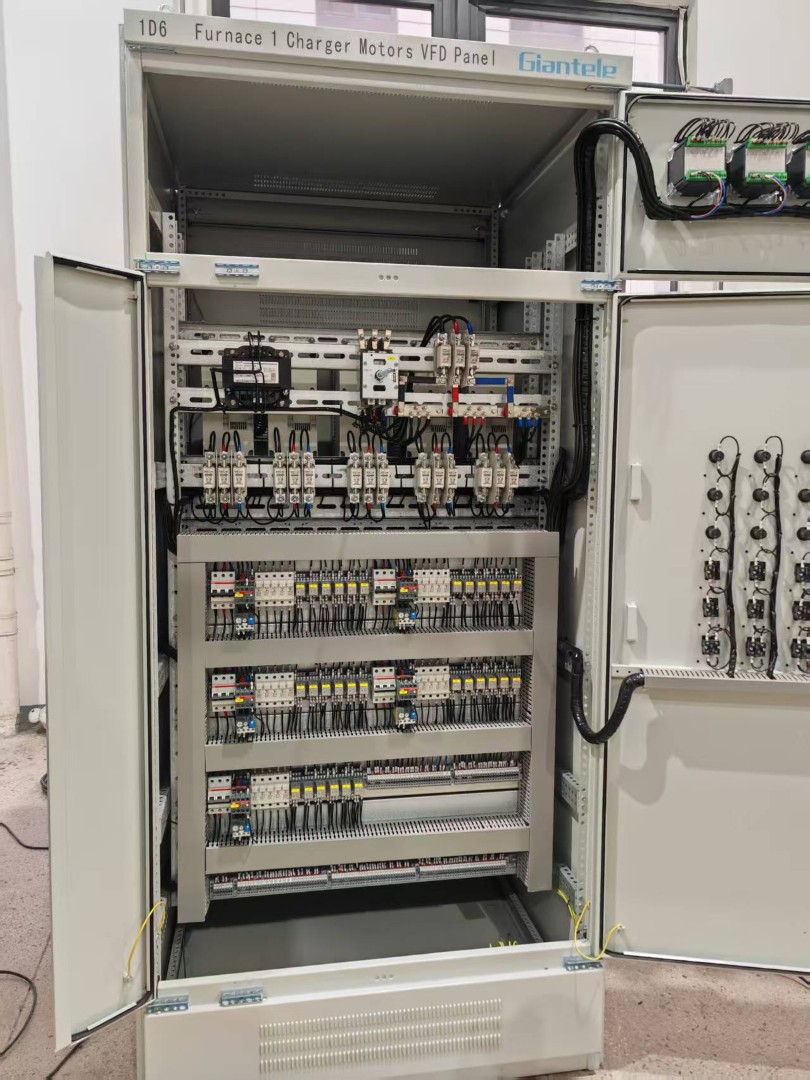
A modular switchboard architecture allows individual functional units — metering modules, outgoing circuit breakers, communication interfaces — to be added, replaced, or repositioned without de-energizing adjacent circuits. This minimizes planned maintenance downtime and dramatically accelerates emergency fault resolution. For facilities with continuous production requirements or high uptime commitments, a modular distribution board reduces operational risk every time maintenance is required.
Smart Metering and Energy Monitoring Integration
Modern industrial power distribution panels increasingly incorporate digital energy meters and communication gateways that deliver circuit-level energy consumption data in real time. This visibility enables proactive energy management, supports sustainability reporting, and powers predictive maintenance programs that identify abnormal load patterns before they escalate into failures. In facilities where motor loads represent a significant share of total consumption, integrating a motor control center alongside the main distribution cabinet delivers both centralized motor management and circuit-level energy visibility in a single coordinated system. Selecting a distribution panel with open-protocol communication support — rather than proprietary interfaces — ensures the board can integrate with future building management or energy management systems without expensive adaptation.
Building in Expansion Headroom from Day One
The most expensive power distribution board is the one that requires premature replacement because no expansion capacity was built in at the design stage. Specifying a distribution panel with additional DIN rail space, extended busbar sections, and spare cable entry knockouts costs very little at procurement — but saves the full cost of board replacement, installation downtime, and associated rewiring when operational demands grow.
Step 6: Evaluate Supplier Capability and Product Certification
The quality of the power distribution board is inseparable from the capability and transparency of the manufacturer behind it.
Type-Tested vs. Partially Type-Tested Assemblies
As explained in the IEC's technical publication on the standard, IEC 61439 defines two verification levels. Type-Tested Assemblies (TTA) have had their complete design verified through comprehensive laboratory testing — every performance claim is backed by physical test data. Partially Type-Tested Assemblies (PTTA) extrapolate performance from a reference design. For critical infrastructure, specifying a fully Type-Tested low voltage power distribution board eliminates the uncertainty inherent in extrapolated performance claims and provides the strongest basis for regulatory compliance documentation.
Technical Documentation as a Quality Signal
A capable manufacturer delivers a complete documentation package alongside every switchboard or distribution cabinet: certified single-line diagrams, busbar sizing calculations, short-circuit verification reports, thermal dissipation analyses, and component datasheets. This documentation is the foundation for safe commissioning, accurate ongoing maintenance, and audit-ready compliance records. The absence of comprehensive documentation is a reliable indicator of a manufacturer cutting corners elsewhere in the production process.
Interoperability and Long-Term Serviceability
A distribution board built around standard DIN rail profiles and universally dimensioned protective devices can be maintained using components sourced from multiple qualified manufacturers. This is strategically important for projects in regions where a single manufacturer's service network may be limited, or where long-term supply chain continuity cannot be guaranteed. Specifying a switch panel designed for generic interoperability protects the project from vendor lock-in and ensures the electric panel box remains fully serviceable throughout its operational life.
Conclusion
Choosing the right power distribution board for your project demands a structured, multi-factor evaluation rather than a single-criteria shortlist. Load profile, voltage and phase matching, IEC 61439 compliance, environmental protection, long-term scalability, and supplier qualification each represent a distinct decision layer — and each one directly affects the safety, reliability, and total cost of ownership of the installed system.
Whether the requirement is a compact distribution panel for a commercial refurbishment, a ruggedized distribution cabinet for an outdoor industrial site, or a high-capacity floor-standing switchboard for a large-scale manufacturing facility, the selection principles remain consistent. A correctly specified low voltage power distribution board is not simply a line item on a bill of materials — it is the infrastructure that every other electrical system in the project depends upon. If your projectinvolves non-standard load profiles, harsh environments, or phased expansion requirements, explore Giant Electric's customized power distribution solutions to match the right board specification to your exact site conditions.