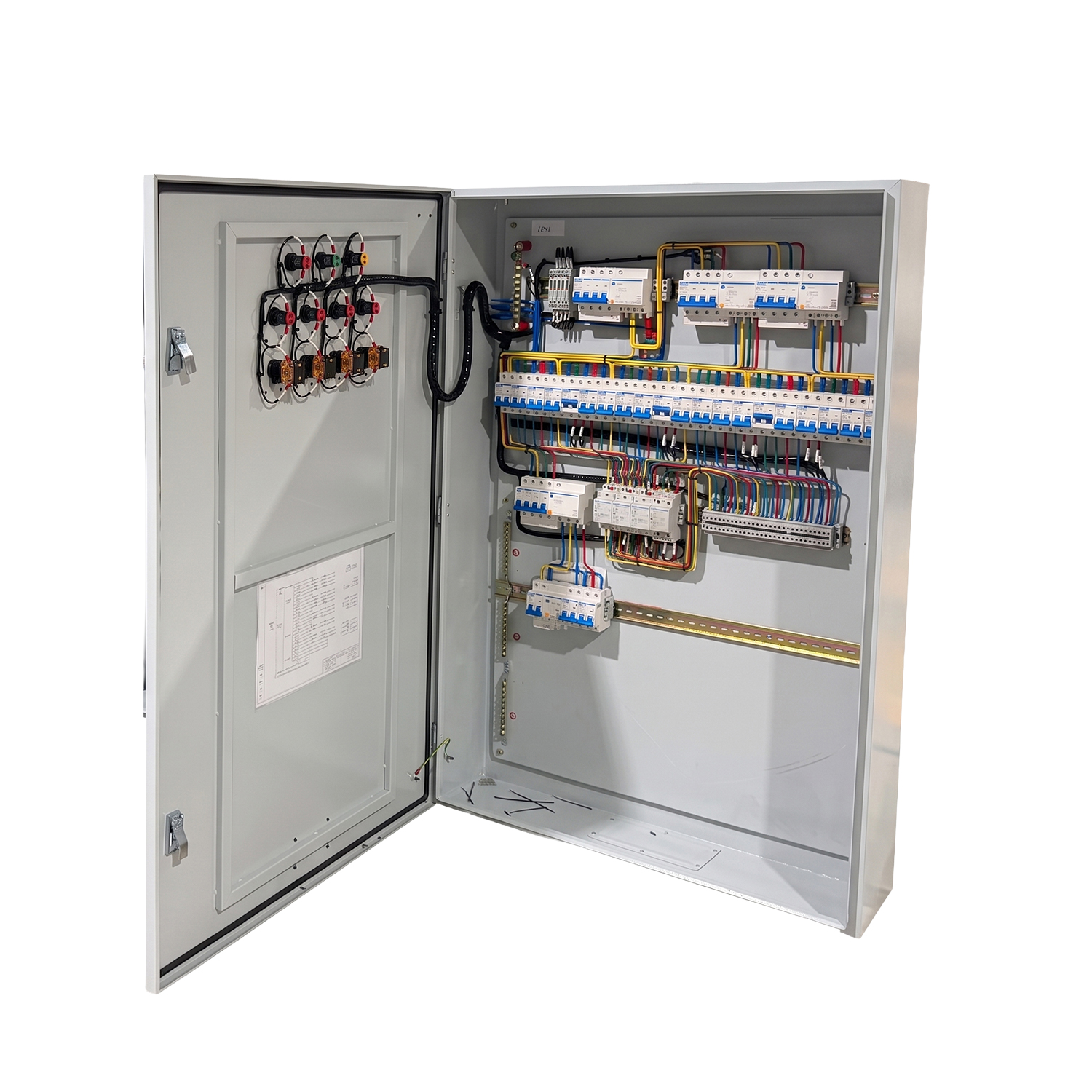
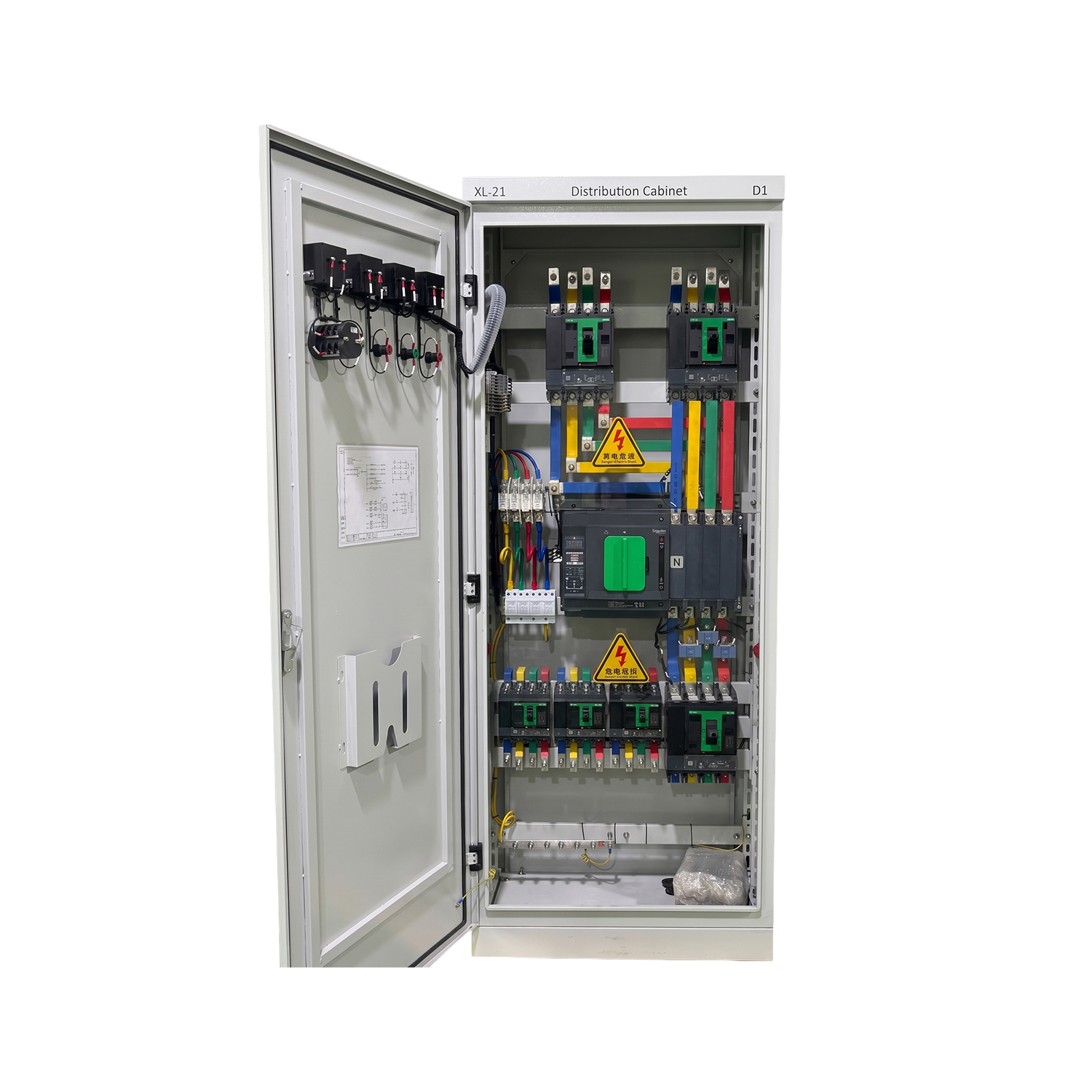
Here is the thing about commercial power distribution. You face a choice between low voltage switchgear in fixed or withdrawable configuration. Fixed panels give you IEC 61439-2 reliability at 30 to 40 percent less cost. For most buildings, the hot-swap feature you pay for in withdrawable units never gets used.
Fixed low voltage switchgear vs withdrawable: what you actually pay for
Most commercial buildings never touch hot-swap. Hotels, offices, malls — they run for years without swapping breakers. Yet you pay 30 to 40 percent extra for withdrawable panels. That money could go toward better metering or protection relays instead.
A GGD panel at 2500A costs far less than an equivalent withdrawable MNS. Across 20 or 30 panels, the savings hit tens of thousands of dollars. For secondary distribution, a power distribution board fed from each switchgear section handles branch circuits efficiently.
Fixed panels also save floor space. 600mm cabinet width versus 800mm for withdrawable. In a 30-panel lineup, you claw back 6 meters of electrical room. When every square meter costs money, that matters.
Switchgear vs switchboard: understanding the difference
People use the terms interchangeably. They are not the same thing. A switchgear handles higher fault currents — our GGD panels are rated 65kA/1s. A switchboard typically maxes out around 25kA. The question when choosing between them is: how much fault current can your system deliver?
If your transformer is 1000kVA or larger, you probably need switchgear. If it is 500kVA or smaller, a switchboard might work. But check your short-circuit study before you decide. A switchboard under-speced for fault current is a liability, not a saving.
Switchgear also compartments its sections. Busbars, breakers, and cables each get their own zone. Switchboards often share compartments. That matters for safety during maintenance — with switchgear, you isolate one section without exposing adjacent live parts.
Low voltage switchboards and how they fit into distribution
A switchboard sits between the transformer and the final distribution panels. It takes the incoming supply and splits it to sub-distribution boards serving different floors or zones. In a 20-story office building, you might have one main switchboard on the ground floor with sub-boards on every fourth floor.
A switchboard rated at 2500A can feed multiple 400A sub-distribution boards. The key is sizing the busbar correctly — your supplier should look at your single-line diagram and verify the ampacity, not just quote the biggest panel they sell.
Electrical distribution board and power distribution board: two names, one job
An electrical distribution board is the workhorse of any building. It receives power from the main switchboard or transformer and distributes it to lighting, HVAC, and socket circuits. Every floor of a commercial building has at least one.
A distribution board is the same device under a different name — Europe and Asia say distribution board, North America says panelboard. Same function: circuit protection, isolation, and metering for branch circuits.
What matters is the IP rating, the busbar rating, and the breaker configuration. A distribution board in a dusty factory needs IP54 at minimum. One in a clean office can get away with IP30. Match the enclosure to the environment, not to the price tag.
Fixed vs withdrawable switchgear: a quick comparison
Here is how fixed and withdrawable panels stack up. Use this to justify your spec to the project owner.
| Dimension | Fixed (GGD / GCK) | Withdrawable (MNS / GCS) |
|---|
| Unit cost per panel | 30 to 40 percent lower | Premium pricing |
| Installation time | 2 to 3 days | 4 to 6 days |
| Maintenance skill level | Standard electrician | Specialist technician |
| Floor space per panel | 600 to 800 mm | 800 to 1000 mm |
| Hot-swap capability | Not available | Available but rarely needed |
The numbers are clear. For commercial buildings, fixed wins on cost, space, and installation speed. You give up hot-swap. You gain everything else.
LV panel sizing and specification guide
An LV panel needs to be sized correctly. Too small and you overheat the busbar. Too large and you waste budget. Start with your connected load, add 20 to 30 percent for future expansion, then check the short-circuit level at the panel location. Adding power factor correction to the same lineup keeps the electricity bill predictable.
A low voltage switchgear panel rated at 65kA handles most commercial building faults without a problem. But if your transformer is close to the panel — within 10 meters — the fault level might be higher than you think. Run the numbers. A 1600kVA transformer with 6 percent impedance puts about 38kA at the secondary terminals. Your LV panel needs to handle that comfortably.
Switchboard vs panelboard: which one for your site?
The debate between switchboard and panelboard comes down to capacity. A switchboard handles 1200A and up. A panelboard tops out at 1200A.
Our GGD fixed switchgear fills the switchboard role. Rated up to 3150A, 65kA short-circuit, compartmentalized construction. It replaces both the switchboard and the distribution panel in many commercial layouts, simplifying the electrical room and reducing termination points.
IEC 61439-2: the standard that matters
Both fixed and withdrawable panels meet the same IEC 61439-2 standard, published by the International Electrotechnical Commission. Busbar design, short-circuit withstand, IP rating — none of these depend on whether the breaker bolts in or slides out. A type-tested panel runs 20 years or more with routine inspection.
Do not let anyone tell you withdrawable is inherently safer. The standard tests both types the same way. What matters is whether the panel passed testing at an accredited lab — not whether breakers slide out. Ask for the type-test certificate before you order. If the supplier cannot produce it, walk away.
Where to deploy fixed LV switchgear
- Commercial buildings: main and sub-distribution for malls, offices, and hotels
- Residential complexes: secondary distribution from transformer to floors
- Light industry: motor control and power factor correction in factories
- Infrastructure: pumping stations, water treatment, and small substations
- Healthcare: secondary distribution where reliability is non-negotiable
Match the panel to where it lives. Coastal site? Powder-coated steel enclosure. Humid basement? Anti-condensation heaters. Your supplier should configure each panel for its environment, not ship the same spec to every location.
Picking the right LV switchgear supplier
Not every factory that builds switchgear builds it well. Look for IEC 61439-2 type-test reports, ISO 9001 certification, and actual export experience. The IEEE recommends verifying test reports from accredited labs before placing any switchgear order. A supplier with 50-plus country shipments handles compliance paperwork without drama.
Ask about capacity and lead times. A 20,000 square meter factory with 200 people should deliver standard GGD switchgear in 4 to 6 weeks. If the quote takes 3 weeks to prepare, production will be slower. Visit the factory if you can. Walk the floor. Check the busbar fabrication area, the powder coating line, and the testing bay. Photos on a website do not tell you if their QA team actually runs the full type-test sequence or just stamps a form.
Ask for project references. A good supplier shares past project photos, single-line diagrams, and test reports. If they hesitate, that tells you something. Ask specifically about projects in your region — Africa, Middle East, Southeast Asia. A supplier who has shipped to Nigeria or Kenya understands container logistics, humidity protection, and local utility requirements in ways a domestic-only factory never will.
Ask about their busbar workshop. Copper quality varies massively between suppliers. Silver-plated busbar with insulated supports is what you want. If the busbar looks dull or has rough edges, the whole panel is suspect. The busbar is the backbone of your switchgear — it carries every amp your building draws for the next 20 years.
What to put in your RFQ for fixed LV switchgear
Most RFQs for LV switchgear are too vague. The supplier quotes whatever they have in stock, and you get a panel that almost fits your project. Write a tight specification instead. Start with the system voltage — 380V, 400V, 690V. Specify the short-circuit level at the panel location, not just at the transformer. Cable entry direction: top, bottom, or both. Enclosure IP rating: IP54 covers most environments. Busbar material and plating. Form of internal separation: Form 2b for most commercial projects, Form 3b or 4b for industrial.
List every outgoing feeder with its breaker type, rating, and trip unit. Fixed or adjustable? Thermal-magnetic or electronic? Include space for spares — 20 percent spare feeder positions costs almost nothing now and saves thousands later. Specify the metering: analog meters are cheap but digital meters give you data for energy management. If your project needs remote monitoring, add Modbus RTU or Ethernet communication to the spec.
Require the supplier to submit a busbar calculation and arc-flash assessment with the quote. If they cannot produce either one, the bid goes to the bottom of the pile. Also ask for thermal imaging data from a similar completed project — this proves their panels run cool under load. A hot busbar is a failing busbar, and you will not know until the building is occupied and the air conditioning is running at full capacity.
Final thoughts
Fixed LV switchgear gives you IEC 61439-2 compliance and 20-year reliability at 30 to 40 percent less than withdrawable panels. For commercial buildings, hospitals, hotels, and residential towers, fixed is the smarter buy. The hot-swap capability you give up almost never gets used in these applications. What you gain is a simpler electrical room, fewer maintenance points, and a lower electricity bill because fixed busbar connections run cooler and waste less energy.
The key is picking a supplier who does not cut corners. Copper quality, busbar plating, powder coating thickness, breaker brand — these small decisions compound over 20 years into either zero downtime or a series of expensive call-outs. A panel that passes IEC 61439-2 type testing at an accredited lab gives you documented proof that the engineering is sound. Everything else is just a sales pitch. Send us your single-line diagram — we reply with a technical proposal, compliance documents, and pricing within 48 hours.