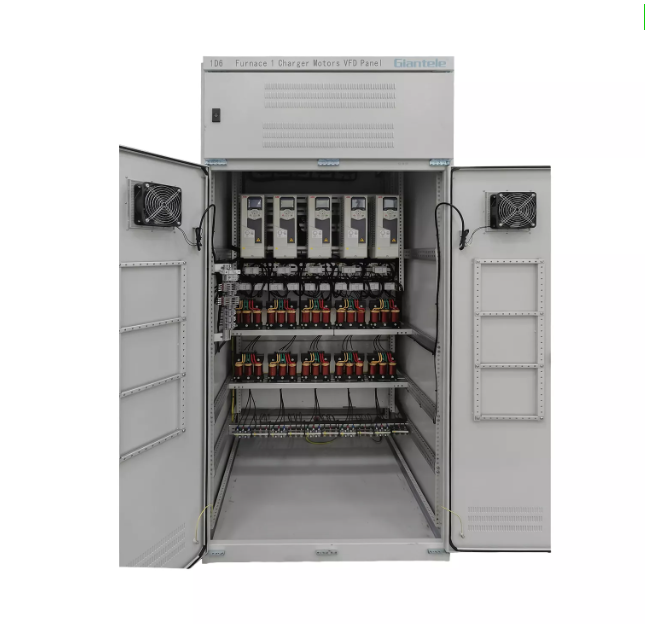
VFD panel vendors specializing in explosion-proof or hazardous location models
A VFD panel for a hazardous area is not a standard drive in a painted box. It is an ac drive control panel built around a certified enclosure that contains any internal spark. This guide shows you how to pick a vendor who gets that right.
Key takeaways
- Ex d, Ex pxb, and Ex e are three different ways to make a VFD safe, and they are not interchangeable.
- Gas group IIA, IIB, or IIC and temperature class T1 to T6 decide which enclosure you need.
- A certificate without a matching nameplate is worthless to a site inspector.
- Remote control and monitoring do not remove the explosion-proof requirement on the drive.
- The MCC breaker and the VFD starter must share the same hazardous-area rating.
What explosion-proof actually means for a VFD panel
Explosion-proof does not mean the panel survives an explosion. It means the enclosure stops an internal spark or hot surface from igniting the gas outside. For a VFD, that usually means an Ex d flameproof box, an Ex pxb pressurized cabinet, or an Ex e increased-safety enclosure built around certified parts.

The zone sets the enclosure method
Across oil and gas sites in the Middle East, Nigeria, and South America, the zone decides the method. The IEA keeps tracking rising gas and refining investment in these regions, which keeps hazardous-area panels in steady demand. A Zone 1 area with flammable gas present in normal operation needs a different enclosure than a Zone 2 area where gas appears only under a fault.
You cannot guess this. A classified-area study sets the zone, and your panel must carry a certificate that names that zone, the gas group, and the temperature class.
An ac drive control panel in a Zone 1 area uses an Ex d flameproof enclosure. The drive DC bus capacitors and IGBT modules run hot and can arc. The flameproof box contains the blast and cools the escaping gas below ignition temperature through machined flame paths. That is why the gaps and bolt spacing on an Ex d box are machined to a tight spec, not just welded shut.
Three enclosure methods that make a VFD safe in a hazardous area
You have three real options for a hazardous-area VFD: a flameproof Ex d box, a pressurized Ex pxb cabinet, or an increased-safety Ex e enclosure. Most drive panels use Ex d or Ex pxb, because a bare VFD cannot meet Ex e on its own. The drive internals run too hot and arc too easily. The enclosure is only half the story. The finished panel must still meet IEC 61439 rules for low-voltage switchgear and controlgear assemblies.
| Method | How it works | Best for | Watch out for |
|---|---|---|---|
| Ex d flameproof | Contains the explosion inside a machined box | High-power drives, Zone 1 | Heavy, costly, poor heat dissipation |
| Ex pxb pressurized | Purges and pressurizes the cabinet with clean air or inert gas | Large multi-drive panels, Zone 1 | Needs a purge controller and gas supply |
| Ex e increased safety | Certified components in a robust non-sparking enclosure | Low-power starters, Zone 2 | VFD internals rarely qualify alone |
Matching the panel to gas groups and temperature classes
Every hazardous area has a gas group and a temperature class, and your VFD panel must match both. Group IIC covers hydrogen and acetylene, the easiest gases to ignite. Groups IIA and IIB cover heavier gases like propane and ethylene. Temperature class T1 to T6 caps the hottest surface your panel may reach.
| Gas group | Typical gases | Temperature class | Max surface temperature |
|---|---|---|---|
| IIA | Propane, butane, methane | T1 to T3 typical | 200 to 450 degrees C |
| IIB | Ethylene, town gas | T3 to T4 typical | 135 to 200 degrees C |
| IIC | Hydrogen, acetylene | T4 to T6 required | 85 to 135 degrees C |
A drive panel almost never meets T6. The heat sinks and braking resistors run hotter than 85 degrees C, so most VFD panels land at T4 or T3. That is why the temperature class drives both the enclosure choice and the cooling method. Control panel industrial automation projects in refineries and gas plants carry the strictest requirements, because the process gas is always present.
A panel that needs T4 but is only rated T3 is a non-starter, no matter how good the price looks. Ask the vendor for the temperature class on the nameplate, not in the brochure.
How to screen VFD vendors for real Ex competence
Any panel manufacturer can print ATEX on a brochure. Few can show you the certificate, the nameplate, and the internal wiring that prove it. Screen on the paperwork and the build detail, not the sales pitch.

Five checks that expose a real Ex vendor
Industrial control panel enclosure manufacturers who work in hazardous areas keep a library of certified boxes, glands, and viewing windows. Ask whether the enclosure, the drive, and the glands are certified as one assembly, or only as loose parts. An assembly certificate is what your site inspector accepts. A vendor whose shop runs under ISO 9001 documented procedures is far more likely to keep that paperwork straight.
Fitting the VFD into a hazardous-area MCC
The mcc definition matters here: a motor control center is a modular line of starter sections. In a hazardous area, the MCC section holding your VFD must carry the same Ex rating as the drive itself, including the mcc circuit breaker that protects it.
Keep the switchgear safe and the drive local
A motor control center mcc in a Zone 1 area uses flameproof or pressurized sections. The mcc circuit breaker that feeds the VFD sits inside the same certified enclosure, because a breaker opening under fault can arc too.
Most sites separate the two: a safe-area MCC or low voltage switchgear feeding a flameproof VFD starter located at the motor. That keeps the big switchgear in a clean room and only the drive lives in the zone.

Placing the drive at the motor also shortens the cable run, which cuts voltage drop and the cost of armored cable. If you need a vfd drive panel that runs in the zone, keep the motor control center panel in the safe area and feed the drive locally.
For the enclosure itself, review how industrial electrical enclosures are rated for your zone, and read the electrical control panel requirements for hazardous locations before you specify. A complete VFD panel buyer guide helps you fix the drive sizing before the Ex enclosure locks you in.
Frequently asked questions
What is the difference between Zone 1 and Zone 2 for a VFD panel?
Can I use a standard VFD inside a flameproof enclosure?
What does Ex d mean for a VFD panel?
Do I need explosion-proof protection for a dust hazard only?
Can I add remote monitoring to a hazardous-area VFD?
What certification should I ask a vendor to show?
Final thoughts
Explosion-proof VFD panels live or die on certification, not appearance. Verify the enclosure method, the gas group, the temperature class, and the certificate before you buy. Contact Giantele for a technical proposal matched to your zone classification.
Need an explosion-proof VFD panel matched to your zone?
Send us your zone classification, gas group, and motor list. We return an Ex-compliant panel layout with the certificate scope, drive selection, and wiring diagram before you commit.