Adding IoT monitoring to an industrial electrical cabinet turns it from a box that distributes power into a data source that tells maintenance teams which motor is drawing high current, which contactor is approaching its mechanical end of life, and whether the panel internal temperature is rising toward a thermal trip threshold. But choosing a supplier who can deliver IoT-enabled monitoring requires understanding the technology stack, not just the hardware. This guide explains what IoT monitoring means in practice, what electrical cabinet suppliers should include in an IoT-ready panel, and how to evaluate whether a supplier's IoT claims match their engineering capability.
Key Takeaways
- IoT monitoring requires sensors, a gateway, and a software layer: An industrial electronic box with IoT capability has current transformers, temperature sensors, and voltage monitoring at the device level. These connect to an edge gateway inside the industrial electrical enclosures that translates the data and sends it to a cloud dashboard or plant SCADA.
- Not all electrical cabinet suppliers mean the same thing by IoT: Some suppliers install a Modbus TCP module on a single device and call it IoT. A real IoT solution monitors every motor feeder, collects energy data per circuit, and presents it through a pre-configured dashboard. Ask the supplier to define exactly what data points their IoT system captures.
- Cybersecurity is the weak link in most industrial IoT deployments: Connecting an industrial electrical box to a plant network opens a security boundary. Reputable industrial enclosures manufacturers follow IEC 62443 cybersecurity standards and use hardware-isolated gateways that do not expose the internal control network to the wider IT network.
- Gateway selection determines protocol flexibility: A panel with a Modbus RTU gateway limits future integration to Modbus-compatible systems. A panel with a multi-protocol edge gateway that supports Modbus TCP, OPC UA, and MQTT gives you flexibility to integrate with whatever platform you adopt in the future.
The IoT architecture inside an industrial electrical cabinet

Three layers that turn an enclosure into a data source
An IoT-enabled industrial electrical cabinet is built around three technology layers. The sensing layer measures electrical parameters at each motor feeder through intelligent overload relays, current transformers, voltage sensors, and temperature probes. Every motor starter that previously reported nothing now generates a continuous stream of current, voltage, power factor, and operating hours data.
The processing layer is an edge gateway mounted inside the industrial electrical enclosures. It collects data from the sensing devices through a communication bus, typically Modbus RTU or Modbus TCP over an internal network. The gateway normalises the data, timestamps it, buffers it during network outages, and prepares it for transmission. This is the component that separates a real IoT panel from a panel with a few smart devices that nobody reads.
The visualisation layer is where data becomes useful. It runs on a plant SCADA screen, a cloud dashboard, or both. Operators see real-time motor status with current draw, temperature rise, fault history, and energy consumption per production line. This layer is typically provided by a third-party platform such as Ignition, WinCC, or a cloud-based system. The supplier's responsibility is to ensure the gateway output is compatible with the platform you choose.
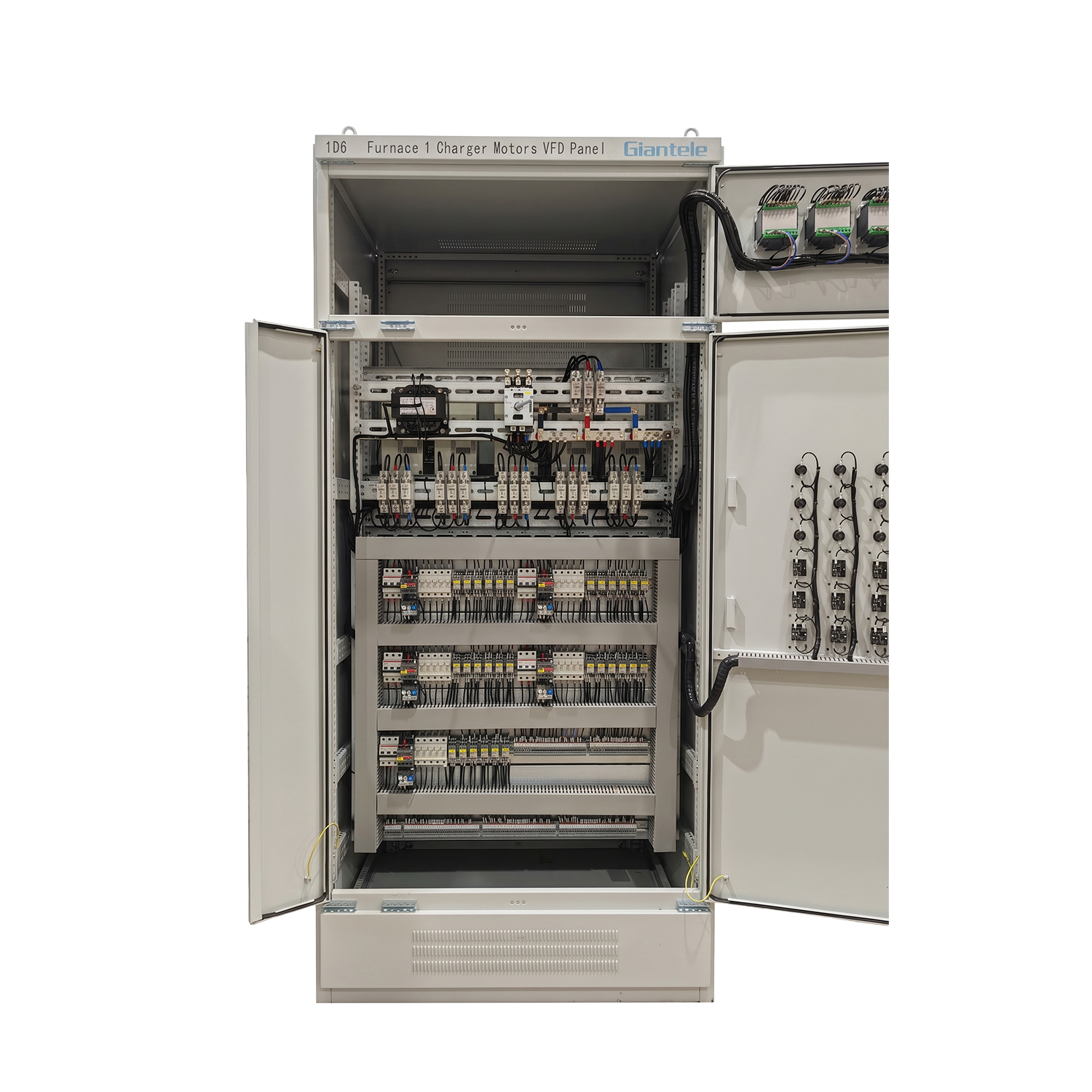
The most common failure point in an IoT-enabled motor control center installation is the communication cabling inside the panel. Bus cables routed too close to power cables pick up electromagnetic interference that corrupts the data. The internal layout of the industrial electrical box must separate the communication bus from the power bus by a minimum distance, typically 200mm, and shielded cables must have properly terminated drain wires. A supplier who understands IoT designs the internal layout with this separation built in from the start. One who does not will leave the installer to figure it out on site.
What IoT monitoring measures inside industrial control panels
| Parameter | Sensor/Device | Business Value |
|---|---|---|
| Motor current (per phase) | Intelligent overload relay or external CT with analogue-to-digital converter | Detects overcurrent before thermal trip. Tracks wear patterns. Baseline comparison triggers maintenance before failure. |
| Motor voltage | Voltage transformer or digital power meter | Undervoltage and phase imbalance detection. Protects motors from operating outside rated voltage range. |
| Panel internal temperature | PT100 or thermocouple sensor at critical hot spots | Warns of inadequate ventilation, failing cooling fans, or VFD heat buildup before components reach thermal limits. |
| Energy consumption (kWh) | Digital power meter per feeder or per section | Enables cost allocation per production line. Identifies energy waste from idling motors and oversized drives. |
| Contactor operations counter | Intelligent contactor with built-in cycle counter | Tracks mechanical wear. Alerts when contactor approaches rated mechanical life, enabling planned replacement during scheduled shutdowns. |
| Harmonic distortion (THD) | Power quality analyser or advanced power meter | Identifies harmonic sources before they cause transformer overheating or nuisance tripping of protection devices. |
| Door open/close status | Magnetic reed switch or limit switch | Security monitoring. Tracks unauthorised panel access. Correlates panel openings with fault events for root cause analysis. |
The industrial power system solutions that integrate these data points into a useful monitoring platform require more engineering investment than the sensors themselves. The ring main unit that feeds the plant may already have some level of monitoring. The consultation challenge is integrating the new IoT data from the motor control panels with existing plant monitoring infrastructure rather than creating a parallel system that nobody checks. The IEC 61439 standard provides verification methods for assemblies, but IoT capability is not yet standardised under this framework. Buyers must therefore define their IoT requirements in the specification, not rely on a standard to guarantee functionality.
Evaluating electrical cabinet suppliers for IoT capability
Five questions that separate IoT-ready suppliers from the rest
- Show me the network architecture diagram for an IoT panel you have delivered. A legitimate supplier produces a diagram showing every sensor, the communication bus topology, the gateway device, and the data flow to the visualisation platform. If they cannot produce this diagram, they have not delivered an IoT panel.
- What edge gateway do you standardise on and why that model? The answer should include the supported protocols, the local buffering capacity during network outages, the operating temperature range, and the cybersecurity certifications. A supplier who cannot answer all four has not done the engineering.
- How do you test the IoT functionality during factory acceptance? The FAT must include a network verification step: every sensor polled, every data point confirmed, and the gateway-to-cloud or gateway-to-SCADA connection tested end to end. Testing the power side without testing the data side is an incomplete FAT.
- What cybersecurity measures are built into the panel? The gateway should sit on a physically separate network interface from the plant control network. It should use TLS encryption for data in transit, support certificate-based authentication, and have a documented firmware update procedure. IoT without cybersecurity is a vulnerability, not a feature.
- Can the IoT system operate during a network outage? The edge gateway must buffer data locally and resume transmission automatically when the network recovers. Without this, every network outage creates data gaps that undermine the value of trend analysis and predictive maintenance.

Many electrical cabinet suppliers offer APFC panel integration with basic power factor monitoring, but adding comprehensive IoT across an entire lineup is a different engineering discipline. Custom turnkey manufacturing solutions that include IoT monitoring require a supplier with both power engineering and network engineering capability. The wiring inside an industrial electrical box follows established standards. The data architecture does not have a comparable level of standardisation, which means the buyer must verify the supplier's approach rather than assuming it meets an industry norm.
The edge gateway: the most important component in an IoT-enabled industrial electrical enclosures

Four criteria for selecting the right IoT gateway for your panel
Turn key solutions that integrate the gateway, the sensors, and the dashboard into a single pre-configured package reduce the integration risk. When a metal clad switchgear supplier also handles the IoT gateway configuration, the responsibility for the end-to-end system rests with one company. When the gateway comes from a third party and the panel from a different supplier, every integration problem becomes a dispute about whose scope it falls under. The ISO 9001 quality framework requires documented verification of outsourced processes. The IEA identifies industrial digitalisation and IoT monitoring as among the most cost-effective measures for improving factory energy efficiency and reducing unplanned downtime.
Deploying IoT monitoring: from specification to operational data
The gap between a supplier who claims IoT capability and one who delivers it reliably is the factory test. A supplier who tests the power wiring and assumes the data side will work because the lights on the gateway are green has not tested the IoT functionality. A air insulated switchgear supplier with IoT capability demonstrates it by showing you a live dashboard connected to a panel on their factory floor, reporting real data from motors running under load. A slide deck of dashboard screenshots is marketing. A live connection to a running panel is verification.
Frequently asked questions
What exactly does IoT monitoring on an industrial electrical box give me that a standard panel does not?
How much does IoT monitoring add to the cost of an industrial control panel?
Can I add IoT monitoring to an existing industrial electrical cabinet?
What cybersecurity risks does IoT monitoring introduce?
Which industrial IoT platforms are commonly used with control panels?
How do I verify that a supplier's IoT solution actually works before ordering?
Final thoughts
Industrial control panel suppliers offering IoT-enabled monitoring solutions are distinguished by their network engineering capability, not by the metalwork or the power components. The sensors, the gateway, and the communication architecture are what make the difference between a panel that collects dust and a panel that collects data. Evaluate suppliers on their ability to design the data layer, specify a gateway appropriate for your plant environment, and test the entire IoT system at the factory before shipment. A supplier who excels at building panels but treats IoT as an afterthought will produce a panel that works electrically and fails digitally. The investment is worth it when the first alert from the IoT system prevents an unplanned shutdown that would have cost far more than the monitoring premium.
Discuss IoT Monitoring Requirements for Your Control Panel Project
Send us your motor list and monitoring objectives. Our engineering team provides a detailed assessment of the IoT options available for your specific application and a specification you can use to compare suppliers.