
Key Takeaways
- A box with an Ex marking and a box without one look the same from the front.
- Ask who holds the certificate for the populated assembly, not for the shell.
- A nema 4x grade covers water and corrosion, never gas.
- One hole drilled on site moves the duty to whoever drilled it.
- Outdoor cabinets fail on condensation and sun before they fail on rain.
Explosion proof power distribution cabinets are bought twice: once as a box, once as a certificate. The second purchase is where most projects stall. A distributor can price the first in a day, and the second takes a factory.
A distributor sells a stocked box, not a certified assembly
Ask a distributor what can ship this month and you get a list of boxes. Ask what the same firm can certify and the list gets short.
An enclosure off the shelf carries an ingress rating. An assembly carries a marking, a certificate number and a temperature class. Those three belong to the works that filled the box.
This is why a cheap offer arrives fast. Someone is pricing the shell and leaving the build to your side of the table.
 Door drawings
The shell ships in a week, the build does not
An empty enclosure leaves a warehouse on the next truck. A populated one leaves after the wiring, the routine test and the paperwork are finished.
The drawings taped inside a door are a working document. They are also the difference between a box and a declared assembly.
Where the enclosure is custom, the gap widens. A bespoke order goes to industrial control panel enclosure manufacturers who also populate it. The certificate has to cover the whole assembly.
So the first screening question is not about stock. It is about who signs the declaration of conformity, and where that person works.
Explosion proof power distribution cabinets that arrive fully documented come from one place, and it is not a warehouse.
The assembly standard is the other half of the story. Ask for a unit built and tested to IEC 61439, then ask which routine tests were recorded against it.
Is nema 4x explosion proof
No. A nema 4x box is watertight and corrosion resistant. It says nothing about gas, vapour or the dust that can ignite.
The 4 in the code is a hosedown test. The X adds a corrosion requirement on top. Both are ingress and materials grades, and the scale stops there.
Explosion protection is a separate document. In CE markets it comes from ATEX and IECEx. The box then carries a marking with a zone, a gas group and a temperature class.
Buyers reach this question from an older vocabulary. A nema rating for explosion proof enclosures sounds authoritative, and no such classification exists in the IEC world.
So ask it plainly: is nema 4x explosion proof? A distributor who answers yes has answered a question you did not ask. Treat that reply as the cheapest test on your list.
How far the number reaches
The number still earns its place, just not the way the catalogue uses it. It grades the shell against water, dust and salt spray.
That matters when the cabinet stands outside. Rain, washdown and coastal air attack every cabinet, explosive atmosphere or not.
The translation runs one way. A nema 4x shell usually lands near IP66. A plain nema 4 box sits closer to IP65.
Use a nema rating for explosion proof as a durability clue, never as the Ex claim. Two questions, two documents, two answers.
| What the label says | What it controls | What it cannot tell you |
|---|---|---|
| nema 4x | Hosedown water and surface corrosion | Gas group, zone or surface temperature |
| IP66 | Dust tightness and jet water | The temperature class under a fault |
| Ex db eb IIC T4 Gb | Protection concept, gas group and a 135 °C surface limit | Whether the assembly was built and tested as one unit |
| ATEX category 2 | Suitability for zone 1 and zone 21 | Who may modify the cabinet later |
If the site is outdoors, read the detail behind nema 4x outdoor enclosure practice first. A bare IP figure from a stockist is not that detail.
Sun, rain and a box that stands outside
Outdoors, the enclosure works harder and the Ex argument gets weaker. Sun raises the internal temperature before any load does.
 Wall box
The rain test is not the gas test
A closed shell keeps weather out through a gasket and a lock. Nothing on that face says which gas group may stand beside it.
Sun and condensation attack the same shell from the inside. Both are site conditions, and both belong in the specification.
A sealed box on a Gulf site can sit 15 K above ambient inside. Against a T4 limit of 135 °C that margin disappears on a hot afternoon.
Outdoor nema cabinets are usually specified with a sunshield and a double roof. Both help, and neither counts as explosion protection.
The phrase weather proof electrical enclosure sells a lot of hardware. It promises rain stays out. It does not promise a gas cloud stays out.
The same holds for a waterproof power enclosure. Water and gas arrive from different directions, and only one of them is stopped by a gasket.
Condensation is the outdoor failure nobody quotes for. A sealed cabinet can swing from 50 °C by day to 10 °C at night. The water lands on its coldest part.
Who signs after the hole is drilled
Every opening on a certified assembly is a rated feature. A gland, a breather, a window and a drain are certified parts, not accessories.
Drill one hole for a cable that was not on the drawing and the marking no longer describes the box. The certificate did not travel with the drill.
In practice the duty moves to the person holding the tool. That is the installing contractor, not the distributor and not the works that shipped the cabinet.

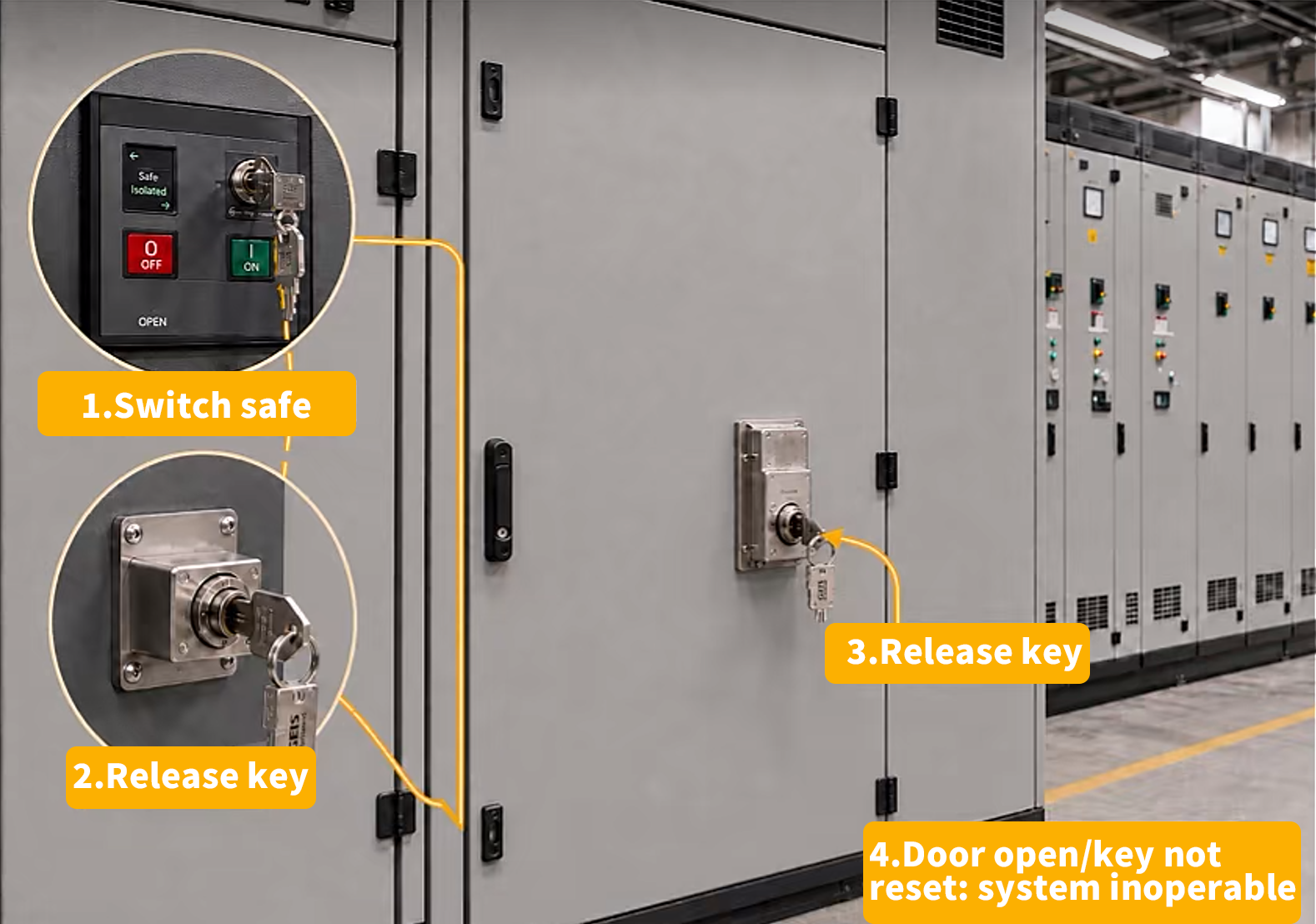
One hole or one open door voids the marking
This is why scope beats price on a job like this. An industrial power system installation that names the gland schedule avoids the argument three months later.
Certified repair follows the same rule. The replacement device has to be the one the certificate covers, not an equivalent that fits the rail.
The feed side is ordinary gear
The zoned cabinet is the last link, not the first. Upstream of it sits ordinary equipment in a safe area.
Electric power distribution inside a plant does not change because one room is zoned. Boards, cables and protection stay standard.
What changes is the boundary. A wall, a door and a cable transit decide where the ordinary network stops and the rated one begins.
Beyond the fence, power transmission and distribution belongs to the utility. Inside it, your own board is the only part you control.
Plants that run their own generation see the same picture. Switchgear in power plant switchrooms is standard LV gear, and the zoned room is a small part of the one-line.
The power distribution system reads as one chain. Mark the point where the Ex rules start, then stop treating everything past it as ordinary.
Electricity demand shapes that chain over time. The IEA tracks industrial load growth. A plant that adds a line usually reopens the same board within a decade.
The switch belongs outside the zone
A transfer switch sits on the safe side of the boundary. Put it inside the zone and you buy an Ex assembly for a job a standard panel does.
The reason is mechanical. Transfer contacts arc in normal service, and an arcing contact in a zoned room needs a flameproof enclosure around it.
So the generator power transfer switch lives in the switchroom. A protected feeder runs from there into the zoned room.
That decision changes the cable schedule. Sketch it before you order a generator switch box, because both ends of the feeder follow from it.
Heat trace and lighting on an oil gathering station usually sit on that feeder. Motors keep their own MCC, which is a separate argument with its own rules.
Ask for the plate, not the catalogue page
The plate is the only page a sales team cannot rewrite. It carries the marking, the certificate number and the rating.
Ask for a photograph of a populated unit's plate. Then read the marking aloud to whoever wrote the specification, and watch the reaction.
Four items on that plate do the work. The marking string, the ambient range, the IP figure and the certificate number.
An enquiry of five lines sorts the channel faster than a factory visit. Send the zone, the gas group, the temperature class and the load list.
Add the certificate number you expect to see, and ask who may modify the assembly after delivery. A stockist answers with a catalogue page, and a works answers with a name.
The quality system behind the paperwork is worth one more question. Ask whether the works runs under ISO 9001, and ask for the certificate scope rather than the logo.
Frequently asked questions
Is a nema 4x enclosure explosion proof?
No. The grade covers water and corrosion, not flammable gas. A cabinet in a zoned area needs an Ex marking under ATEX or IECEx. That marking names a zone, a gas group and a temperature class. A supplier who treats 4x as an Ex answer is selling a shell.
What does a distributor need before quoting an Ex cabinet?
Four inputs: the zone, the gas group, the temperature class and the load list. Add the ambient range and the cable schedule if the site is outdoors. With those, a works can size the enclosure. Without them, every price is a guess with a delivery date.
Can a distributor certify an assembly it did not build?
Not as a rule. The certificate belongs to the manufacturer named on it. That name is tied to the design, the components and the test record. A distributor who populates a certified empty enclosure becomes the manufacturer of a new assembly. That assembly needs its own assessment.
Can we drill a cable entry after delivery?
Only under the certificate holder's written procedure, and usually only in their workshop. Each opening is a rated feature. A hole cut on site changes the protection concept and voids the marking. Plan the gland schedule before the order, and leave spare entries closed with certified plugs.
Do outdoor cabinets need a sunshield in hot climates?
Yes, if the internal temperature matters. A sealed cabinet in direct sun runs well above air temperature, and the surface limit is what the marking promises. A double roof or a shade structure buys 10 to 15 K on a typical site. That is cheaper than a colder temperature class.
Which documents should arrive with the cabinet?
Four: the declaration of conformity, the Ex certificate for the assembly, the routine test record and the as-built drawing. Add the gland schedule and a wiring diagram in the language of the installing crew. Anything missing will be asked for by an inspector.
Who supplies spare devices for a certified assembly?
The certificate holder should, or a supplier working to their instructions. The spare must match the certified part, not just the rail width and the current rating. A different device changes the temperature rise. Keep one spare per ten outgoing ways, stored with the certificate copy.
Final thoughts
Most of the risk in this purchase sits in the paperwork. A box is easy to compare and a certificate is not. Send the zone, the gas group and the load list. Ask for the plate before you ask for the price.
Send the zone and the gas group
Tell us where the cabinet stands, which zone applies and what it feeds. We will answer with the documents we can supply and the questions still open.
Contact Giantele