Key Takeaways
- Compact is a heat claim and a service claim before it is a footprint claim.
- Ask for the temperature rise at full load, not the ambient rating on the label.
- Busbar section per amp and free cable space decide whether the unit stays cool.
- One output has to be isolatable without opening the whole enclosure.
- Four similar manufacturer phrases point at four different kinds of firm.
Compact is a heat claim before it is a space claim
Data center power distribution is bought by the rack. Every new rack asks for more current out of one floor tile.
The unit that serves a row shrinks with each generation. That is where trouble starts, because the copper is unchanged and the surface is not.
So a compact unit is a heat claim and a service claim at once. Treat the dimensions as the last thing you check, not the first.
The chain decides the duty. Utility, transformer, generator power transfer switch and row unit all feed one fault level.
Start upstream. A power distribution center chosen for the whole hall fixes the short-circuit duty that every compact unit downstream inherits.
Five figures that decide whether a unit is compact or merely small
Five numbers separate a unit built for a hall from a small cabinet with a label on the door. Get all five in writing.
A datasheet that lists only dimensions has answered a different question. Width and ways are the easy part to print.
| Figure | What it fixes | What to ask for |
|---|---|---|
| Temperature rise at full load | How much heat leaves the enclosure | The tested rise in kelvin, not the ambient rating |
| Busbar section per amp | Current density and local hot spots | Square millimetres per 100 A at rated current |
| Free cable space | Bend radius and lug room at the terminals | Entry depth and the largest lug the unit accepts |
| Short-circuit withstand | How the unit behaves at its own terminals | kA for one second, with the tested assembly named |
| Isolation per output | Whether one row can be worked on alone | Outgoing device type and whether it can be locked off |
Most switchgear manufacturers quote the ambient figure because it is printed on the sheet. The rise comes from a test, which is the point of asking.
That test leaves a paper trail. Ask which routine tests the works runs, then compare it with distribution board testing practice on the site side.
A works that runs the tests itself can answer a follow-up question. One that outsources the test will quote the certificate and stop there.
Ten kilowatts that have nowhere to go
Losses in a low voltage assembly run at roughly one to two percent of throughput. A 1000 A unit therefore leaves 10 to 20 kW inside the cabinet.
That heat has three exits: the metal, the air and the cable. A compact unit has less of all three, so the design has to be deliberate.
Painted steel sheds about 150 W per square metre at a 30 K rise. Four square metres of surface loses well under a kilowatt that way.
 Tap joints
Every bolted tap is a hot spot
Each bolted tap adds resistance in the middle of the run, and it sits where the air barely moves. A joint reading warm on a thermal image tells you about a surface, not the metal behind it.
A fan at the back of the bars cools the air around that joint. It buys margin in a compact unit, and it adds a part that fails.
Everything above the convected figure needs moving air. In a sealed box that means fans, filters and a path for both.
Ask what happens when the fan stops. A unit that relies on forced cooling should carry a thermal trip or an alarm.
Demand keeps rising, which is why this stopped being a detail. Data center electricity use is now tracked as its own line by the IEA.
Data center voltage is not one number
A hall runs at 400/230 V or at 415/240 V, and the two are not interchangeable.
The unit, the UPS output and the metering have to agree before anything else is sized. Retrofitting the wrong band costs more than the unit.
Data center voltage also sets the fault level. A higher supply pushes more current into a terminal fault, and a compact unit has less copper to absorb it.
Voltage drop is the third number. A long run can eat two percent before the load sees it, and the unit adds its own share.
Measurement settles the argument. A power distributor box with revenue-grade metering makes the drop visible instead of theoretical.
Keep the drop budget in the enquiry. Two percent at the row is a serviceable target, and the figure is yours to set.
A PDU is a panelboard with harder duty
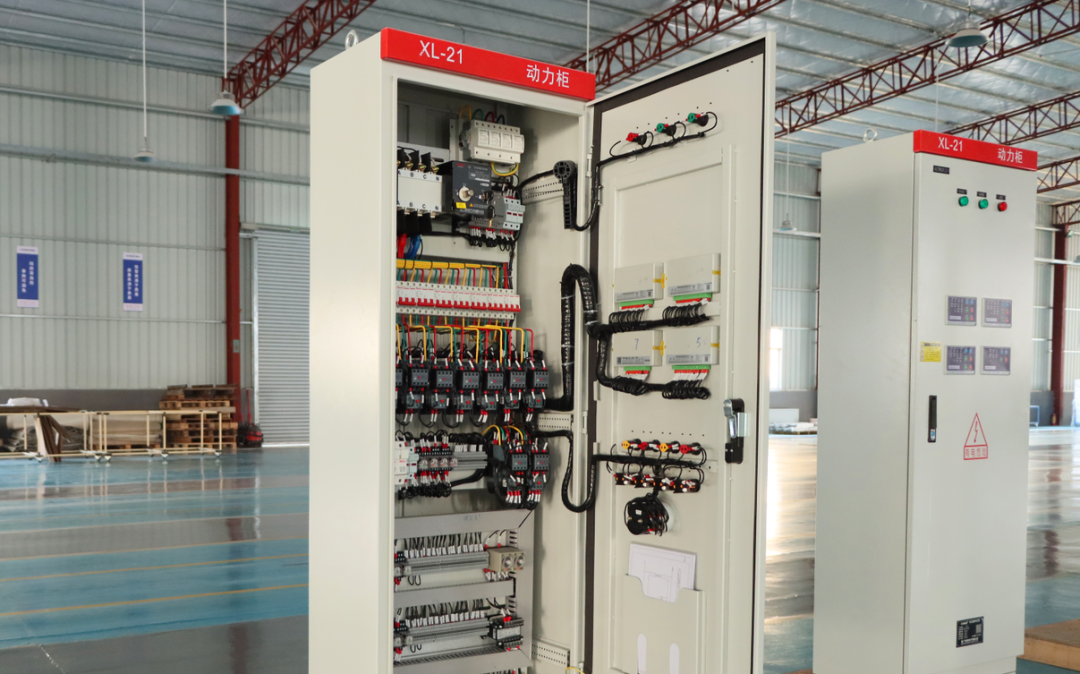
The internals look familiar: branch devices on a rail, a copper bar behind them, a neutral and an earth bar.
Duty is what changes. Branch circuits in a hall sit near full load for years, not for an eight hour shift.
That rules out the 80 percent rating common on a lighting board. Specify 100 percent rated devices and a busbar sized for continuous current.
Many panelboard manufacturers can fold the metal and fit the devices. Fewer can document the rise and the withstand for the assembly as a whole.
Low voltage switchgear manufacturers usually can, because the busbar jig and the type test already exist on their floor.
Telemetry is where the two paths split. Buyers comparing distribution panel boards for a hall expect per-branch current reporting.
A board in a corridor is not asked for that. The metal looks alike, but the paperwork is thinner.
What compact takes away
Compactness is usually taken out of the cable chamber. The chamber is the cheapest place to save millimetres.
It is also the most expensive place to find a problem, because the fix arrives after the floor is closed.
 Cable entry
Room to bend is part of the rating
A large conductor needs a bend radius several times its diameter, and the chamber has to hold it. A 240 mm² core drawn tight against the door is a joint under permanent side load.
The space for that bend is part of the rating, and it rarely appears on the general arrangement. Ask for the deepest lug the unit takes and the clearance behind the door.
Neither figure is standard, so ask for both by name.
Money follows that geometry. A distribution board price list that gives only width and ways hides the chamber.
Outdoor siting adds one more layer. Many halls are built as skids, and a unit that sits outside needs a shell before anything else.
In that case the shell has to be a waterproof power enclosure rated for rain and hose. The PDU inside is only as good as that first barrier.
Service one output without opening the whole unit
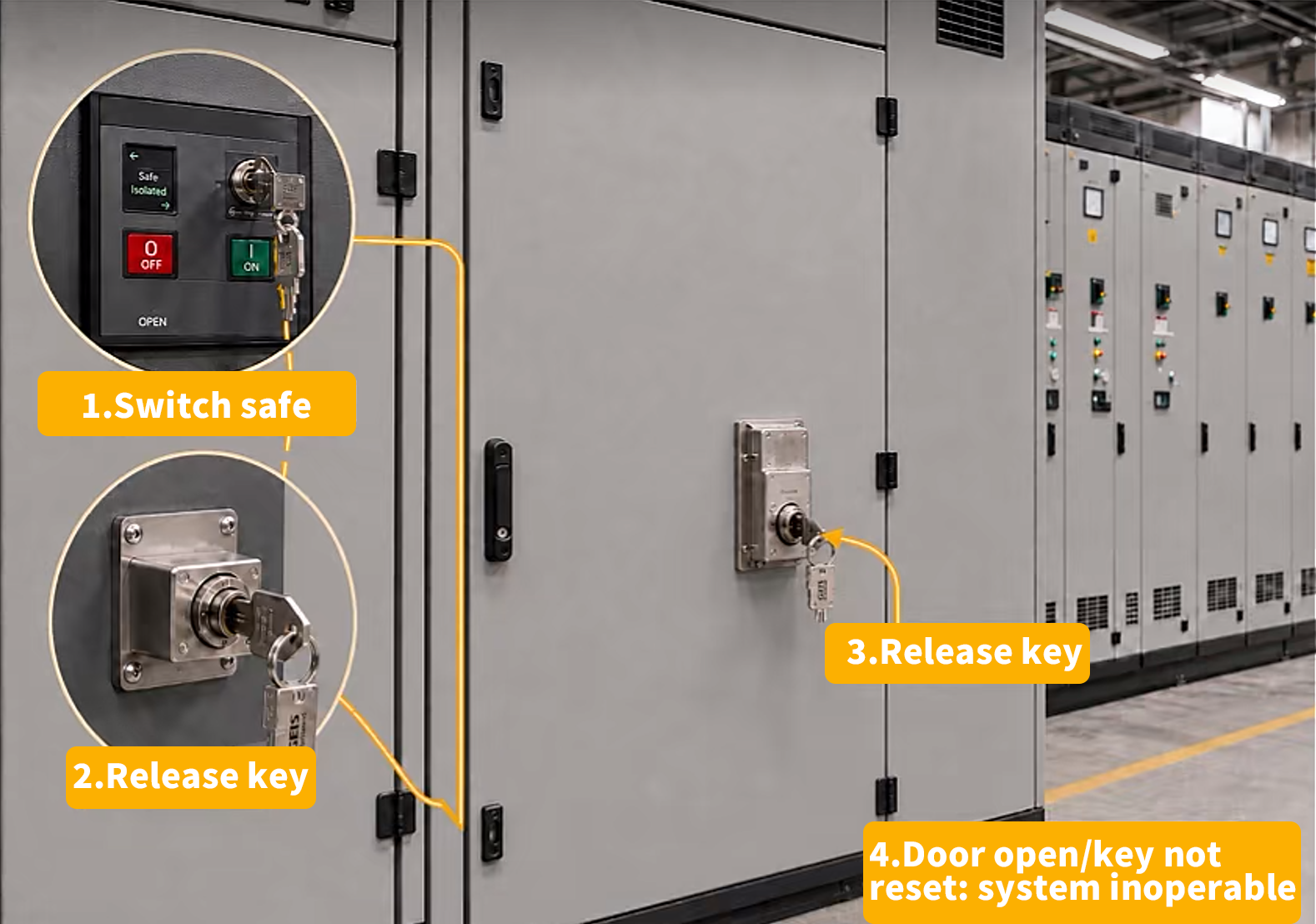
A hall cannot lose forty racks to change one breaker. The unit has to let a technician isolate a single output while the rest stays live.
The question is mechanical before it is electrical. It comes down to the outgoing device, its barrier and its lock-off point.

A row of devices is easy to add and hard to service
A unit that needs the main device opened for a branch fault will be bypassed on a Sunday night. Design for the Sunday night.
The idea is borrowed from motor control, where one compartment is isolated at a time. A low voltage motor control center does exactly that, and the pattern carries down to a row unit.
Spares are the cheap half of the argument. The expensive half is a shutdown scheduled around a missing device.
Four phrases, four different firms
Four similar phrases sit in this corner of the market, and they do not point at the same firms.
| Phrase | What it usually points at | The question it leaves open |
|---|---|---|
| switchgear manufacturers | Any assembly from 400 V upward | Which voltage band the works is set up for |
| low voltage switchgear manufacturers | Assemblies below 1 kV | Whether they build for rack duty or plant duty |
| switch gear manufacturers | Older spacing, often plant-side firms | Whether the assembly itself has a type test |
| lv switchgear manufacturers | Shorthand, usually export-facing | What documentation travels with the unit |
None of the four says whether the firm can document a temperature rise on the assembly.
That is the question to carry into the enquiry, and the only one that separates two similar quotations.
A works that builds for plants will happily quote a hall unit. It will also size the busbar for a duty cycle the hall never runs.
Plant work keeps a different rhythm. Switchgear in power plant runs at a steady load, while a rack row swings with the IT load.
Five lines to send with the drawing
An enquiry gets a useful answer when it carries five things. Without them the reply is a price for a box.
- Rated current per row and the number of outgoing ways.
- Supply voltage, and the fault level at the unit terminals.
- Maximum ambient in the hall, not the design figure.
- Which outputs must stay live during maintenance.
- The test documents you will accept at handover.
The last line separates suppliers. A works that tests the assembly can name the standard behind it.
Assemblies built to IEC 61439 are verified as a whole, not device by device. That is the difference a buyer is paying for.
A supplier holding ISO 9001 certification has a document trail. A trail is not a test report, so ask for both.
Keep the language plain. Data center power distribution is a chain, and each supplier can only prove its own link.
Frequently asked questions
What makes a power distribution unit compact rather than merely small?
What temperature rise should I ask for?
Is 415/240 V better than 400/230 V for a data hall?
Can one unit serve more than one row?
How much spare capacity should a row unit carry?
Do compact units need forced cooling?
What documents should arrive with the unit?
Start with the test report
Compact units look alike in a photograph. Three documents separate them: a test report, a busbar calculation and a cable chamber dimension.
Check those three against the fault level you will actually have. The shortlist shortens itself, and the price conversation gets shorter too.
Send the row current, the way count, the ambient and the fault level. Ask every supplier for those five figures, then compare what comes back.
Send the five figures
Tell us the ways, the voltage band and the ambient in the hall. We will come back with the figures and the test documents behind them.
Contact Giantele