
Key takeaways
- The drive already measures current, temperature and faults. You buy the access, not the sensors.
- A monitoring offer without a wiring schedule is a promise, not a product.
- Read-only data earns its cost. Write access needs a permit system and your IT team.
- Alternation belongs in the panel, so the pumps keep cycling when the link drops.
- Six alarms with an owner beat sixty that nobody reads.
No two companies offering remote monitoring for vfd control panels sell the same package. One ships a gateway and a login. Another wires the drive, the alarms and the link into the vfd panels you already own. This guide is written for the second kind of supplier.
The drive measures, the vendor sells the read
A modern drive measures output current, DC bus voltage, heatsink temperature and run hours. It also keeps the last ten faults. None of that is new.
What you buy is a way to read it from another town. So the first question is not which platform to choose. It is which registers the vendor can reach.
Some drives expose a full map over Modbus. Others need an option card before one value leaves the cabinet. Most vfd panels sold today answer Modbus over an RS485 pair.
Every electrical distribution panel in this class ships with a drive manual. Ask the vendor to mark the pages that list the communication parameters.
A supplier who cannot point at those pages has not done this before. That one question saves a month of correspondence.
Start with the vfd drive wiring diagram
 Signal pairs
Every signal has a terminal and a name
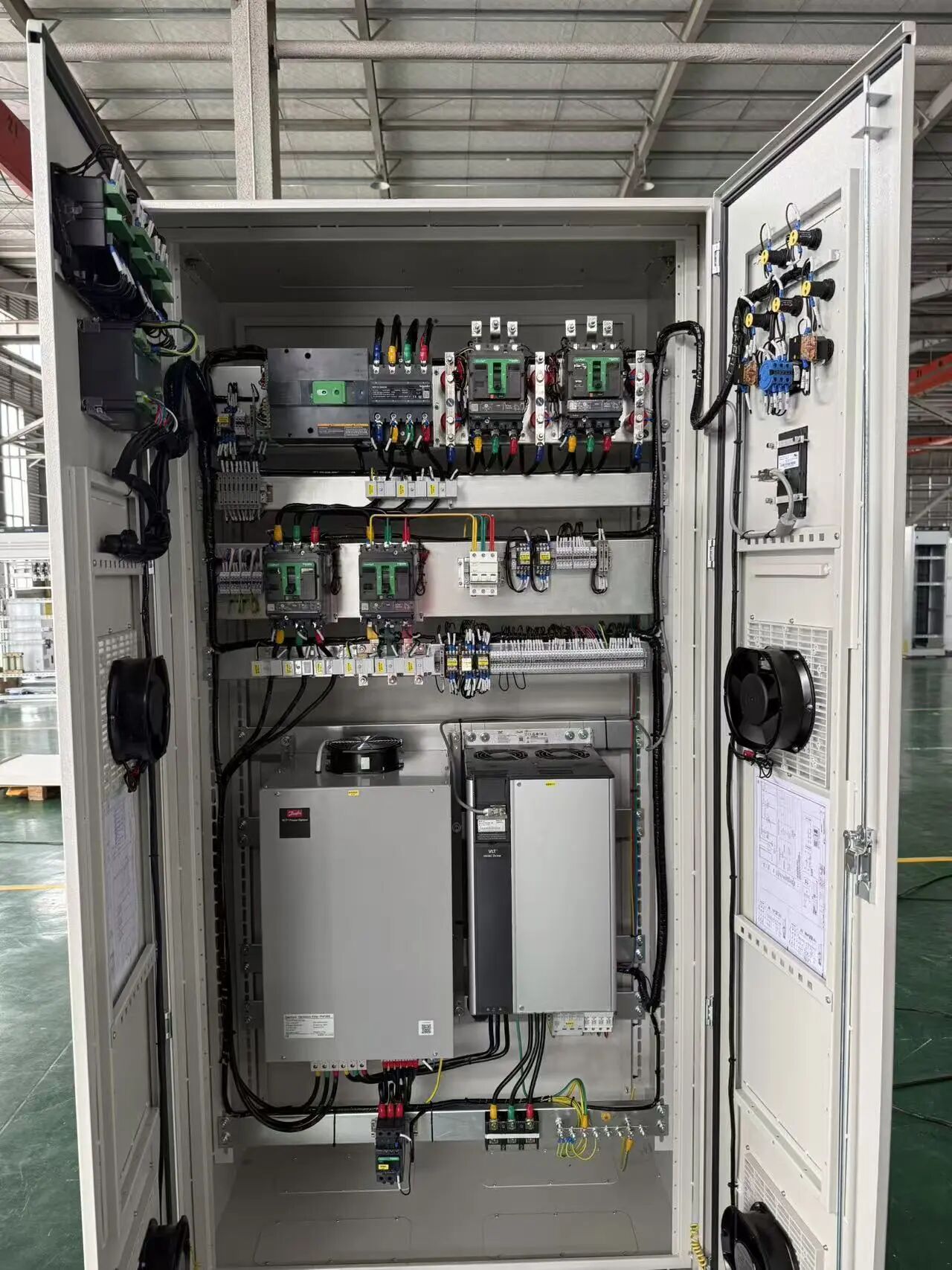
The vfd drive wiring diagram is the real scope document. It names the terminal for the run command and the one for the speed reference.
It also names the relay that closes on a fault. Read it before the quote, not after the order.
A drawing with no spare relay means an option card. That card sits on the critical path of every order for vfd panels.
Three signals cover most sites. Run status, fault status and one analog value. Everything else is detail you can add later.
| Signal | Where it comes from | What it proves | Extra hardware |
|---|---|---|---|
| Run status | Digital output or relay | The motor turns, not just receives a command | One spare relay |
| Fault status | Dry contact relay | The drive has tripped, with a code | None if the relay is free |
| Speed reference | Analog input, 4 to 20 mA | The frequency the drive follows | Shielded pair |
| Output current | Modbus register over RS485 | Load trend, blocked impeller, belt slip | Twisted pair and terminator |
| Heatsink temperature | Modbus register | Cooling is failing before the trip | None |
| Energy, kWh | Modbus register | Cost per tonne or per cubic metre | None |
Two rows of that table need a wire. The rest need a protocol. With no spare relay and no RS485 pair, the quote grows a card.
That card can cost more than the gateway. Ask for one spare relay per drive at the design stage. The problem then disappears.
Keep the RS485 pair away from motor cables. A drive output radiates hard. A screened pair in the same duct will pick it up. Give the bus its own route and earth the screen at one end.
Where the panel door stops and the link begins

Whatever the door cannot show, the link cannot add
Before you accept a remote offer, read the local interface. A vfd panel board that shows nothing on its own door will not show more on a phone.
The gateway sits between the drive and the network. On a small panel it is a DIN rail device. One side takes the serial cable, the other the SIM card.
Remote offers often price the gateway and forget the supply. Give it a miniature breaker and a fused 24 V supply. A gateway fed from the drive control terminals dies when the drive trips. That is the moment you need it most.
Mount it inside the assembly, not in a box on the wall. The panel carries an IEC 61439 design verification. Anything added later should stay inside that envelope.
One offer from these industrial electric companies may send only a run signal. That tells you nothing at 2 am. Ask for current, temperature and the fault code, in that order.
Then ask what happens when the link drops. The drive should hold its last command. A panel that stops the motor because a router rebooted is a design fault.
Duty and standby inside a duplex pump control panel
 Relay per duty
One relay per pump keeps the swap honest
A duplex panel earns its cost in the logic, not in the enclosure. Two pumps, one duty and one standby.
The controller decides which is which. The relays carry that decision to the cloud and to the alarm list.
Set alternation on run hours for dirty water, and on cycles for clean water. Hours suit a sump with long runs. Cycles suit a package plant that starts often.
Three parts of that logic decide pump life. Alternation shares the wear. Failure transfer starts the lag pump when the lead trips. Run-hour logging makes the swap a record, not a guess.
What an alternating pump controller must never forget
An alternating pump controller has to keep working when the network is down. Put the logic in the panel, then let the cloud watch it.
The worst failure is silent. Alternation stops, one pump runs for a year, and the standby seizes in its cradle. Trending hours per pump is the only way to catch that.
Retrofitting a legacy board usually means an hour meter and two auxiliary contacts. That work is quoted as motor control panel retrofit services on most sites. It costs less than any platform subscription you will be quoted.
Septic sites need their own alarm set
A septic dual pump controller often runs two small pumps on floats, with no drive in sight. The duty is dirty, the site is remote, and nobody visits weekly.
The useful signals differ here. High level, high-high level, pump fail, and current per pump. Current warns you first. On sites like this, vfd panels are the exception.
A blocked impeller raises current before the float ever trips. Trend it for two weeks and the drift appears without anyone driving out to look.
Site camps, lodges and small works across Zambia and Kenya run this way. One technician covers forty sites. A link that shows current per pump turns a two hour drive into a phone call.
Which alarms earn their place
An automatic panel can raise sixty alarms and still miss the one that matters. Most offers expose every drive fault, because the gateway reads whatever it finds.
Filter the list. Six alarms with an owner and an action beat sixty that everyone ignores.
- Drive tripped, with the fault code and the timestamp.
- Motor current outside the normal band for that duty.
- Heatsink temperature rising across a week.
- Pump or fan run hours past the service interval.
- Communication lost for more than ten minutes.
- Control supply or 24 V rail lost.
Set thresholds from the plant, not from the datasheet. A drive that trips at 90 degrees should warn you at 75.
Then name a phone. An alarm routed to a shared inbox is an alarm nobody owns. The better offers name the person and the escalation time in writing.
How a controller shapes the data
Add a PLC to a row of vfd control panels and the cabinet stops being a set of drives. The PLC holds the sequence, the alternation and the alarm logic.
Good plc control panel design keeps safety in copper and sequence in code. A remote link should never be able to start a motor. Read-only access costs less and clears IT review faster.
Publish a register map with fixed addresses and stable tag names. When a drive is replaced in year three, that map should still work without a rewrite.
Motor control technology choices you can maintain
Motor control technology moves faster than a water utility replaces panels. Pick the protocol your own electricians can test with a laptop.
Modbus RTU survives because it is simple and most drives speak it. Ethernet adds speed a pump station does not need, plus a switch you must power and cool.
If the plant reports energy, read kWh from the drive and file it under your own energy management process. One register replaces a month of manual meter reading.
Ask mcc manufacturers what they expose on the panels they build. The answer separates a builder who has done this from one who has not.
Motor controls that fail without a word
Not every motor has a drive. Plenty of plants run contactors and thermal overloads. Those electrical motor controls report nothing at all.
A direct on line starter with one auxiliary contact can report running or stopped. That single bit is the cheapest monitoring upgrade on most sites.
The second cheapest is a watchdog on the control supply. Many mystery stops are a blown control fuse, not a motor fault.
Builders who test to ISO 9001 procedures hand over the auxiliary contact schedule with the drawing. Ask for it by name.
Motors and the systems they drive take around 45% of global electricity, according to the IEA. Most of that load still has no data channel attached.
Most vfd control panels already carry the data you want. Start there, then the starters with a spare contact, then the rest of the plant.
A consultant selling industrial power system solutions should start with those points, not with a platform.
Frequently asked questions
How much does remote monitoring add to a VFD panel?
Can I add monitoring to an existing VFD panel?
Do I need a PLC to monitor a VFD?
What happens to the pumps when the network fails?
Is a cloud dashboard enough for a septic dual pump controller?
Which protocol should I ask for?
Who should own the SIM card and the data?
Final thoughts
Remote monitoring is a wiring job before it is a software job. Get the spare relay, the RS485 pair and the alarm list into the enquiry. The dashboard is the easy part.
Give us the drive models, the pump arrangement and the site network. We will return a panel schedule with the monitoring points marked and the alarm list attached.
Send the drive list with the enquiry
Give us the drives, the pump arrangement and the site network. We will return a panel schedule with every monitoring point marked and the alarm list attached.
Contact Giantele