Remote monitoring and diagnostics for industrial control panels transform reactive maintenance into predictive maintenance. Instead of discovering a failed motor starter when production stops, a monitoring service alerts you that the motor current is trending upward, the contactor cycle count is approaching its rated life, or the VFD control panel is reporting an overtemperature warning. This guide explains what remote diagnostics services offer, which industrial electric companies provide them, and how to evaluate whether a monitoring service delivers real value or a dashboard nobody checks.
Key Takeaways
- Remote diagnostics addresses two different problems: The first is fault response — knowing what failed and why before the maintenance team arrives on site. The second is condition monitoring — detecting trends that predict failure before it occurs. Most industrial power services companies offer the first. Fewer deliver the second.
- A vfd remote control panel generates richer diagnostic data than a motor starter: A VFD reports motor current per phase, DC bus voltage, drive temperature, fault codes with timestamps, and accumulated operating hours. A standard motor starter reports run, stop, and overload trip. The diagnostic value difference is an order of magnitude.
- Remote access is not the same as remote diagnostics: Viewing a PLC program over a VPN connection allows remote troubleshooting by a human engineer. A diagnostics service analyses data continuously and generates alerts without a human watching the screen. Industrial electric companies that offer VPN access as their remote service are selling connectivity, not diagnostics.
- Enclosure companies with diagnostic services add value beyond the metal box: The diagnostics hardware — current transformers, temperature sensors, gateway modules — lives inside the enclosure. An enclosure company that also provides the monitoring service ensures the hardware and the service are designed together, not bolted together.
What remote monitoring actually measures on an industrial control panel

The diagnostics start with the data the sensors capture
Remote monitoring of industrial electrics generates data at three levels. Level one is binary status: motor running, motor stopped, circuit breaker open, circuit breaker closed. This is basic monitoring that tells you the current state of every device but provides no trend information. Enclosure companies that sell this as remote monitoring are selling connectivity, not diagnostics.
Level two adds analogue values: motor current per phase, voltage, power factor, enclosure internal temperature, and VFD DC bus voltage. These values create trends over time. When the current on pump number three has been increasing by 2% per month for six months, the bearing is wearing. The diagnostics service should alert on this trend, not wait for the overload trip. Industrial power companies with genuine diagnostic capability deliver level two as standard and level three — predictive analytics — as the differentiator.
Level three diagnostics uses the historical data to predict failures. A vfd control panel that has been running a blower motor for 18 months at a steady load draws a baseline current. When the current deviates from that baseline by more than 10% and the deviation is not explained by a change in process conditions such as a flow rate adjustment, the diagnostics system flags it as a potential mechanical issue. This is the level that separates genuine diagnostic services from basic monitoring. The IEC 61439 standard covers assembly verification but does not yet define standardised diagnostic data formats, which is why the diagnostic capability varies significantly between industrial electric companies.
Data points that remote diagnostics services capture
| Component | Data Collected | Diagnostic Value |
|---|---|---|
| Motor contactor | Operations counter, coil voltage, contact resistance trend | Predicts contactor failure 2-4 weeks before it occurs based on increasing contact resistance or approaching mechanical life limit. |
| Motor overload relay | Current per phase, phase imbalance, ground leakage, thermal capacity used | Identifies developing bearing problems, winding deterioration, or mechanical overload from the driven equipment. |
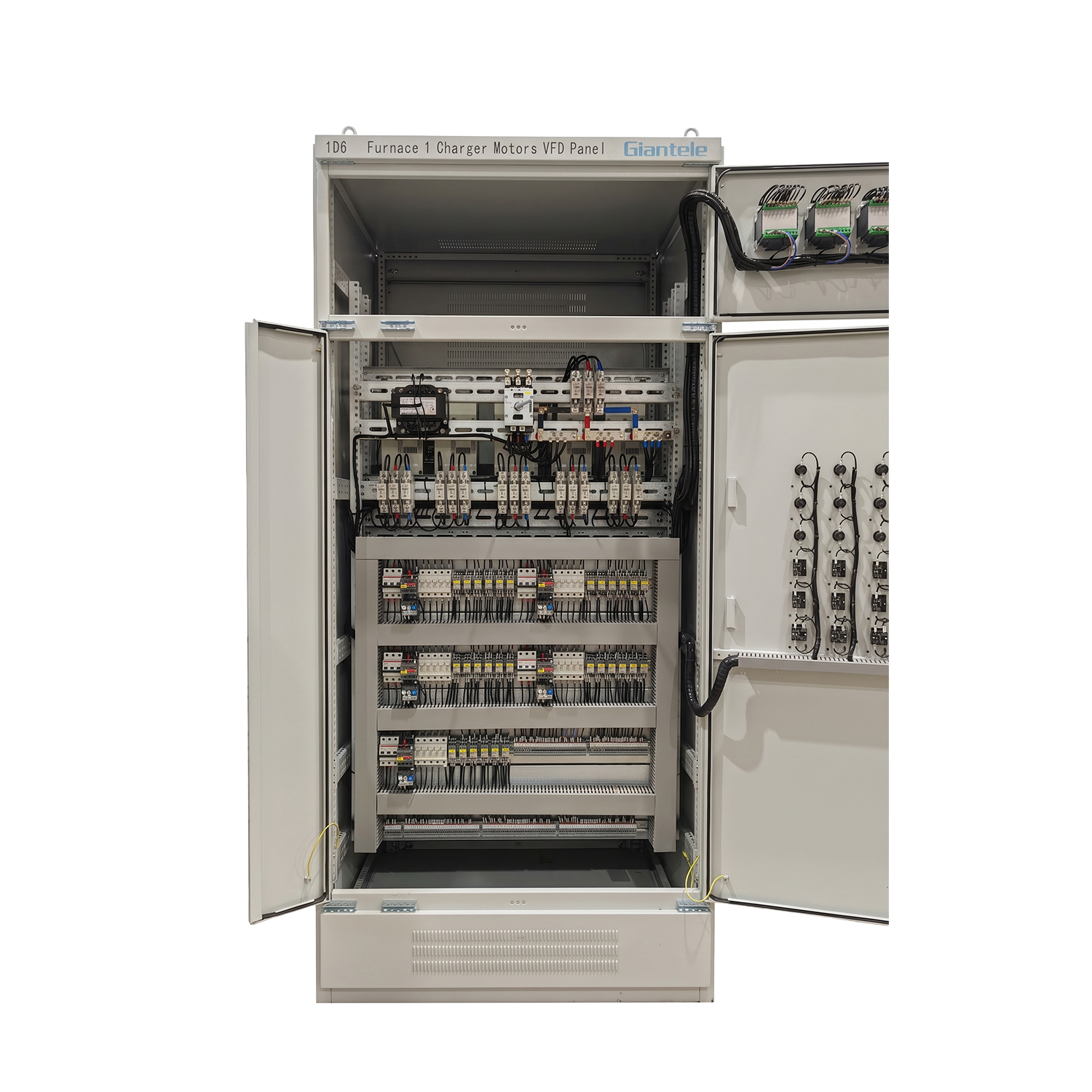
| VFD control panel | Motor current, DC bus voltage, IGBT temperature, fault codes, run hours, kWh consumption | Rich dataset. DC bus voltage trends indicate incoming supply issues. IGBT temperature trends indicate cooling problems. Fault codes with timestamps enable root cause analysis. |
| Circuit breaker | Open/closed status, trip count, trip cause (overload vs short circuit) | Frequent trips on the same circuit point to a developing problem. The trip cause distinguishes overload from fault conditions. |
| Enclosure environment | Internal temperature, humidity, door open/closed status, cooling fan status | Rising temperature indicates blocked ventilation or failing cooling. Humidity trends warn of condensation risk. Door status provides security monitoring. |
| Busbar system | Busbar temperature at joints, voltage drop across sections | Hot joints indicate loose connections or corrosion. Voltage drop trends indicate increasing resistance at a joint that needs maintenance. |
Automation systems for industrial lines with integrated diagnostics capture all of the above data points from a single platform. Industrial machine automation in factories with multiple production lines generates diagnostic data from dozens or hundreds of devices simultaneously. The value of the diagnostics service depends on whether it filters that data into actionable alerts or dumps it into a dashboard that overwhelms the maintenance team. An SVG panel with remote diagnostics should generate zero alerts in normal operation and specific, high-priority alerts when something is about to fail.
Evaluating industrial power companies for diagnostic services
Four questions that reveal genuine diagnostic capability
A diagnostic service that generates 200 alerts per day is useless because the maintenance team ignores all of them. A service that generates three alerts per month, each of which correctly identifies a developing problem, changes how the plant operates. The difference is in the alert filtering, not the sensor hardware.
The power capacitor for power factor correction in factories can also be remotely monitored. When the power factor drops below the target range, the diagnostics system identifies which capacitor stage is not switching correctly rather than reporting "low power factor." The specificity of the alert is what makes diagnostics useful.

An industrial power company with genuine diagnostic capability can demonstrate the difference between a raw data dashboard and filtered diagnostic alerts. Ask for a live demonstration of the alerts from a panel that has been in service for at least six months. The alert history should show a few real events, not fifty "motor running" status messages dressed up as diagnostics. The ISO 9001 framework requires documented processes for service delivery, which should include the alert configuration methodology.
VFD remote control: the richest source of diagnostic data

Why VFD remote control panel data drives the best diagnostics
The industrial control panel protecting the VFD busbar should also be monitored remotely. When harmonic current levels increase, the diagnostics service should correlate the increase with the operating status of the VFDs rather than raising a generic "high harmonics" alert. This specificity is what industrial electrics diagnostics companies differentiate on. A capacitor contactor system with remote diagnostics provides the same type of specific fault identification: which capacitor stage failed, not just "low power factor."
How remote diagnostics changes maintenance operations
Industrial power services companies that offer remote diagnostics typically charge a monthly subscription per connected panel or per connected motor feeder. The subscription covers the cloud platform or SCADA integration, the data storage, the alert configuration, and periodic diagnostic reports from a human engineer who reviews the data trends. Enclosure companies that also provide diagnostics typically bundle the monitoring hardware into the panel purchase and charge the subscription separately. The gas insulated switchgear feeding the plant distribution network should also be monitored remotely because a medium-voltage fault affects the entire factory.
The IEA has documented that industrial facilities with continuous remote monitoring of motor-driven systems reduce unplanned downtime by 25-40% compared to facilities relying on periodic manual inspection. The diagnostic data enables a shift from calendar-based maintenance — replace the bearings every 12 months whether they need it or not — to condition-based maintenance — replace the bearings when the current signature indicates they are degrading. The savings come from eliminating both the cost of unnecessary maintenance and the cost of failures that calendar-based schedules miss.
Frequently asked questions
What is the difference between remote monitoring and remote diagnostics?
How much does a VFD remote control panel diagnostics service cost?
Can I add remote diagnostics to an existing control panel?
How do enclosure companies integrate diagnostic hardware into new panels?
What diagnostic data is most valuable for predictive maintenance?
How do I verify that an industrial power company's diagnostics claims are genuine?
Final thoughts
Remote monitoring and diagnostics services for industrial control panels are a maintenance investment, not a hardware purchase. The value comes from the alerts that prevent unplanned downtime and the trend data that enables condition-based maintenance. A vfd control panel with remote diagnostics provides the richest data set. An industrial power company with genuine diagnostic capability demonstrates it through alert history, not dashboard screenshots. Evaluate diagnostics services on the quality of the alerts, not the quantity of the data points. Three accurate alerts per month that prevent three failures is worth far more than two hundred status messages that nobody reads.
Discuss Remote Diagnostics for Your Control Panel Project
Send us your motor list and monitoring objectives. Our engineering team provides an assessment of diagnostic options for your application and a specification for the data points that matter most to your maintenance team.