

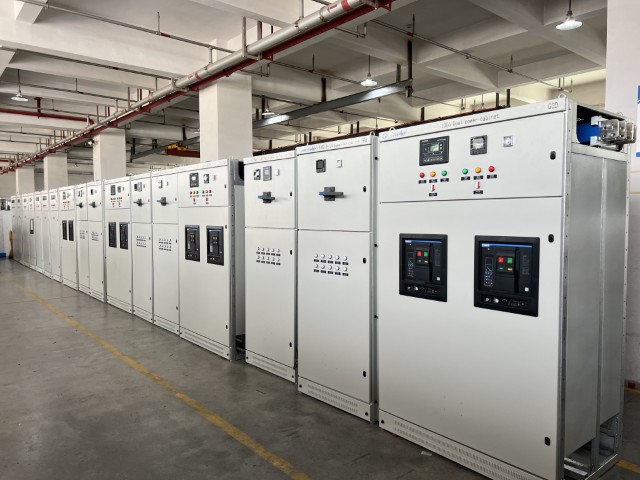
Old switchgear rarely fails without warning. It runs out of spare parts, out of fault rating or out of ways for one more feeder. This guide covers what a low voltage switchgear retrofit replaces, when the assembly has to be rebuilt, and how to plan the outage.
Key takeaways
- Most of a retrofit is scope, not hardware: the incomer, the devices and the protection settings usually fit inside the enclosure you already have.
- Change the frame and the verification resets: a structural change takes the assembly outside its original design verification file.
- Sequence the work by feeder, not by board: ten ways come across in three weekends if you keep a live path at every step.
- Ask switchgear suppliers for the original file first: without the old drawing set and test evidence, a retrofit quote is a guess.
- Budget 20-30% beyond the device list: cable re-termination, torque checks, labelling and re-testing are the parts nobody quotes.
What a low voltage switchgear retrofit actually covers
A retrofit keeps the enclosure and the busbar, and renews what has aged or no longer carries the duty. That means the incomer, the outgoing devices, the protection settings and the cable terminations. The frame, the cable trench and the building works stay where they are.
The trigger is rarely a failure. It is usually a device family that went obsolete, an insurer asking for a current withstand figure, or a line that needs two more feeders than the board was sized for.
Age on its own tells you little. A 25-year-old board in a dry switchroom can still be sound, while a 12-year-old unit in a humid coastal plant may show tracking across the insulators already.
Which parts of an old board can be renewed in place
Inside the existing enclosure you can normally replace the incomer, the outgoing devices, the control wiring, the metering and the terminations. Every one of those bolts onto the frame or the bar, so the work stays mechanical instead of structural.
The steel outlasts everything inside it. A switchgear panel is built to hold its rating for 25 years, while a breaker that has switched a motor circuit for 20 years is close to the end of its working life.
| Item | Typical life | Renew in place? |
|---|---|---|
| Incomer air circuit breaker | 15-20 years | Yes, if the frame size matches |
| Moulded case devices | 10-15 years | Yes, with new lugs and spreaders |
| Protection and trip units | 10-15 years | Yes, when the CTs are still sound |
| Busbar and insulators | 25-30 years | Only after an insulation test |
| Enclosure frame and doors | 25-30 years | Rarely worth replacing |
| Cable terminations | 10-15 years | Always replace during a retrofit |
Withdrawable switchgear is the easier candidate, because the chassis already gives you a defined interface. New low voltage electrical switchgear drawers slide into the old rails when the frame pitch matches, so the outage is measured in hours instead of days.

Why the incomer usually goes first
The incomer takes every fault and every switching operation on the board. Its trip unit is also the part most likely to be obsolete, which is why it is the one device you cannot always buy again.
A modern trip unit adds settings the old one never had: adjustable short-time delay, earth fault protection and a port for the plant's own records.
When the assembly has to be rebuilt instead
Three conditions force a new assembly rather than a retrofit. The fault level at the board has climbed above the original withstand, the busbar cannot carry the extra load, or the enclosure has no room for the ways you need.
Any change to the frame, the bar cross-section or the way pitch takes the assembly outside the configuration that was originally tested. That test file describes one build, so a structural change puts the verification back on the table.
That is why power distribution switchgear is quoted as a new build more often than buyers expect. A replacement assembly arrives with its own type test, and no argument about scope afterwards.
Ask which edition of IEC 61439 the replacement was tested against. That is the document an insurer or an electrical inspector asks to see, and a board whose frame has changed cannot show it without re-verification.
Fixed and withdrawable sections in an old plant
Most plants of this age run a mixture. Feeders that change often sit in drawers, while fixed switchgear carries lighting and small power where nothing moves. A retrofit can extend either pattern, but only if the new sections match the existing pitch.
Where the room is tight, industrial electrical switchgear on a fixed frame fits more ways into the same footprint. You give up the quick swap and gain roughly 15-30% on the cost of each way.

What the old busbar tells you
Before anyone quotes a device swap, the bar needs an insulation test and a torque check on every joint. A bar that passes both is worth keeping, and that single decision removes about a third of the cost.
Bolted joints loosen over 20 years of thermal cycling, so the retorque is not optional. It is the cheapest hour of the whole job and the one that prevents the hottest connection.
Planning the shutdown so production survives
Retrofit work is planned around feeders rather than boards. If the plant can run from a temporary feed or a second incomer, the work moves to weekends and the production loss stays close to zero.
Sequence matters more than speed. Land the new incomer, transfer the load, then strip the old one. Done in that order, the plant keeps a live path at every step.
A cement plant in Nigeria ran its mill and packing lines through a four-weekend retrofit that way, moving a few feeders at a time while the kiln stayed fed from its own section.
Budget the hours honestly. A three-way compartment swap takes four to six hours with the section isolated, and re-testing afterwards takes another half day. Two crews on opposite shifts finish a ten-way retrofit in three weekends.
Electricity demand across Africa and Southeast Asia keeps climbing, and the International Energy Agency records that growth year after year. A board that is already short of ways will not wait for a convenient shutdown.
What the site has to prove before you order
Four checks decide the scope, and all four belong in the tender documents. Skip them and every quotation you receive will describe a different job, which makes the prices impossible to compare.

Four measurements that set the price
Retrofits seldom stop at one board. The sub main boards downstream usually need their incomers re-rated to match the new upstream protection, or discrimination between the two is lost.
Switchgear suppliers and custom switchgear manufacturers
Two questions separate the two routes. Can the supplier read your original drawings, and can they still supply a spare compartment in five years? A retrofit lives inside an existing arrangement, so drawing literacy matters more than the size of a catalogue.
Stock switchgear suppliers sell the device and expect you to fit it. Custom switchgear manufacturers survey the board, model the busbar and hand back a revised drawing set with the verification documents. The second route costs more and removes most of the site risk.
- Drawing set: will they redraw the single-line diagram as modified, or hand over a datasheet?
- Test evidence: does the price include a routine test report for the modified board?
- Site survey: is a visit included, or is the price built from your photographs?
- Spares window: how long will the new device family and drawer stay available?
- Outage plan: does the quote state hours per feeder, or only a total duration?
Outdoor switchgear adds one more line to the comparison. A kiosk exposed to sun and rain needs the enclosure assessed before any device changes, because a roof that leaks will destroy new devices faster than it destroyed the old ones.
One limit sits upstream of all of this. The electrical switch gear feeding your board fixes the fault level the new devices must break, and that figure comes from the transformer and the utility rather than from the retrofit contractor.
What the retrofit file should contain at handover
A retrofit without a file is a repair. An as-built single-line diagram, a routine test report, the torque values used on every joint and a spare parts list are what an inspector, an insurer or the next plant manager will ask for.
All four cost very little to produce while the board is still open, and almost nothing can be reconstructed six months later. Ask the manufacturer how they control those records before you place the order.
A supplier working to ISO 9001 files the torque values and test results against a serial number, which is what turns a folder of paper into evidence you can hand over.
Frequently asked questions
How long does a low voltage switchgear retrofit take?
Can you retrofit switchgear without replacing the enclosure?
Is a retrofit cheaper than a new assembly?
Can new trip units be fitted to old circuit breakers?
Can outdoor switchgear be retrofitted in place?
Do I need the original type test file to retrofit a board?
What do switchgear suppliers need to price a retrofit?
Final thoughts
Decide first whether you are renewing devices or changing the frame. That one answer sets the price, the outage and the paperwork. Then send Giantele your nameplate photographs, fault level and way count for a retrofit scope you can compare.
Planning a retrofit on an old board?
Send the nameplate photographs, the single-line diagram and the fault level. Giantele engineers return a scope that separates what can be renewed in place from what has to be rebuilt.


