


Electricity users rarely judge a distribution network by its diagram. They judge it by whether essential equipment keeps operating when a cable needs work or a local fault occurs. That practical expectation explains the importance of the Ring Main Unit (RMU). Installed at medium-voltage nodes, an RMU gives operators controlled switching, protection, and isolation points between feeders and transformers. It does not create power or replace a transformer; it makes the distribution path more manageable. This article explains where that value comes from, how it affects project decisions, and what buyers should examine before specifying an RMU.
Key Takeaways
A Ring Main Unit supports power supply continuity by enabling sections of a medium-voltage network to be switched and isolated selectively.
Its value comes from the system arrangement, protection coordination, operating procedure, and chosen configuration—not simply from the number of panels.
Load break switches, circuit breakers or fuse-switch combinations, earthing facilities, cable terminations, and interlocks work together to support safe operation.
RMU switchgear is often valuable where space is limited and an outage has operational, safety, or commercial consequences.
Smart-grid functions can improve visibility and control, but remote operation should be designed around the utility’s protection, communication, and cybersecurity requirements.
Why a Ring Main Unit Matters in Medium-Voltage Distribution
A Ring Main Unit is compact, metal-enclosed medium-voltage switchgear used to connect, switch, protect, and isolate parts of a distribution system. In a typical ring arrangement, a site or group of substations can be supplied from two directions. The network is often operated with a normally open point, rather than as a permanently closed loop, so operators can control fault levels and avoid unintended circulating current. If one cable section is faulted or deliberately removed from service, switching can isolate the affected section and restore healthy loads from the available side when the network design permits it.
That distinction is important. An RMU alone does not guarantee uninterrupted power. A second viable source, correctly rated cables, selective protection, switching authority, and an approved restoration procedure are all needed. What the RMU provides is the physical and operational means to sectionalize the network. Without appropriate switching nodes, a ring is only a cable layout; it is difficult to operate safely when conditions change.
In a radial network, the same equipment can still be useful. An RMU can create a defined feeder isolation point, protect a transformer branch, or provide a compact interface between incoming supply and downstream equipment. The resilience benefit is usually different from a true alternate-feed ring, but safe isolation and organized feeder control remain meaningful. That is why a specification should start with the network’s operating philosophy instead of assuming that every three-way unit serves the same purpose.
For a broader view of product formats and available configurations, readers can review Giantele’s Ring Main Unit range. The category context matters because a medium-voltage node must be matched to its voltage class, current, fault duty, protection concept, installation environment, and cable arrangement.
The Operational Problem an RMU Solves
Most distribution interruptions become expensive when a local event is allowed to affect a much larger area. A damaged cable, an insulation issue, a scheduled termination replacement, or a transformer-side fault may require part of a feeder to be taken out of service. With coordinated sectionalizing points, operators can identify the affected segment, open the required ways, apply earthing according to the approved procedure, and keep unaffected portions available where an alternative supply path exists.
This is the central contribution to distribution network reliability: the RMU helps limit the scope of an event. It is not a substitute for protection studies or field operating rules. Instead, it implements the switching and isolation decisions that those engineering activities define. A system with unsuitable protection settings, inadequate short-circuit capability, or unclear switching authority cannot become reliable merely by adding remote controls.
The same principle improves planned maintenance. Rather than de-energizing an entire downstream area for work on one section, the operator can isolate the work zone if the network and procedure allow it. The potential benefit is continuity for healthy loads and a clearer, safer work boundary for the maintenance team. Before relying on that benefit, project teams should confirm the single-line diagram, back-feed restrictions, load capacity on the alternate route, and the site’s lockout, tagging, and earthing practices.
Components That Turn a Cabinet into a Switching Node
An RMU is best understood as an integrated assembly rather than a generic cabinet. The internal arrangement varies, yet several functional elements are common.
Functional element | System role | Specification question |
|---|---|---|
Incoming and outgoing feeder ways | Connect cable sections and allow sectionalizing | How many cable ways are required now and after expansion? |
Load break switch | Makes or breaks rated load current under defined conditions | What switching duty and operating mechanism are required? |
Circuit breaker or switch-fuse way | Provides a protection path for a transformer or feeder | Which protection philosophy and coordination study applies? |
Earthing switch and interlocks | Support a controlled, visibly managed safe-working process | How are key interlocks and operating sequences documented? |
Cable compartment and terminations | Provide the interface to the MV cable system | Are connector type, cable size, screening, and test access compatible? |
Protection, indication, and control devices | Detect, indicate, or communicate conditions as specified | Is local indication enough, or is a monitored or remote-ready design needed? |
The load break switch is particularly easy to misunderstand. It is intended to make and break load current within its rated duty; it is not automatically the same as a circuit breaker with a protection relay. Where transformer protection, feeder protection, or fault-clearing duties require it, the project may use a circuit-breaker way or a properly coordinated fuse-switch combination. The right choice depends on transformer rating, inrush behavior, protection selectivity, utility practice, and maintenance strategy. It should be confirmed by qualified electrical engineers, not selected solely by a familiar panel pattern.
Earthing functions and mechanical or electrical interlocks are equally consequential. They support a sequence in which an operator cannot casually access a cable compartment or perform a conflicting switching action. Their design must align with the site’s operating procedure. A good procurement discussion therefore includes how the unit will be operated, tested, maintained, and released for work—not just its voltage and number of ways.
Why Ring Networks Improve the Recovery Options
In a conventional radial feeder, a downstream customer normally depends on one upstream path. If that path is unavailable, the downstream section remains de-energized until switching or repair creates an alternative. A ring-type medium-voltage distribution network gives planners another option: two feeder directions can serve nodes around a route. During normal conditions the scheme may have an open point, yet a healthy section can potentially be resupplied after operators isolate the faulted part and shift the open point.
The restoration logic can be expressed in plain text as: available healthy load capacity must be greater than or equal to the load transferred after isolation. That simple relationship highlights an often-missed constraint. A second cable direction is not enough if the remaining source, transformer, or cable route cannot carry the transferred demand. Engineers also need to consider starting currents, diversity, future load, voltage drop, fault level, and any process loads that cannot tolerate even a short interruption.
For urban feeders, commercial developments, industrial campuses, transportation facilities, and large residential districts, the advantage is operational flexibility. Dense sites also make compact equipment attractive, provided cable bending space, access, ventilation or environmental conditions, civil works, and safe approach distances are evaluated. The purpose is not to make a network look more sophisticated. It is to create practical options for fault isolation and planned work.
Protection and Transformer Interfaces: Complementary Roles
An RMU and a transformer are commonly installed close together, but their functions are different. The transformer changes voltage to suit the downstream system. The RMU manages medium-voltage circuit paths and provides the location for switching, isolation, and a specified protection scheme. Treating them as alternatives produces weak specifications because it ignores how they cooperate at a distribution node.
For example, a common arrangement includes two ring ways and one transformer-protection way. The two ring ways connect the incoming and outgoing sections of the ring. The protection way connects the transformer branch through either a fuse-switch combination or circuit breaker arrangement, selected according to the application. This is often called a 2+1 configuration, although actual mechanical design and naming conventions differ by manufacturer. Larger nodes may require additional feeder ways, metering, bus sectionalizing, or a different protection arrangement.
Giantele’s existing guide on the purpose of a Ring Main Unit further clarifies the distinction between RMU switching duties and transformer voltage conversion. Project teams should also consider the relationship with medium-voltage switchgear: an RMU is a compact switchgear solution for specific distribution-node duties, while medium-voltage switchgear covers a wider family of assemblies and protection arrangements.
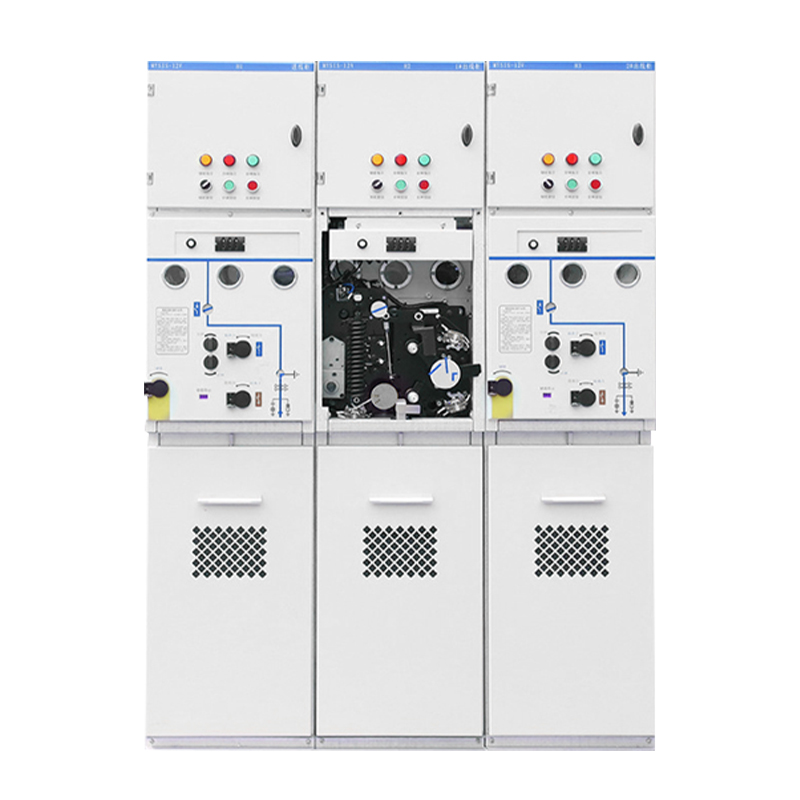
Smart Grid Capability: Useful When It Serves an Operating Need
Modern distribution projects increasingly ask for fault indication, motor operation, voltage or current sensing, remote status, event records, and communications interfaces. These functions can help operators locate abnormal conditions and execute approved switching more efficiently. They can also support condition-based maintenance and network automation when data quality, ownership, and response procedures are established.
However, a smart RMU should be specified by use case. A remote-ready panel with no finalized communication protocol, no approved control philosophy, and no responsible monitoring team may add complexity without adding value. Questions should include: Which indications are required locally? Which signals must reach SCADA or another platform? Who can issue remote commands? How are interlocks represented in the control system? What happens during loss of auxiliary supply or communications? How will access control and cybersecurity be managed?
The answer may range from a local fault indicator to a fully integrated distribution automation scheme. The durable principle is that digital features should reinforce the protection and operating process already defined for the physical network.
A Practical Selection Framework
Start with the single-line diagram. Identify supply sources, feeder directions, transformer branches, normally open points, critical loads, and anticipated expansion. Then select equipment around the conditions that actually govern performance: rated voltage, rated current, insulation level, short-time and peak withstand capability, making and breaking duty, internal arc considerations where required, enclosure environment, cable interface, and applicable standards or utility specifications.
Next, establish the protection philosophy. A transformer branch may need a fuse-switch combination in one application and a circuit breaker with relay protection in another. Feeder protection may require different sensing, selectivity, or communications. Do not treat protection as an accessory chosen after the cabinet configuration. It shapes the configuration itself.
Then examine lifecycle operation. Is the location indoors, outdoors, underground, coastal, dusty, hot, humid, or subject to restricted access? Can personnel operate the unit safely? Are spare ways needed? What testing points, indication, or monitoring will maintenance crews rely on? What training and documentation are required? An apparently compact solution is only successful when it remains accessible and understandable throughout its service life.
Zhejiang Zhegui Electric Co., Ltd. can support early technical conversations around configuration requirements, while the final design should remain grounded in the project specification and qualified engineering review. For projects prioritizing reduced use of SF6, the site also presents SF6-free Ring Main Unit options that can be discussed against the project’s insulation, environmental, and operating requirements.
Where RMUs Create the Most Value
RMUs are often selected where reliability, compactness, and clear switching boundaries converge. In city networks, they help establish controllable feeder nodes in limited space. In commercial buildings and shopping complexes, they can support the upstream MV distribution arrangement where continuity plans are important. In industrial plants, they can separate process areas, transformers, or feeder sections so a localized issue does not automatically dictate a plant-wide response. In renewable-energy or infrastructure projects, their relevance depends on the topology, grid interface, and required protection coordination.
No application should be treated as automatic approval. For instance, a remote outdoor location may favor a particular enclosure and monitoring approach, while a high-density indoor substation may be governed by access, clearances, fire strategy, and cable routing. A coastal site may need material and sealing choices suitable for its environment. The decision should be tied to actual service conditions, not copied from a project in a different climate or network arrangement.
Conclusion
The essential importance of the Ring Main Unit lies in control at the distribution node. It gives a medium-voltage system defined places to switch, isolate, protect, and—when the network is designed for it—restore healthy loads from an alternate direction. That capability can reduce the impact of faults and planned work, but only when the RMU, cable network, protection settings, operational procedures, and load capacity are designed as one system.
The best specification starts with the network’s needs: the critical loads, the available supply paths, the required protection, the environment, and the way people will operate and maintain the equipment. With those decisions in place, an RMU becomes more than compact switchgear. It becomes a practical tool for safer, more resilient medium-voltage distribution.
FAQs
Is a Ring Main Unit only used in a closed ring network?
No. It is especially associated with ring distribution, but it can also provide compact switching, isolation, and protection functions in radial arrangements. The continuity benefit depends on the actual network topology and available alternate supply path.
Does an RMU eliminate all power outages?
No. It can help limit the area affected by a fault or maintenance activity, but recovery depends on fault location, protection coordination, source capacity, cable condition, operating procedures, and whether another suitable supply route is available.
What is the difference between an RMU and a transformer?
An RMU controls medium-voltage circuit paths and provides switching, isolation, and a specified protection interface. A transformer changes voltage between systems. They commonly work together at the same distribution node.
When is a circuit breaker preferable to a fuse-switch combination?
That depends on protection coordination, transformer characteristics, fault-clearing requirements, utility practice, selectivity, and the desired level of control or monitoring. It should be decided through the protection study and project specification.
Can an RMU be operated remotely?
Some configurations can include motor operation, sensing, communications, and remote control capability. Remote operation should only be implemented with a clear control philosophy, permission model, interlocks, communications design, and cybersecurity approach.
What information is needed for an RMU quotation?
Provide the single-line diagram, rated voltage and current, fault-duty requirements, number and type of ways, transformer details, protection requirements, cable interface, installation environment, standards, desired monitoring, and future expansion expectations.