


Automatic power factor correction helps your electrical system save energy. When you use lots of machines, the system can waste energy. APFC panels help by changing power use on their own. This lets you do more work with less wasted electricity.
The U.S. Energy Information Administration says businesses can lower electricity costs by up to 30% with APFC panels.
Key Takeaways
Automatic Power Factor Correction panels help save energy. They adjust power use by themselves. This can lower electricity costs by up to 30%.
A high power factor means less energy is wasted. Try to keep the power factor close to 1. This helps things work better and lowers your bills.
APFC panels watch power factors all the time. They make changes right away to keep things running well. You do not need to do anything yourself.
Making your power factor better with APFC panels helps your equipment last longer. This means you spend less on repairs and have less downtime.
Using APFC panels makes power quality better. This gives you steadier voltage and helps electrical systems work better.
Power Factor Basics
What Is Power Factor?
People talk about power factor when they discuss electricity. Power factor shows how well your system uses energy. It tells you how much electricity does real work. A high power factor means most energy runs your machines. A low power factor means lots of energy is wasted.
Power factor can be explained in a few ways:
It is the cosine of the angle between current and voltage.
It is the ratio of resistance to impedance in AC circuits.
It is the ratio of active power to apparent power.
You can find power factor with these formulas:
Power Factor Formula | Description |
|---|---|
Power Factor = Real Power (W) ÷ Apparent Power (VA) | This formula finds power factor using real and apparent power. |
Power Factor = Real Power (kW) / Apparent Power (kVA) | This formula uses kilowatts and kilovolt-amperes to find power factor. |
A perfect power factor is 1. This means all your power goes to your equipment. Most systems do not reach 1, but you want to get close.
Why Power Factor Matters
Power factor is important for your bills and your system’s health. A low power factor means your system needs more current. This causes extra energy loss in wires and transformers. You may pay more for electricity and your equipment may wear out faster.
Low power factor can cause problems like:
More line losses
Wasted generation capacity
Lower system efficiency
Higher electricity costs from penalties
Less system capacity
Higher running costs
Penalties from utility companies
For example, a factory with a power factor of 0.75 might pay $1,200 more each month in penalties.
Some countries, like Mexico, want you to keep power factor above 90%. If you do not, you might get a penalty. Bad power factor can waste up to 20% of energy in networks. This means you spend more and your system works harder.
If you improve your power factor, you save money and waste less energy. Your equipment lasts longer. You also help make the power grid stronger and more efficient.
Automatic Power Factor Correction Overview
How Automatic Power Factor Correction Works
Automatic power factor correction can help your electrical system. An APFC panel checks your power factor all the time. It makes changes by itself, so you do not have to. The panel uses sensors to watch the power factor and voltage. If the power factor gets low, the apfc panel tAPFCurns on capacitor banks. These banks add power to help balance your system. When the load changes, the panel turns the capacitors off or on again. This keeps your power factor close to 1.0. Your system works better and wastes less energy.
Here is what an apfc panel does for you:
It checks and fixes the power factor by itself.
It turns capacitor banks on or off when needed.
It keeps your power factor close to unity and saves energy.
It lowers reactive power demand and helps you avoid extra charges.
It uses smart controllers to watch and change things right away.
You do not have to check your system all the time. The apfc panel does this job for you. This makes power factor correction easy and dependable.
APFC Panel vs. Manual Correction
You can pick automatic or manual power factor correction. The main differences are simple to understand:
Feature | Automatic Power Factor Correction (APFC) | Manual Power Factor Correction |
|---|---|---|
Control Method | Senses and changes things by itself | Needs someone to check and switch |
Efficiency | Works better because it is automatic | Not as good, needs a person there |
Components | Has sensors, switches, capacitors, and smart parts | Just has capacitors in one place |
Operational Life of Capacitors | Lasts longer because it switches less | Wears out faster from more switching |
An apfc panel gives you quick and correct power factor correction. You do not have to do anything by hand. Manual power factor correction means you must check and change things yourself. This takes longer and you might make mistakes. Automatic power factor correction works better and helps your equipment last longer.
APFC Panel Operation
Monitoring and Sensing
The APFC panel helps your system work well. It starts by watching your power all the time. The panel uses sensors to check current and voltage. These sensors see the phase difference between them. This lets the panel know your power factor right away. Microprocessors inside the panel use this data fast. You do not need to check anything yourself. The panel handles everything for you.
Analysis and Switching
After getting the data, the panel studies what is happening. The controller checks the power factor and sees if it needs to change. If the power factor drops below 0.9, the panel knows more reactive power is needed. The APFC relay then picks how many capacitors to turn on or off. This happens by itself and keeps your power factor near 1.
Here is a simple way to see how it works:
The controller always checks the power factor.
If the power factor is too low, the controller figures out how much reactive power is needed.
The panel turns on the right number of capacitor banks.
If the load changes, the panel turns capacitors off or on again.
The system keeps changing to stay close to unity power factor.
Tip: Smart controllers use special math to handle changing loads. They gather data and make fast choices to keep your system working well.
Key Point | Description |
|---|---|
Intelligent Controllers | Use math to adjust to different loads. |
Data Collection | Always collecting data helps fix mistakes. |
Capacitor Bank Control
The APFC panel uses steps to control capacitor banks. Each bank has capacitors that add reactive power to your system. The controller turns these banks on or off in steps as needed. Special contactors help switch the capacitors safely. These contactors limit inrush current to protect your equipment.
There are different types of capacitor banks, like standard or detuned with reactors. Many banks use metal covers for better safety. The panel also has safety features like self-healing capacitors and pressure disconnects.
Feature | Description |
|---|---|
Power factor correction | Uses a step-by-step design |
Capacitor types | Standard and detuned banks with reactors |
Capacitor units | Metal covered, temperature Class D |
Safety features | Self-healing, pressure disconnects, discharge resistors |
Control mechanism | Microprocessor controller with many switching steps |
Contactors | Special contactors that limit inrush current |
Installation | Easy to install and take care of |
Practical Example
Here is a real example. In Surat, engineers put in 50 kVAR and 150 kVAR APFC panels for dyeing units. Before, the power factor was only 0.72. After using APFC panels, it went up to 0.97. This made energy costs drop by 20% each month. The APFC panels added reactive power when needed and kept the system working well. You can see how automatic correction helps save money and improve performance.
APFC Panel Components
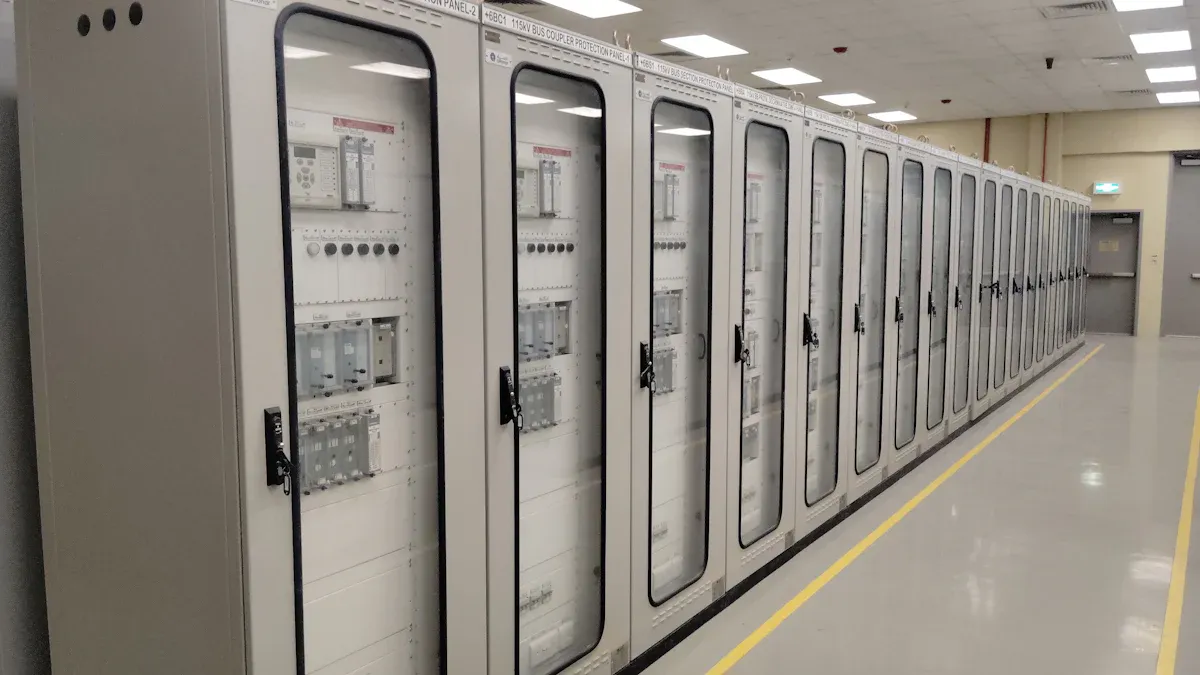
Capacitor Banks
Capacitor banks are the most important part of apfc cabinets. These banks store and give out reactive power to help your system. This helps your system reach the right power factor. Each apfc cabinet uses different sizes and numbers of capacitors. For example, a 600 KVAR apfc cabinet might use 25, 50, and 75 KVAR units together. Bigger apfc cabinets, like 1000 KVAR, use more and larger capacitors. The table below shows how each rating uses different capacitor values:
KVAR Rating | Capacitor Values |
|---|---|
600 KVAR | 25, 25, 50, 50, 75, 75, 75, 75, 75, 75 |
700 KVAR | 25, 25, 50, 75, 75, 75, 75, 75, 75, 75, 75 |
800 KVAR | 25, 25, 50, 75, 75, 75, 75, 100, 100, 100, 100 |
900 KVAR | 25, 25, 50, 50, 50, 100, 100, 100, 100, 100, 100, 100 |
1000 KVAR | 25, 50, 75, 75, 75, 100, 100, 100, 100, 100, 100, 100 |
You can see that the number of capacitor units changes for each rating.
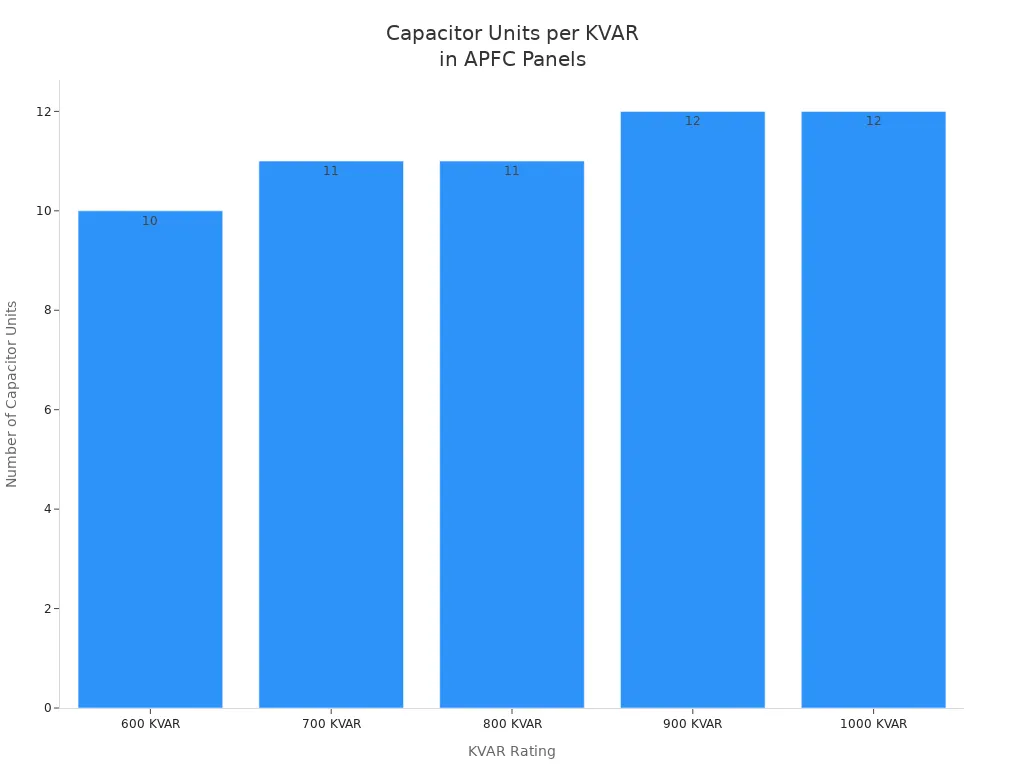
Most apfc cabinets use capacitors rated from 6kV to 35kV. They have step sizes like 100, 200, or 300 kVAr. This setup lets your apfc cabinets change quickly when loads go up or down.
Controllers and Relays
Controllers are like the brains of apfc cabinets. They get data from sensors and decide when to turn capacitors on or off. Relays work with controllers to connect or disconnect the right capacitor banks. This teamwork keeps your power factor close to the goal. You do not need to do anything because the controller does it all in real time. The table below shows the main parts and what they do:
Component | Function |
|---|---|
Capacitor box | Stores reactive power and turns on to improve power factor. |
Controller | Uses data to control capacitors for real-time changes. |
Relays | Connects or disconnects capacitors when the load changes. |
Circuit Breakers | Protects the system from problems like faults and overloads. |
Switching Devices
Switching devices help you control power fast and safely in apfc cabinets. Many apfc cabinets use thyristors, which are special switches with no moving parts. These devices can connect or disconnect capacitors in just milliseconds. Thyristors last longer and need less care because they do not wear out. They also work quietly, so your workspace is not noisy. Here are some main advantages:
Advantage | Description |
|---|---|
Speed | Thyristors connect and disconnect capacitors almost instantly. |
Durability | No moving parts means less damage and longer life. |
Maintenance | Thyristor systems need less fixing, so costs are lower. |
Silent Operation | Thyristors are quiet, making work areas nicer. |
Improved Voltage Regulation | Good control of reactive power keeps voltage steady and stops overheating. |
Extended Equipment Life | Steady voltage helps machines work better and break less. |
Sensors and Protection
Sensors in apfc cabinets check your system’s power factor all the time. They send this information to the controller, which decides if your system needs help. Protection devices keep your apfc cabinets safe from too much power or faults. They make sure your system works even if there are power surges. The process goes like this:
Step | Description |
|---|---|
Monitoring | Sensors check the power factor of the system. |
Analysis | The controller looks at the data and sees if the power factor needs fixing. |
Capacitor Activation | If needed, certain capacitors turn on to give reactive power. |
Real-Time Adjustment | The system keeps changing itself to keep the power factor good, even if energy use changes. |
Tip: Good sensors and protection devices in apfc cabinets help you avoid expensive downtime and keep your equipment safe.
Benefits of Automatic Power Factor Correction
Efficiency and Cost Savings
You can make your facility use energy better with an automatic power factor controller. When your power factor is good, your system needs less current for the same work. This means you waste less energy and pay less for electricity. For example, a steel plant in India saved 15% on energy bills after using a power factor controller. You also do not get penalties from utility companies for a lagging power factor. The table below shows how a power factor controller helps you save money and follow rules:
Benefit | Description |
|---|---|
Improves Power Factor and Reduces Penalties | Watches and fixes power factor right away, so you do not pay extra charges. |
Cuts Down on Electricity Bills | Controls reactive power, so your monthly costs go down. |
Protects Equipment and Enhances System Life | Lowers heat and voltage drops, so equipment lasts longer. |
Meets Utility and Regulatory Requirements | Keeps your power factor in the right range, so you avoid fines. |
Supports Uninterrupted Operations | Makes changes by itself, so you do not have to check the system. |
Improved Power Quality
A power factor controller does more than just save money. It also makes your power better. When your power factor is close to 1, you lose less energy in wires and keep voltage steady. This means your machines work better and use energy well. The table below shows how much you can lower line losses by improving your power factor:
Power Factor Improvement | Line Losses Without PFC | Line Losses With PFC (0.95+) |
|---|---|---|
0.1 | 8–12% | 2–4% |
You will see less voltage drop and fewer problems with your equipment. A power factor controller also lowers harmonics and keeps voltage steady. This means your system works smoother and can handle more load without new upgrades.
Your electrical system works better
Voltage stays steady
You can use more machines at once
You lose less power in the system
Tip: Keeping a good power factor helps your system stay safe and reliable.
Equipment Longevity
When you use a power factor controller, your equipment lasts longer. A high power factor means your machines do not get too hot or break down fast. You spend less money fixing or replacing them. Power factor correction lowers stress on your devices and cuts maintenance costs. You also avoid problems like low voltage and too much heat. Some people saw their systems work 18% better after installing a power factor controller.
Spend less on repairs
Stop equipment from breaking early
Lose up to 30% less energy
Make your electrical devices last longer
You get a system you can trust and save money over time.
You can make your building use energy better with automatic power factor correction. APFC panels watch and fix your power factor. This helps you save money and keeps your equipment safe. Here are the main points:
Key Takeaways | Description |
|---|---|
Enhanced Efficiency | APFC panels fix lagging power factor and keep voltage steady. |
Cost Reduction | You do not get extra charges and your bills go down. |
Equipment Performance | Good voltage means less heat and fewer times you need repairs. |
Smart Integration | APFC panels can work with energy systems for more control. |
Many people say APFC panels help lower electric bills and make equipment last longer. As smart tech gets better, APFC panels will be even more important for energy use in the future.
FAQ
What does an apfc panel do in your electrical system?
You use an APFC panel to keep your power factor close to 1. The panel adds or removes capacitors automatically. This helps you save energy and avoid extra charges from your utility company.
Why should you choose an apfc panel over manual correction?
You get faster and more accurate results with an apfc panel. The panel works by itself and does not need you to check or switch anything. This means you avoid mistakes and keep your system running smoothly.
Can an apfc panel help lower your electricity bill?
Yes, you can lower your electricity bill with an apfc panel. The panel reduces wasted energy and helps you avoid penalties for low power factor. Many businesses see big savings after installing one.
How do you know if you need an apfc panel?
You may need an apfc panel if your power factor drops below 0.9 or you get penalty charges. If your equipment uses lots of motors or you see high energy bills, an apfc panel can help you fix these problems.
Is it hard to install or maintain an apfc panel?
You will find that most apfc panel systems are easy to install. Maintenance is simple because the panel works automatically. You only need to check the system sometimes to make sure everything runs well.