


Air insulated switchgear, often abbreviated as AIS, is a form of power-distribution equipment in which air is used as the main insulating medium around primary live parts. It brings together switching, protection, isolation, measurement, control, and interlocking functions so an electrical network can be operated as a coordinated system. The term does not identify a single cabinet, voltage rating, or circuit configuration. AIS may be arranged for incoming supply, outgoing feeders, transformer protection, bus sections, metering, or ring-network duty, depending on the project design. Buyers should also distinguish conventional ambient-air construction from sealed dry-air assemblies.
Why insulation is central to the definition
Electric power equipment must keep energized conductors separated from grounded metalwork and other conductors at the required voltage. In conventional AIS, the needed separation is achieved through air clearances, solid-insulation parts where necessary, enclosure design, and coordinated component construction. The actual dimensions and insulation performance are engineering matters tied to the equipment’s voltage class, duty, environment, and applicable requirements.
Air insulated switchgear should therefore never be described as simply “open equipment.” Many AIS systems use metal enclosures, compartments, shutters, barriers, and controlled access to support operation and maintenance. Access to primary components remains subject to the equipment design, approved isolation procedures, and authorized working conditions.
The insulation medium must also be distinguished from the current-interruption technology. An air-insulated assembly can use a vacuum circuit breaker: air provides insulation around relevant primary parts, while the breaker interrupts current inside its vacuum interrupters. These functions describe different parts of the equipment design.
Core functions inside an AIS line-up
Function | Typical equipment involved | Purpose in the distribution system |
|---|---|---|
Switching and interruption | Circuit breaker, load switch, or switching device | Connects, carries, and interrupts current under conditions for which the equipment is rated. |
Protection | Relays, sensors, instrument transformers, fuses where applicable | Detects defined abnormal conditions and initiates the required protective action. |
Isolation and earthing | Disconnecting and earthing functions | Supports controlled isolation and grounding for approved service activities. |
Distribution | Busbars, feeder terminations, cable compartments | Routes incoming power to outgoing circuits in the approved system arrangement. |
Control and information | Control circuits, indicators, meters, communications | Provides command, status, alarms, measurements, and remote interfaces where specified. |
These functions must be selected as a whole. A protection relay does not create protection by itself; it needs correct instrument-transformer inputs, settings, trip circuits, breaker capability, a coordination study, and commissioning tests. Similarly, a disconnecting function is part of an approved isolation process. This system perspective helps buyers avoid specifications that list components without defining how they must work together.
Switching devices also have different duties. A load switch should not be assumed to provide the fault-interruption capability of a circuit breaker. Confirm how each feeder is protected and which device performs the required interruption under the specified abnormal conditions.
Common AIS constructions
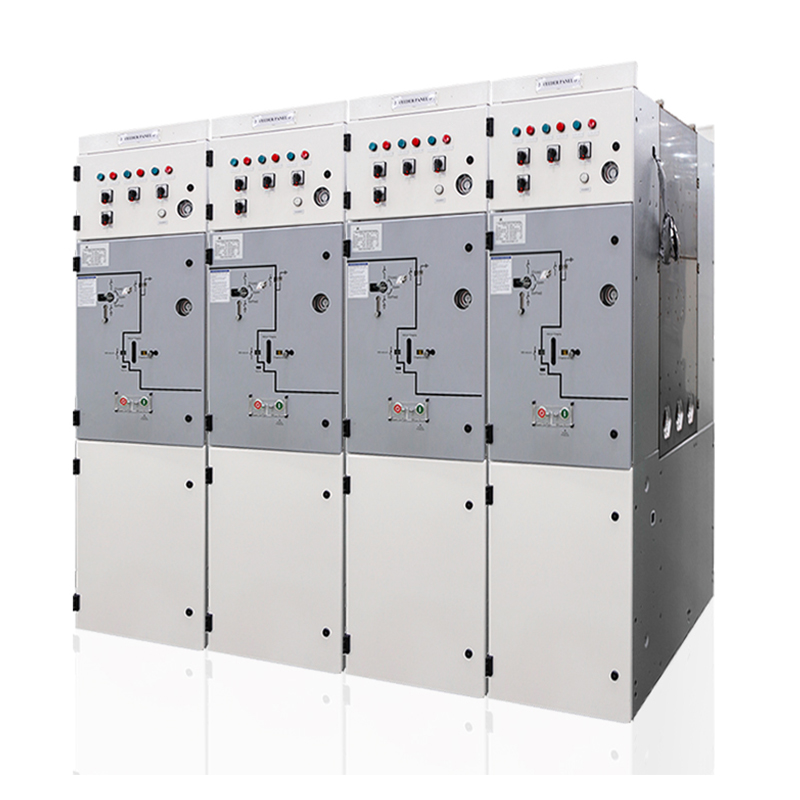
Air insulated switchgear can appear as fixed or withdrawable assemblies, metal-enclosed or metal-clad constructions, feeder panels, incomer panels, bus couplers, and ring-main-unit systems. These terms describe different aspects of an assembly and can overlap. The vocabulary matters because the physical construction changes service access, compartment separation, cable arrangement, interruption technology, and the type of work permitted under controlled conditions.
Zhejiang Zhegui Electric Co., Ltd. offers medium-voltage equipment in several distribution structures. A specific ring-network example is its SF6-Free Air-Insulated Switchgear for 12 kV systems. This product uses a sealed dry-air or nitrogen insulation arrangement, so it should be distinguished from conventional ambient-air panels when assessing clearances, environmental exposure, and internal service access.
A compact product is not automatically an AIS product, and an AIS product is not automatically an open-yard arrangement. Identify the actual insulating medium, enclosure structure, and switching functions before assigning a product to an equipment category.
Where AIS fits—and where the question needs more detail
AIS can be suitable for substations, industrial facilities, commercial buildings, infrastructure sites, and utility distribution where the required footprint, clearances, enclosure, and maintenance arrangements are feasible. This is a starting point, not an installation approval. A building with abundant room may favour an accessible conventional AIS line-up; a highly constrained urban site may require a different equipment architecture. Severe pollution, humidity, salt exposure, or restricted service access can also change the result.
For comparison, a Gas-Insulated Ring Main Unit uses a sealed SF6 insulation system. It can perform distribution switching and protection functions while using a different primary insulation arrangement. Compare equivalent feeder duties, installed dimensions, service requirements, and lifecycle responsibilities before choosing between the technologies.
Buyers should avoid asking only “Is AIS suitable for my application?” A stronger question is: “Can this AIS configuration meet our electrical duty, physical envelope, environmental conditions, access plan, and lifecycle responsibilities?” That wording turns a generic product question into an engineering decision.
What to specify before buying
Provide the voltage class and frequency, rated current, required short-circuit and interruption duty, grounding method, single-line diagram, feeder and transformer details, protection and metering requirements, cable data, enclosure and environment, arrangement drawings, communication needs, testing, documentation, spare parts, and expected expansion. Also identify the target market’s applicable requirements and the party responsible for final system coordination.
These details let the manufacturer make a meaningful proposal and let the buyer compare alternatives fairly. They also expose project decisions that cannot be resolved by choosing a model name: whether the installation needs a withdrawable breaker, what isolation sequence is required, how much service space is available, and what condition monitoring or remote-control functions are justified.
If the specification requires an SF6-free option, a Solid-Insulated Ring Main Unit represents another insulation approach for evaluation. Solid-insulated equipment is a separate category and should not be called AIS merely because it avoids SF6. Assess its ratings, interfaces, protection arrangement, and maintenance requirements against the same project specification.
Request supporting documents for the exact assembly offered. A general product-family description does not establish the ratings, test performance, extension compatibility, or installation conditions of every configuration within that family.
Conclusion
Air insulated switchgear is a coordinated distribution assembly that uses air as its principal insulation medium around relevant primary equipment. Its value comes from a suitable combination of electrical duty, construction, layout, environment, protection, and maintenance planning. Buyers should distinguish insulation technology from interruption technology and identify whether the proposed equipment uses conventional ambient-air or sealed construction. Zhejiang Zhegui Electric Co., Ltd. manufactures low- and medium-voltage distribution equipment. The right AIS selection begins with the project’s system requirements, then confirms the compatible product structure, interfaces, and supporting documentation.
FAQs
What does AIS stand for in switchgear?
AIS stands for air insulated switchgear, referring to equipment that uses air as the main insulating medium around relevant primary live parts. Confirm the actual construction when a compact product uses a sealed dry-air arrangement.
Is AIS the same as medium-voltage switchgear?
No. AIS identifies an insulation approach. Medium-voltage switchgear is a broader category that includes different insulation technologies and equipment constructions.
Does AIS include protection relays?
It can include protection and control systems, but the exact relays, sensors, settings, and communications depend on the project specification. Effective protection also requires compatible interruption capability, trip circuits, coordination, and testing.
Can AIS be installed outdoors?
Some configurations may be designed for outdoor service, but enclosure, environment, ratings, access, and installation requirements must be verified for the specific design.
Why do AIS layouts need clearances?
Electrical clearances form part of the insulation design, while operating and maintenance spaces support access and service activities. The required distances depend on the equipment construction and applicable project requirements.