


In the complex landscape of industrial power distribution, engineering decisions often boil down to a single, critical conflict: the trade-off between initial Capital Expenditure (CapEx) and long-term Operational Expenditure (OpEx). Fixed installations offer immediate savings during construction, but they demand total system shutdowns for routine maintenance — a luxury most African manufacturing plants, mines, and data centers simply cannot afford.
This is where withdrawable switchgear fundamentally changes the equation. It is not merely a circuit breaker on wheels — it is a chassis-based system engineered for zero-downtime environments. Unlike fixed counterparts, these systems allow physical isolation and safe extraction of active components without de-energizing the main busbar. Maintenance shifts from reactive shutdowns to proactive, continuous operations.
This guide explores the engineering mechanics, the hidden SCADA implications, the true cost picture, and the safety trade-offs versus fixed systems — so you can decide whether the premium for withdrawable technology aligns with your operational goals.
Key Takeaways
- Operational continuity: Withdrawable units allow maintenance on individual circuits without de-energizing the main busbar — cutting MTTR from hours to minutes.
- Unique test function: Test secondary control circuits while primary power is mechanically disconnected — impossible with fixed designs.
- Cost reality: Higher upfront CapEx and increased SCADA I/O are offset by long-term flexibility and reduced downtime costs.
- Safety protocol: Relies on visible breakpoints and interlocks — requires strict closed-door operation to mitigate arc flash risk during racking.
- Africa fit: Plants with unstable grids, costly shutdowns, or remote sites (mines, cement, oil & gas) recover the CapEx premium within 18–24 months.
Engineering Mechanics: How Withdrawable Switchgear Functions
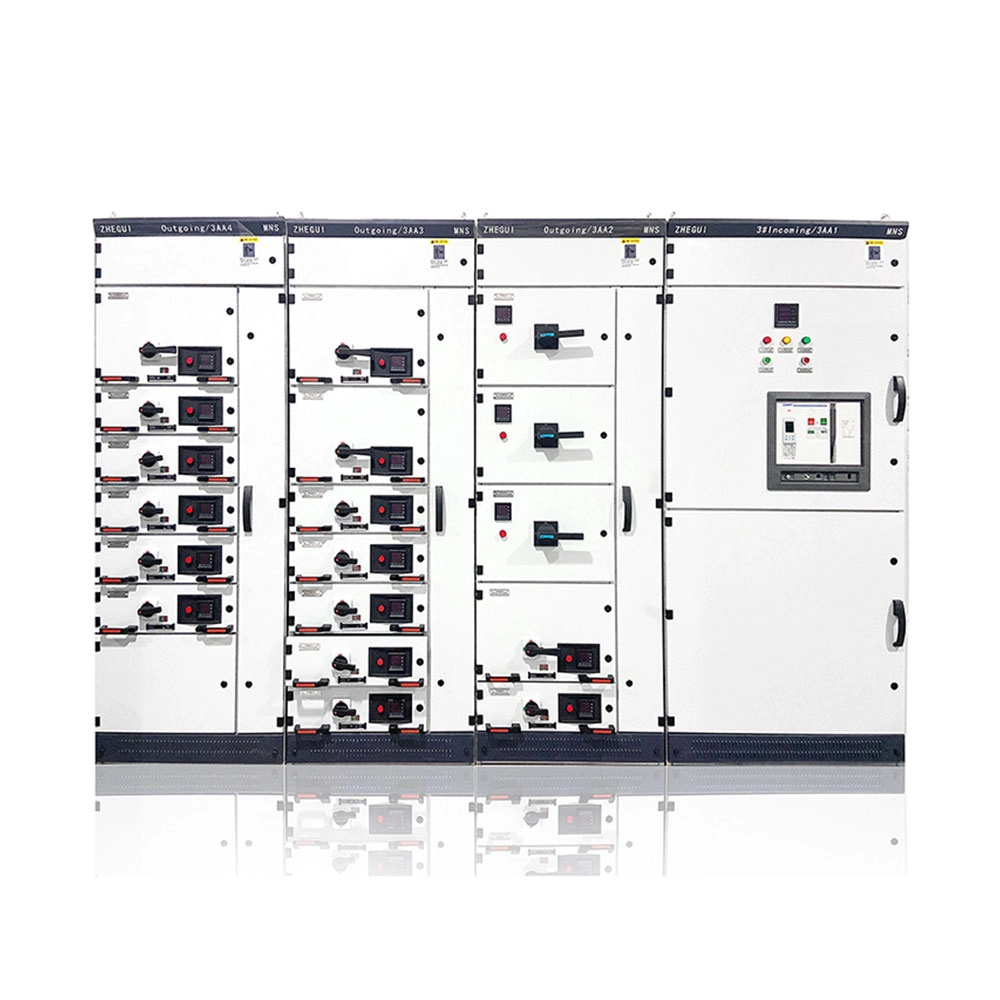
To fully appreciate the value of this technology, we must look inside the enclosure. The defining characteristic of withdrawable switchgear is its two-part architecture: a fixed frame (the cradle) connects to the busbar and cables, while a moving part (the truck or cassette) holds the circuit breaker and auxiliary components. This separation allows the active unit to move while the enclosure remains static.
The Chassis and Cradle Architecture
The truck mechanism rides on precision rails within the chassis, using telescopic rails or a worm-gear racking mechanism to move the breaker in and out of contact with the primary power stabs. This movement is not arbitrary — it follows a strict mechanical logic designed to ensure operator safety and system integrity.
- Fixed cradle: permanently bolted to the frame, carries busbar & cable connections
- Withdrawable truck: houses the breaker, moves on rails between Service/Test/Isolated positions
- Automatic shutters: drop down to cover live contacts the moment the truck is withdrawn
The Three-Position Logic
The core engineering advantage lies in the three distinct positions the breaker can occupy within the chassis. Understanding these positions is crucial for safe operation:
| Position | Main Power | Auxiliary Circuit | Typical Use |
|---|---|---|---|
| Service | Connected | Connected | Normal operation, carrying load |
| Test | Disconnected (air gap) | Connected | Testing relays & logic without HV exposure |
| Isolated | Disconnected | Disconnected | Extraction, inspection, maintenance |
The No-Isolator Advantage
A distinct engineering benefit of this architecture is the elimination of upstream isolation switches. In fixed switchgear, a separate Disconnecting Switch is legally and technically required to ensure safety before a breaker can be serviced. Withdrawable units integrate this function directly into their mechanics.
The act of racking out the breaker creates the necessary isolation distance. Shutters automatically drop to cover the live busbar contacts, creating an IP2X or higher barrier. This integral isolation simplifies the single-line diagram and reduces panel component count.
Four Mechanical Wins Built Into Every Cassette
Fixed vs. Withdrawable Switchgear: A Decision Framework
Choosing between fixed and withdrawable is rarely about one being "better." It is about matching equipment to the criticality of the application. The framework below highlights the technical differences that drive the decision.
| Feature | Fixed Switchgear | Withdrawable Switchgear |
|---|---|---|
| Isolation Method | Requires separate upstream isolator | Integral via racking mechanism |
| Maintenance Impact | Often requires busbar shutdown | Hot-swap; busbar stays live |
| Space & Density | Lower density (needs isolator clearance) | Up to 36 modules per MCC column |
| Replacement Time | 2–6 hours (with shutdown) | 10–15 minutes |
| Initial CapEx | Lower (~60–70%) | Higher (premium for chassis) |
| Long-term OpEx | Higher (downtime cost) | Lower (continuous operation) |
| Best Fit | Commercial, low-criticality loads | Mines, data centers, process plants, hospitals |
The Isolation Gap
Fixed systems rely on a separate component to guarantee safety. If a fixed breaker fails, technicians must open the upstream isolator. In many compact designs, this isolator shares a compartment with the busbar — forcing total shutdown of that bus section. Withdrawable switchgear solves this by allowing the faulty unit to be physically removed while the rest of the board hums along uninterrupted.
The Old Way: Fixed Switchgear
Every breaker fault becomes a bus-section shutdown. The whole plant feels it.
- Requires upstream isolator + dedicated clearance
- 2–6 hours downtime per breaker swap
- No test position — must energize to verify relays
- Lower density: ~12 feeders per column
The Smart Way: Withdrawable
Faulty unit out, spare unit in — busbar never sees a moment of darkness.
- Integral isolation — racking out IS the isolator
- 10–15 minute cassette swap, busbar live
- Test position validates relays safely
- Higher density: up to 36 modules per MCC column
Space and Density
Counterintuitively, withdrawable systems often achieve higher power density. Fixed systems need physical space for technicians to access tools and unbolt busbars. Withdrawable units, utilizing a plug-and-play chassis, can be stacked vertically (e.g., up to 36 modules per MCC column) because front access is inherently easier.
Maintenance Intensity Scenarios
Scenario A — Fixed application: A commercial office building. Power is critical, but maintenance can occur at night. A "fit and forget" approach works. The lower cost of fixed breakers makes sense because the cost of a planned shutdown is negligible.
Scenario B — Withdrawable application: A copper smelter in Zambia, or a Nigerian Tier-III data center. The cost of stopping a process line for one hour often exceeds the price of the switchgear itself. The ability to swap a cassette in 15 minutes justifies the premium many times over.
How a Cassette Swap Works — In 15 Minutes
Here is the exact field workflow our African commissioning team trains plant technicians on. Every step is designed to keep the operator outside the arc-flash boundary while the upstream busbar remains live.
Before we switched to withdrawable MCC, every kiln breaker fault meant a 6-hour line stop. Now the spare cassette goes in during the next planned micro-shutdown. We sleep better. Plant Electrical Manager, Ogun State Cement Producer, Nigeria
Get the Withdrawable Switchgear Spec Sheet (PDF)
Full IEC 61439-compliant technical data, dimensional drawings, and ratings up to 6300A — ready to drop into your tender package.
The Business Case: TCO, ROI, and Hidden Costs
While the operational benefits are clear, the financial implications require scrutiny. The Total Cost of Ownership (TCO) calculation involves balancing the CapEx premium against operational flexibility.
The Empty-Cradle & Deferred Investment Play
Withdrawable systems carry a higher initial price tag due to mechanical complexity. However, smart investors use the spare unit strategy: install empty chassis (cradles) during the initial build — a low-cost item — then purchase active breaker units only as load demand materializes years later.
This defers a significant portion of the capital investment and gives you instant capacity for future expansion without disrupting the energized board.
Furthermore, keeping one spare breaker module on the shelf provides an insurance policy for the entire facility. If a feeder trips and the breaker fails, maintenance teams plug in the spare immediately, restoring power while the faulty unit is repaired on a bench. This plug-and-play capability is impossible with fixed types.
Hidden Cost: SCADA and I/O Points
There is a technical caveat often missed during procurement: automation cost. A fixed breaker might send only three signals to the PLC: Open, Closed, Trip.
A withdrawable unit, conversely, generates a flood of status data. The SCADA must know if the breaker is in Service, Test, or Disconnected position; it monitors earthing switch status and spring readiness. This dramatically increases I/O point count on your PLC or DCS — budget accordingly for additional automation hardware and programming hours.
Safety, Compliance, and Operational Risks
Safety is the paramount argument for withdrawable technology, but it introduces specific risks operators must manage.
Visual Separation: The Built-In Safety Net
Electrical safety relies heavily on certainty. When an operator racks out a withdrawable unit, they see a physical gap. The breaker is visibly removed from the panel. This visual separation provides a psychological and physical assurance that no software indicator can match — it confirms the circuit is dead before anyone touches a tool.
Arc Flash Risks: The Skeptical View
We must acknowledge the risk profile of moving parts. The highest risk of an arc flash often occurs during the connection or disconnection of power contacts — exactly the action of racking in. If alignment is poor or insulation is compromised, the movement can trigger a fault.
Mechanical Reliability
Complexity brings failure points. A fixed breaker is bolted down; it does not move. A withdrawable unit relies on shutters, rails, grease, and mechanical interlocks. If rails bend or grease hardens, the unit can jam. Regular maintenance of the chassis mechanism — not just the electrical contacts — is vital to ensure the system works when needed.
Our Withdrawable Switchgear & Companion Products
Browse the full Giant Electric range engineered for African industrial loads — every unit IEC 61439 verified and ready for OEM/ODM branding.
GCS / GCK Withdrawable Switchgear
Up to 6300A · IEC 61439-2 · ABB / Schneider / GE breakers
View product → GGD Fixed-Type LV Switchgear
Up to 3150A · IEC439 / GB7251 · cost-optimised for commercial loads
View product → XL-21 Power Distribution Board
380V/660V · up to 630A · for industrial & civil buildings
View product → KYN28 12/24kV Metal-Clad Switchgear
Armoured withdrawable MV · 4 sealed compartments · CNC steel
View product → SVG Static Var Generator
IGBT-based reactive power · flicker elimination · industrial grids
View product → 12kV SF6 Ring Main Unit
Sealed stainless casing · IP67 · maintenance-free for urban grids
View product →One Manufacturer, Every Switchgear You Need
From LV distribution to MV metal-clad — single source, single QC standard, single container shipment.
From the Field: Nigerian Cement Plant Saves $180K/Year
A 1,500 TPD cement producer replaced fixed LV switchgear with Giant Electric withdrawable MCC panels
Previously, every kiln drive breaker fault meant a 6-hour line shutdown — averaging $30K in lost production per incident. After commissioning IEC 61439-compliant withdrawable MCC in 2024, cassette swaps now take under 20 minutes during planned micro-stops.
Giant Electric GCS / GCK Withdrawable LV Switchgear
IEC 61439-2 verified · Up to 6300A main bus · Form 4b separation · Tested at KEMA-equivalent labs
Procurement Checklist: Evaluating Manufacturers
When sourcing withdrawable switchgear — especially from overseas suppliers — verify these mechanical and electrical characteristics before issuing the PO. Click each item to tick it off:
Pre-Purchase Verification Save & Print
- Interlock RobustnessIt must be physically impossible to rack the breaker in if contacts are closed, or open the door while the breaker is not in Isolated position.
- Standard ComplianceDesign verification per IEC 61439-1/2 (LV) or IEC 62271-200 (MV), with documented internal arc containment test reports.
- Busbar FlexibilityFor high-redundancy sites, confirm the system supports double busbar configurations (single breaker switchable between two bus sources).
- Replacement SpeedConduct a time-and-motion test: a trained technician should swap a faulty cassette for a spare in under 15 minutes.
- Shutter MechanismInsulated shutters (not just metal) covering busbar contacts when the breaker is withdrawn — verify IP2X minimum on the dead front.
- Spare Parts PipelineManufacturer commits in writing to 10+ year spare cassette availability. Get part numbers and lead times in the quotation.
- African Climate RatingSpecify dust (IP54 minimum for cement/mining sites), humidity (anti-condensation heaters), and temperature derating curves up to 50°C ambient.
- Local Support & SparesConfirm response time for technical support and whether a regional stock or service partner exists in your country.
Not sure which configuration fits your load profile?
Send us your single-line diagram. Our engineers reply with a verified spec and budget price within 12 working hours.
Conclusion: When the Premium Pays For Itself
Withdrawable switchgear represents the industry standard for critical power continuity. While it introduces higher complexity and upfront cost, it offers unparalleled flexibility in maintenance and operation. The ability to isolate, test, and replace units without total shutdown serves as a vital insurance policy for modern industrial processes.
For non-critical commercial loads where overnight shutdowns are acceptable, fixed switchgear remains a valid, cost-effective choice. However, for data centers, mines, cement plants, refineries, and critical infrastructure across Africa, the investment in withdrawable technology is not just about convenience — it is a strategic requirement for operational resilience.