


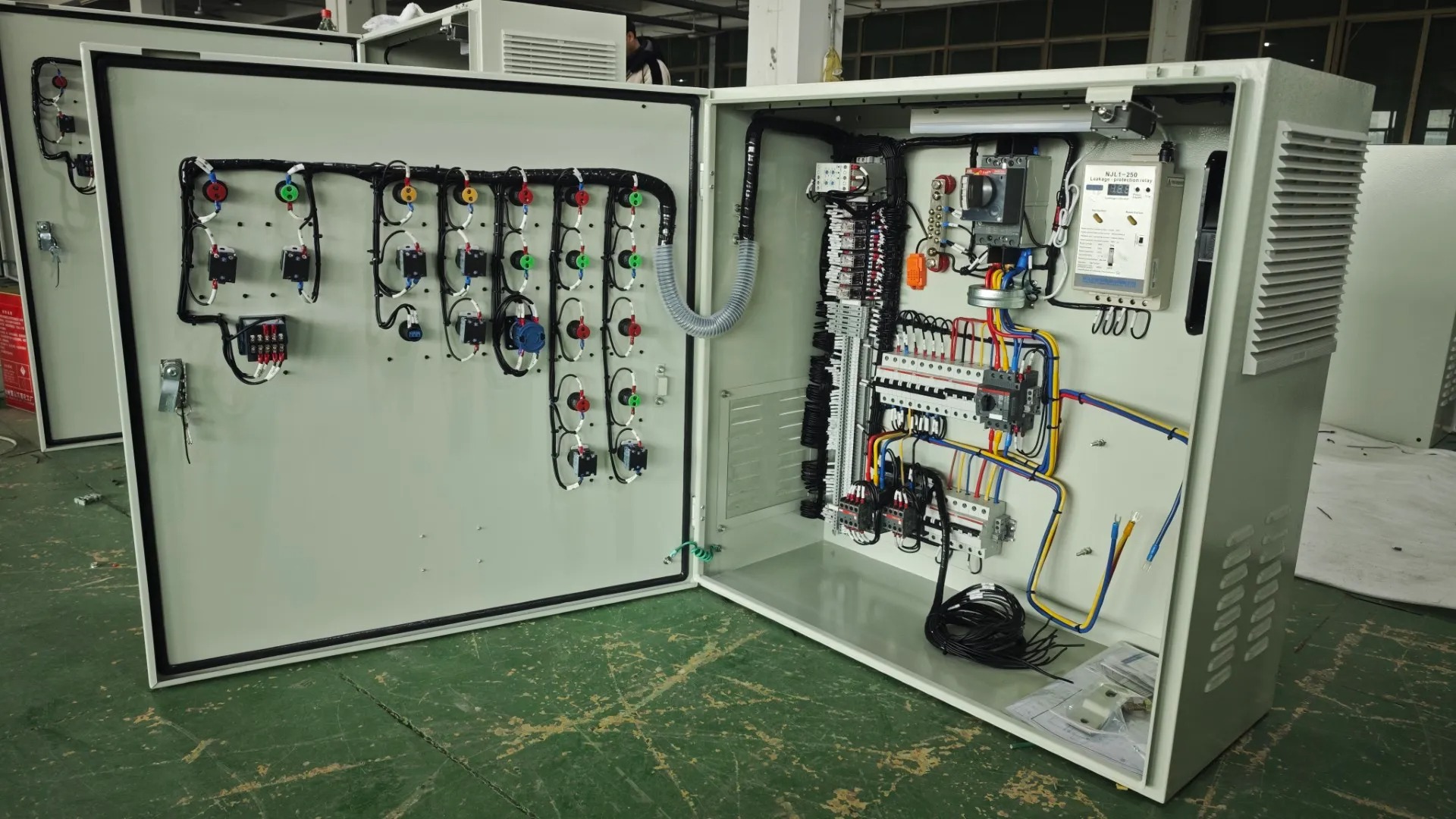
A power distribution board, or distribution board, can have equal breaker counts and still carry very unequal phase currents.
Start with measured demand, and test proposed circuit moves against the site's changing workload.
What Would You Change in This Board?
Consider an illustrative board supplying single-phase circuits from three phases. During a steady operating period, the readings show 46 A, 34 A, and 25 A.
The busiest phase carries almost twice the current of the lightest phase. Yet the board has the same number of outgoing breakers on each phase.
The circuit schedule identifies an 11 A load on L1. Moving that circuit to L3 appears to produce a much closer balance.
Allocation | L1 | L2 | L3 | Highest phase current |
|---|---|---|---|---|
Existing arrangement | 46 A | 34 A | 25 A | 46 A |
Proposed 11 A move | 35 A | 34 A | 36 A | 36 A |
This arithmetic assumes stable loads with similar power factors and current waveforms. It illustrates phase allocation rather than a complete electrical design.
The result looks promising because the highest phase current falls by 10 A. However, the table leaves two questions unanswered. Does that load stay at 11 A during important operating periods? Can its complete circuit move without disrupting protection or other equipment?
Effective power distribution board load balancing answers both questions before changing connections.
Replace the Snapshot with an Operating Picture
Single-phase load balancing needs more than one current reading. A single reading describes one moment, not the whole installation. Heating, cleaning, production, and charging loads can peak at different times.
Build a circuit schedule that connects each load with its operating pattern. Record the current phase, equipment served, measured demand, protective device, and expected hours of use.
Mark circuits with changing connected equipment, such as socket outlets. Their future demand may differ from the load present during the survey.
Use qualified personnel and an approved measurement method for the site. Where loads vary, log currents over representative operating periods instead of collecting unrelated spot readings.
The record should identify the production state alongside the electrical data. Otherwise, a later comparison may mistake a quieter shift for successful balancing.
Useful survey evidence includes phase currents, neutral current, and relevant voltage readings. Do not assume that a breaker marked 32 A carries 32 A. Its rating concerns protection, while measured demand describes how the connected load operates.
Test the Move Against a Second Operating Period
Return to the example, but now consider the evening shift. Suppose the board then carries 30 A on L1, 28 A on L2, and 36 A on L3.
The proposed circuit draws only 4 A during that period. Moving it produces 26 A, 28 A, and 40 A respectively.
Operating period | Existing L1 / L2 / L3 | After the proposed move | What changed? |
|---|---|---|---|
Daytime steady load | 46 / 34 / 25 A | 35 / 34 / 36 A | Lower peak and closer balance |
Evening steady load | 30 / 28 / 36 A | 26 / 28 / 40 A | Higher evening peak |
The daytime improvement remains real, but it does not tell the whole story. The move increases the evening load on the phase that already carries the most current.
Whether that tradeoff is acceptable depends on capacity and operating priorities. If L3 lacks sufficient evening capacity, the proposed move needs revision.
The designer could investigate a different circuit, several smaller moves, or a revised load schedule. The objective is an acceptable distribution across relevant conditions, not perfect equality in one photograph.
Tip: Compare proposed allocations during the periods that stress the board, rather than choosing the neatest single set of readings.
Keep the number of proposed changes manageable. A small, justified change can be easier to verify than a broad rearrangement based on uncertain demand.
Check What Travels with the Circuit
Its Neutral and Protective Arrangement
A circuit includes more than its phase connection. Check neutral routing, residual-current protection, isolation arrangements, and any linked conductors.
Crossing neutrals between different residual-current devices can cause unwanted operation and undermine the intended arrangement. The phase and neutral must remain within the correct sensing and connection scheme.
Its Controls and Supply Dependencies
Some equipment shares control circuits or depends on a particular supply relationship. Moving one connection without tracing those dependencies can create unexpected operating behaviour.
Check alternative supply operation where the board connects to a generator or transfer system. Phase loading under that source may impose different constraints.
Why Better Phase Balance May Leave Neutral Current High
Balanced linear loads can cancel their fundamental currents in the neutral. Unequal phase loading leaves a residual fundamental current, so redistribution can reduce that component.Single-phase electronic loads can behave differently because their current waveforms contain harmonics. Some triplen components add in the neutral even when phase RMS readings are similar.
Therefore, equal phase readings do not establish acceptable neutral loading. Measure the neutral separately, especially where electronic equipment forms a large part of the load.
If neutral current remains high after a justified phase change, investigate its components. Repeatedly moving circuits without waveform information may achieve little further improvement.
Make the Change Measurable and Keep It Useful
Once the designer approves an allocation, prepare the work and verification plan. Qualified personnel should establish safe isolation before altering connections.
Use the approved circuit schedule during the change, and update labels immediately. Complete the required checks before restoring the board to service.
Then repeat measurements under comparable operating conditions. Compare the important phase peaks, neutral current, and any relevant protection behaviour.
The acceptance record should explain what improved and what remains limited. A change that reduces one peak may still require monitoring during another operating period.
Conclusion
Balance actual demand across operating periods, and verify each circuit's neutral, protection, and supply dependencies before moving it.
Share your power distribution board schedule with Giantele to discuss an arrangement based on the loads you expect to operate.
FAQ
Q: Can equal breaker counts balance a power distribution board?
A: A power distribution board needs phase allocation based on actual circuit demand. Equal breaker counts can hide large differences in current and operating hours.
Q: Must a power distribution board always show identical phase currents?
A: A power distribution board needs acceptable loading throughout its intended operation. Identical readings at one moment do not establish a suitable allocation across changing loads.
Q: Does phase balancing reduce the total connected load?
A: Phase balancing redistributes demand between supply phases. It does not remove the connected equipment or automatically reduce its operating energy use.
Q: Why measure neutral current after moving circuits?
A: Neutral current can include both imbalance and harmonic components. Improved phase readings may leave significant harmonic loading that still needs assessment.