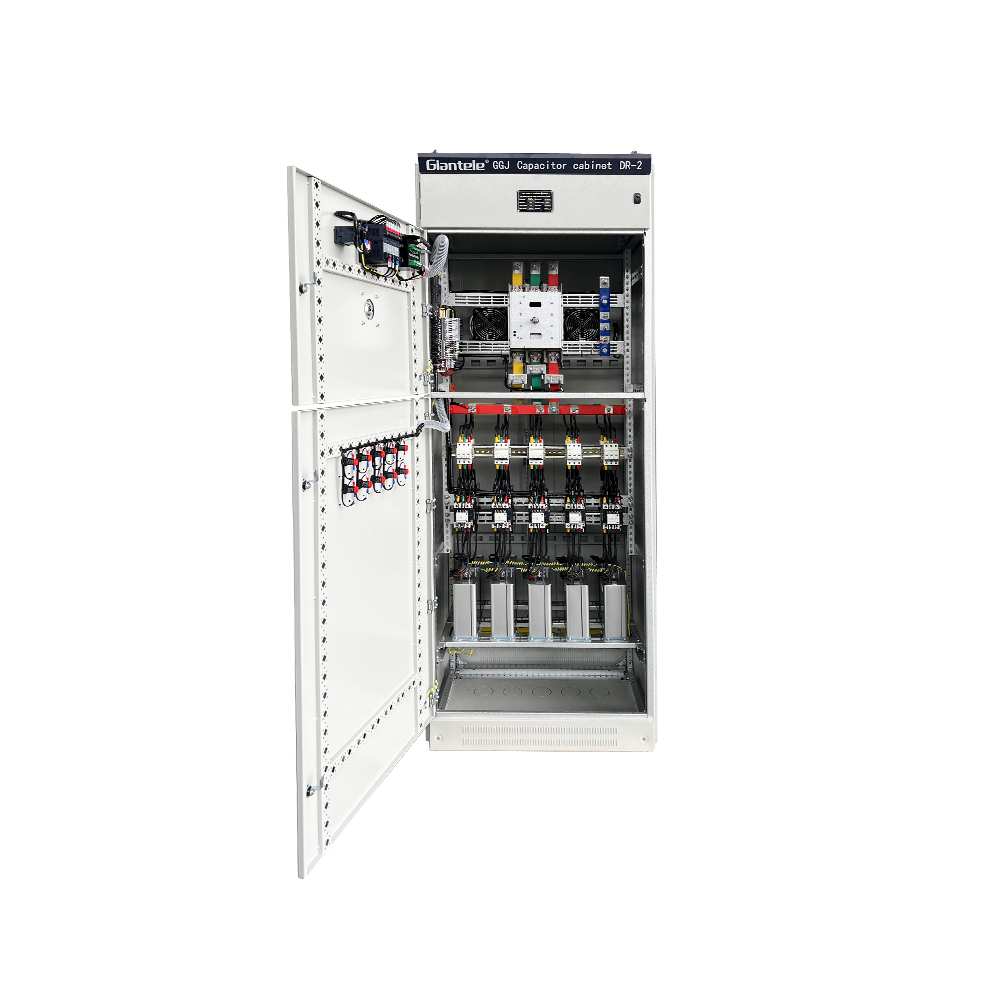


50kVAR to 1000kVAR from a single panel. Multiple panels in parallel for loads above 1000kVAR. Standard voltages: 380V, 400V, 480V, 690V. Custom voltages available. IP54 powder-coated enclosure standard. Detuning reactors optional for sites with THD above 10 percent. CE certified, IEC 61921 compliant. Lead time 4 to 6 weeks for standard configurations.
Most sites see full payback in 12 to 18 months. The math: take your monthly PF penalty and divide it into the panel cost. A factory paying $2,000 per month in PF penalties saves $24,000 per year. A panel costing $18,000 pays back in 9 months. After that, pure savings. Plus you free up transformer capacity and reduce cable losses — both are real money.
A power factor correction capacitor bank with automatic staged switching wins for any site where loads vary during the day — factories, commercial buildings, water treatment. A fixed capacitor bank for power factor correction costs less upfront but overcorrects at light load and undercorrects at full load. If your utility penalizes leading PF, a fixed bank causes more problems than it solves.
Six to twelve stages is standard for a power factor capacitor bank in industrial service. More stages mean finer correction — less hunting, less overcorrection, longer contactor life. Capacitor banks for power factor correction work best when the smallest stage is no larger than 25 percent of the total kVAR rating. That way the controller can hit any load point without overshooting.
A standalone capacitor bank supplies fixed reactive power. It corrects PF at one load point but overcorrects at light load. A pfc capacitor bank inside an APFC panel does the same job under automatic control — the controller reads real-time PF and engages only the stages it needs. Fixed correction is cheap upfront. Automatic correction saves more over time.
Understanding what is apfc panel is step one — it is not just a box of capacitors and contactors. A proper apfc panel manufacturer tests every stage individually, provides IEC 61921 compliance reports, and builds with low-loss polypropylene film capacitors rated for 180,000 hours. Visit the factory. Ask for serial-numbered build records. If they hesitate on either, keep looking.
An apfc panel monitors your power factor in real time and switches capacitor banks automatically to keep it above 0.95. The controller reads voltage and current, decides which capacitor stages to engage, and heavy-duty contactors do the switching. When you work with a reliable apfc panel supplier, you get the IEC 61921 test report, compliance certificate, and factory calibration records with every panel shipped.


Your electricity bill has a line item most people ignore. Power factor penalty. If your power factor sits below 0.85, the utility charges 20 to 30 percent extra. Every month. An power factor correction panel eliminates that charge. It pays for itself in 12 to 18 months. After that, it prints money.
An apfc panel is an automatic power factor correction panel. Here is what is apfc panel in plain terms: a cabinet with a controller, contactors, and capacitor banks that watches your electrical network in real time and switches in exactly the reactive power your loads need. No human intervention, no manual switching, no guesswork.
Induction motors, transformers, fluorescent lighting ballasts — all draw reactive power. That reactive power does zero useful work but still travels through your cables and transformers. The utility meters it anyway and charges you for it. Capacitor banks for power factor correction supply reactive power locally at your main distribution board, so the utility never sees the lag. Your meter spins slower. Your bill shrinks.
A well-designed APFC panel tracks power factor continuously. It engages capacitor stages when PF drops below 0.95 and disengages them when it rises. Most sites with induction loads see PF numbers between 0.70 and 0.80 without correction. That means you are paying roughly 25 percent more per kWh than you need to. Every month the panel runs, you recover some of the purchase price.
Let us put numbers on it. A factory in Lagos runs induction motors totaling 500kW. Power factor sits at 0.72. Monthly electricity bill: $12,000. The penalty portion — roughly 25 percent — is $3,000. Install a 300kVAR pfc capacitor bank at the main board. PF jumps to 0.96. Penalty drops to near zero. Annual saving: $36,000. Panel cost: around $18,000 installed. Payback: six months.
Most sites take 12 to 18 months. Faster if your utility charges steep penalties. Slower if your PF is already above 0.85. But the math is always the same — a power factor correction capacitor bank returns its cost faster than any other electrical upgrade you can make. No plant shutdown required. No production downtime.
Open the door and you see four clear zones. First, the controller — it reads voltage and current on all three phases, calculates real-time PF, and decides which stages to call. Second, the contactor array — heavy-duty switching devices, each one handling a single capacitor stage. Third, the capacitor bank — low-loss polypropylene film capacitors with built-in discharge resistors. Fourth, the busbar and cabling — tinned copper, torque-checked, with thermal imaging verification.
A power factor capacitor bank inside an APFC panel is not just a pile of capacitors. Each stage is individually fused. Each contactor has pre-charge resistors to damp in-rush current. The controller uses a PID algorithm to avoid hunting — switching stages on and off rapidly would wear out contactors fast. Good controllers switch smoothly and hold steady.
Fixed capacitor banks were the old way. One set of capacitors permanently connected. They correct PF at full load but cause overcorrection at light load. Overcorrection pushes PF above 1.0 — leading power factor — which is just as bad as lagging. Some utilities penalize leading PF too.
A capacitor bank for power factor correction with automatic staged switching solves this. Six to twelve stages, each a fraction of the total kVAR. At light load the controller uses one or two stages. At full load it uses all of them. PF stays between 0.95 and 0.99 regardless of what the factory is doing. No hunting. No overcorrection. No wasted contactor life.
For bonus points, staggered switching spreads thermal load across contactors. Stage one is not always the first to engage. The controller cycles through them. That is how a panel runs 250,000 operations without replacing a contactor.
Small site with one 200kW motor? A 100kVAR panel does the job. Medium factory with 500kW of induction load? 300kVAR to 400kVAR. Large plant with 1500kW? A 1000kVAR panel or two smaller panels in parallel. The rule of thumb is 0.5 to 0.7 kVAR per kW of motor load. But rules of thumb are guesses. Send us your single-line diagram and we will do the proper calculation.
Voltage matters too. 380V, 400V, 480V, 690V — we build for all of them. The IEC 61921 standard covers power factor correction capacitors rated up to 1000V. Every panel we ship carries an IEC 61921 compliance declaration. Ask for the test report before you order. A supplier who cannot produce one is not testing their panels.
Any site with multiple induction motors benefits from automatic correction. Factories with production lines running 24/7 see the fastest payback. Commercial buildings with HVAC chillers and water pumps save from month one. Water treatment plants with large pump motors are perfect candidates — constant loads, poor PF, high bills.
The one place an APFC panel does less good: sites where loads change every few seconds. Welding shops, crane operations, mining hoists — loads that swing from zero to full and back in under a second. The contactors cannot keep up. For those sites, talk to us about a static var generator instead. No moving parts, responds in microseconds.
Power factor correction and harmonics are related problems. Variable frequency drives, UPS systems, and LED lighting create harmonic currents that overheat capacitors. If your total harmonic distortion (THD) exceeds 10 percent, standard capacitor banks will fail early. Capacitors and harmonics do not get along — the capacitors act as low-impedance paths for harmonic currents and burn out.
The fix is an active harmonic filter combined with detuned capacitor banks. The filter cancels harmonics before they reach the capacitors. The detuned reactor shifts the resonance point away from common harmonic frequencies. It costs more upfront but saves you from replacing fried capacitors every six months.
If your site has both poor PF and high harmonics, solve them together. An APFC panel with 7 percent detuning reactors handles THD up to 20 percent. Above that, an active harmonic filter plus a standard APFC panel is the better split. Per the IEEE 519 standard, harmonic mitigation is part of responsible electrical design — not an optional extra.
Not every factory that slaps a controller and some capacitors in a box makes a proper panel. A real apfc panel manufacturer tests every stage individually before assembly. Controller calibration check. Capacitor capacitance and dissipation factor measurement. Contactor pull-in and drop-out voltage test. Then a full system test — all stages cycling under load, PF verified at multiple load points, thermal scan of every busbar joint.
Ours is a 20,000 m² factory with 200 people. ISO 9001 quality management through every step. Each panel gets a unique serial number. We keep build records for 10 years. If you call us five years later needing a replacement capacitor for panel APFC-2026-0037, we know exactly which one was installed and where to send it.
The International Electrotechnical Commission publishes IEC 61921 as the governing standard. We build to it. We test to it. We ship the compliance report with the panel. Not a photocopy — the original test data from the batch your panel came from.
Choosing an apfc panel supplier is not complicated if you know what to check. Do they test each panel before shipping? Ask for the test report. Do they build to IEC 61921? Ask for the compliance certificate. How fast do they deliver? Standard panels should ship in 4 to 6 weeks from a factory with buffer stock. What about after-sales? You want a supplier who can diagnose a panel over WhatsApp, not one who goes silent after the invoice is paid.
Export experience matters. A supplier shipping APFC panels to 50-plus countries has seen every compliance requirement and every shipping challenge. They know which documents your customs office needs. They pack for container transport, not local truck delivery. They respond to emails within 24 hours, not 72. These things sound small until you are stuck in port clearance with a panel that cannot leave the dock.
A real apfc panel supplier invites you to visit. 20,000 square meters, 200 people, panels in various stages of assembly — you can walk the floor and see how yours gets built. If a supplier dodges the factory visit question, that tells you everything you need to know. Get in touch for a technical proposal. We respond within 48 hours with sizing, pricing, and lead time for your specific application.
