


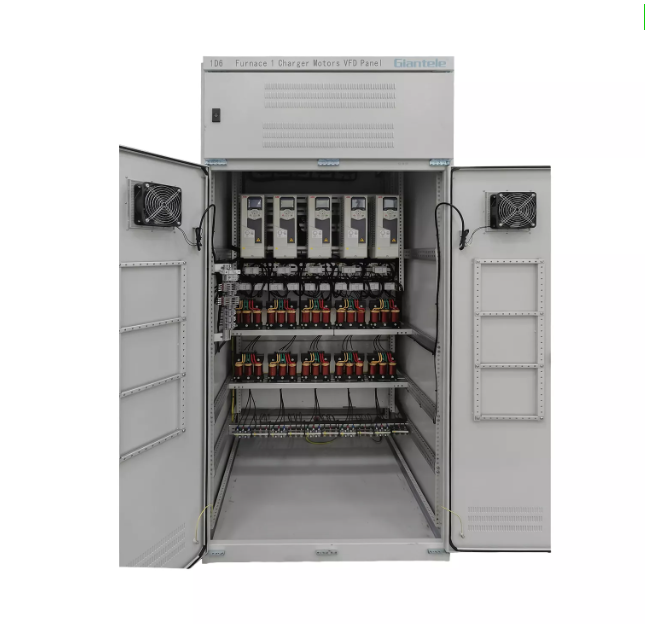
VFD Control Panel is a motor control panel used for controlling the speed of a motor, motor protection, and stable motor operation. It is also known as VFD Panel because it encloses the drive along with other electrical components into a single panel.
Not all motor systems require to operate at full capacity all the time. Pumps, fans, conveyors, and other machine tools need different operating speeds. The VFD Control Panel makes sure that the motor can adjust according to the requirements so that energy can be conserved.
For an electrical project, a VFD Control Panel not only encloses an AC Drive, but it also protects the drive, provides control logic, indicates operational status, and adds safety features.
Giant Electric specializes in offering reliable electrical products for power distribution and control applications.

A Variable Frequency Drive Control Panel refers to a panel that is composed of a variable frequency drive in an electrical box together with its protection, controls, wiring, displays, and operation components.
The primary role of the Variable Frequency Drive Control Panel is easy to understand. The control panel controls the speed of the motor by varying its frequency and voltage.
An individual VFD unit is just the drive unit, which controls speed. However, it does not always provide a total field solution.
A VFD Control Panel consists of both the VFD and the control panel. It may incorporate circuit protection, switches, gauges, alarms, cooling units, and communication units.
Therefore, buyers are getting more than just a variable drive unit; they get a full motor control system.
Item | Standalone VFD | VFD Control Panel |
|---|---|---|
Main function | Controls motor speed | Controls motor speed and supports system protection |
Structure | Drive unit only | Drive, cabinet, protection, wiring, controls, and display |
Protection level | Limited by the drive itself | Can include circuit breakers, fuses, relays, and enclosure protection |
Operation | Usually controlled from the drive keypad | Can use buttons, switches, indicators, meters, or automatic signals |
Best for | Simple motor speed control | Complete motor control projects with safety and monitoring needs |
The main purpose is motor speed control. The panel adjusts motor speed so equipment can follow process demand.
For example, a pump can slow down during low water demand. A fan can reduce speed when less airflow is needed. A conveyor can match production speed more accurately.
The enclosure protects internal electrical parts. It keeps dust, moisture, heat, and accidental touch away from the drive.
This matters because many work sites are humid, dusty, or busy. A good drive cabinet also makes wiring cleaner and operation safer.
Input power enters the panel first. Protection devices manage electrical safety. Then the VFD changes the power output.
The motor receives controlled voltage and frequency, so it runs at the required speed. Operators can adjust speed through buttons, switches, a keypad, or automatic signals.
VFD panels usually control three-phase AC motors. These motors appear in pumps, fans, compressors, conveyors, mixers, and production machines.
The panel can serve one motor or several motors. The final design depends on load type, control method, and site conditions.

The VFD is the core component. It controls motor speed by changing frequency and voltage.
The drive must match the motor data, including power, voltage, current, frequency, and load type. If the drive is poorly matched, the system may trip or run badly.
A VFD Control Panel usually includes a circuit breaker. It helps protect the circuit from short circuit or overload.
The panel may also include fuses, relays, surge protection, and motor protection parts. These parts help reduce damage during abnormal conditions.
Sometimes the front door may include buttons, switches, lights, meters or even keypads. The above components help operators manage the equipment.
Speed, current, frequency, operating condition and alarm status can be shown using displays. This makes the inspection process easier.
Some panels need more functions. They may use PLC control, bypass control, communication modules, line reactors, filters, cooling fans, or heaters.
A bypass can keep the system running when the drive needs service. A PLC can support automatic control.
Component | Main Role | Why It Matters |
|---|---|---|
Variable Frequency Drive | Adjusts motor frequency and voltage | Controls motor speed based on real demand |
Circuit Breaker | Protects the circuit from overload or short circuit | Improves electrical safety |
Control Interface | Includes buttons, switches, lights, or keypad | Helps operators control and monitor the system |
Display or Meter | Shows speed, current, frequency, or alarms | Makes daily inspection easier |
Cooling Parts | Fans, filters, heaters, or ventilation parts | Helps prevent overheating |
PLC or Communication Module | Supports automatic or remote control | Useful for advanced control systems |

Direct motor starting runs the motor at fixed speed. But many systems need flexible speed control.
A VFD Control Panel adjusts the motor to actual demand. This is useful for pumps, fans, conveyors, and other variable-load systems.
A lot of energy is wasted by the motors when running at maximum speed despite not needing to. This problem can be addressed using a VFD panel.
As the speed decreases, energy usage will also decrease.
Direct starting can cause sudden shock. It may stress motors, belts, pumps, pipes, and connected machines.
A VFD Control Panel allows smooth acceleration and deceleration. The motor starts smoothly and stops smoothly.
Stable speed regulation improves the whole process. The panel can help maintain pressure, flow, airflow, or production speed.
This makes the system easier to manage because speed follows demand.
Pump control is one of the most common uses. A VFD Control Panel can manage water supply, pressure boosting, irrigation, wastewater, and drainage.
The panel changes pump speed based on flow or pressure needs. So, the pump does not need to run at full speed all the time.
Fan control also benefits from variable speed. HVAC systems need different airflow under different loads.
A VFD panel can control exhaust fans, cooling fans, ventilation fans, and air circulation systems.
Many machines need stable motor control. Examples include conveyors, compressors, mixers, machine tools, food machines, and production lines.
A VFD Control Panel helps these machines start smoothly and run at the right speed.
Some projects need one panel for one motor. Others need one panel for several motors.
A custom control cabinet can include manual control, automatic control, signal feedback, and remote monitoring.
A VFD Control Panel can protect motors from overload, abnormal current, and operating faults.
Protection devices help reduce damage when a fault happens. The VFD can also monitor motor current and respond to abnormal load.
The enclosed cabinet improves safety. It keeps live parts inside the panel and limits accidental contact.
Power isolation also helps during maintenance. Clear labels, grounding, indicators, and switches make the panel easier to operate.
Smooth speed control reduces stress on the motor and driven equipment. This helps protect pumps, fans, belts, and mechanical parts.
Because the system does not always run at full speed, wear may also decrease.
Operators need clear information. A VFD panel can show status, speed, current, frequency, and alarm signals.
This helps workers respond quickly when a problem appears. It also supports easier inspection and repair.
Start with motor data. Check power, voltage, current, frequency, phase, speed range, and load type.
The panel must match the motor and working load. A pump load may need a different setup from a conveyor load.
The environment affects the cabinet design. Check dust, humidity, heat, outdoor exposure, corrosion risk, and ventilation.
Indoor panels may need a simpler enclosure. Harsh sites may need stronger sealing, cooling, or anti-condensation design.
Some systems only need manual speed control. Others need automatic control through sensors or PLC signals.
You may also need remote monitoring, alarm feedback, communication ports, or bypass control.
A VFD Control Panel should use proper wiring, grounding, protection, and heat dissipation.
The design should also follow the project’s required electrical safety rules. For this definition article, specific market access rules do not need detailed explanation.
Selection Factor | What to Check | Design Impact |
|---|---|---|
Motor Data | Power, voltage, current, phase, frequency, and load type | Helps match the VFD and protection devices correctly |
Load Type | Pump, fan, conveyor, compressor, mixer, or machine | Affects speed range, control logic, and drive sizing |
Working Environment | Dust, humidity, heat, outdoor exposure, or corrosion risk | Determines enclosure, cooling, and sealing requirements |
Control Method | Manual control, sensor control, PLC control, or remote control | Affects buttons, wiring, communication, and automation design |
Safety Requirements | Grounding, protection, isolation, labels, and heat dissipation | Supports safer operation and maintenance |
Correct wiring is essential. Cables should follow the electrical drawing and connect to the right terminals.
Technicians should tighten terminals and check polarity. Good grounding helps reduce noise and supports safe operation.
VFDs produce heat during operation. So, the cabinet needs enough space and airflow.
Some panels need fans, filters, air conditioning, or heaters. Good cooling helps the drive work more reliably.
Before operation, the VFD needs correct parameters. These include motor current, voltage, frequency, speed range, acceleration time, and deceleration time.
After setting, technicians should test rotation direction and running status.
Final inspection helps avoid early faults. Check input voltage, protection devices, wiring, cabinet condition, and component fixing.
Then test alarms, indicators, and control signals. Run the motor at low speed first, and check for noise or vibration.
VFD Control Panel refers to an entire motor control unit that has a VFD, protective components, wiring, control elements, display elements, and protective enclosure.
The device controls motor speed, ensures safety, facilitates energy conservation, and provides equipment protection. The device proves ideal for such machines as pumps, fans, HVAC, conveyors, and industrial machinery.
Before purchasing a panel, determine the motor specifications, loading conditions, environmental conditions, control specifications, and protective specifications. In this way, you will help the supplier provide you with a proper VFD panel.
Giant Electric is an electric company providing reliable electrical solutions for practical power distribution and control purposes. If your project requires stable motor speed control, then a quality VFD Control Panel will do fine.
A: A VFD Panel houses a drive, protection, controls, and display.
A: A VFD Panel changes frequency and voltage to match demand.
A: A VFD Panel reduces shock, energy waste, and mechanical wear.
A: Usually yes, but savings and protection can offset cost.
A: Check motor data, wiring, grounding, heat, and parameter settings.


