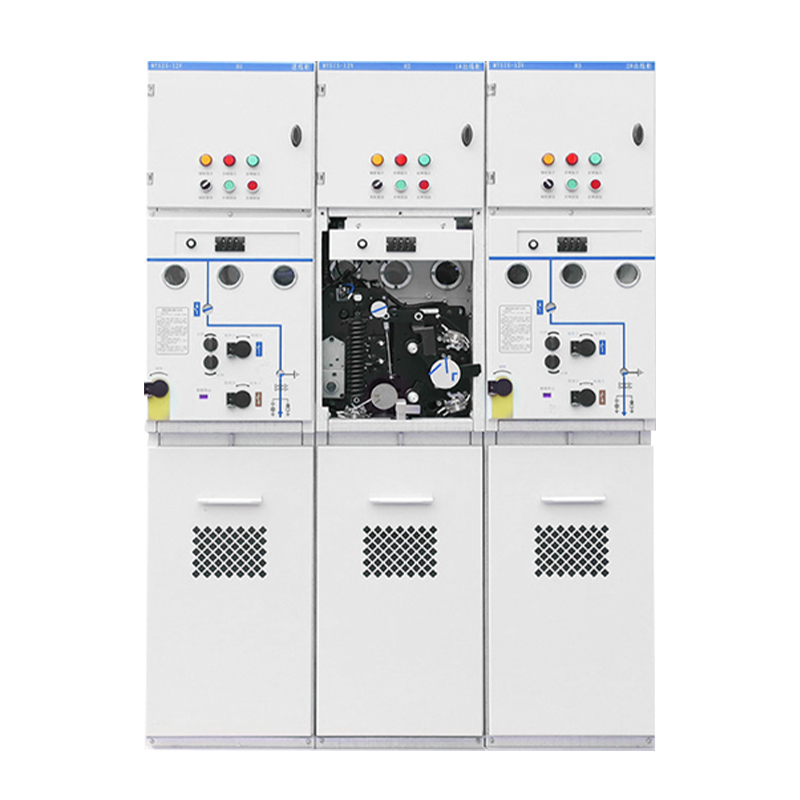
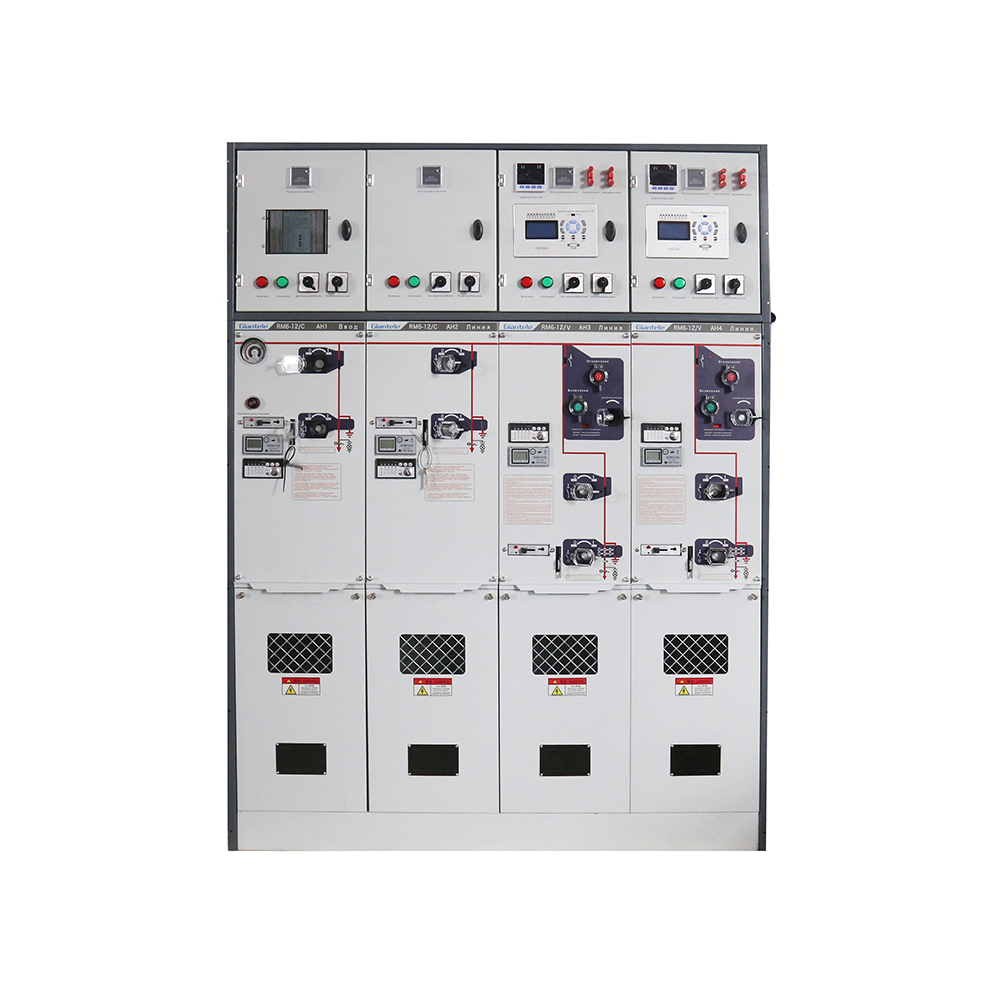
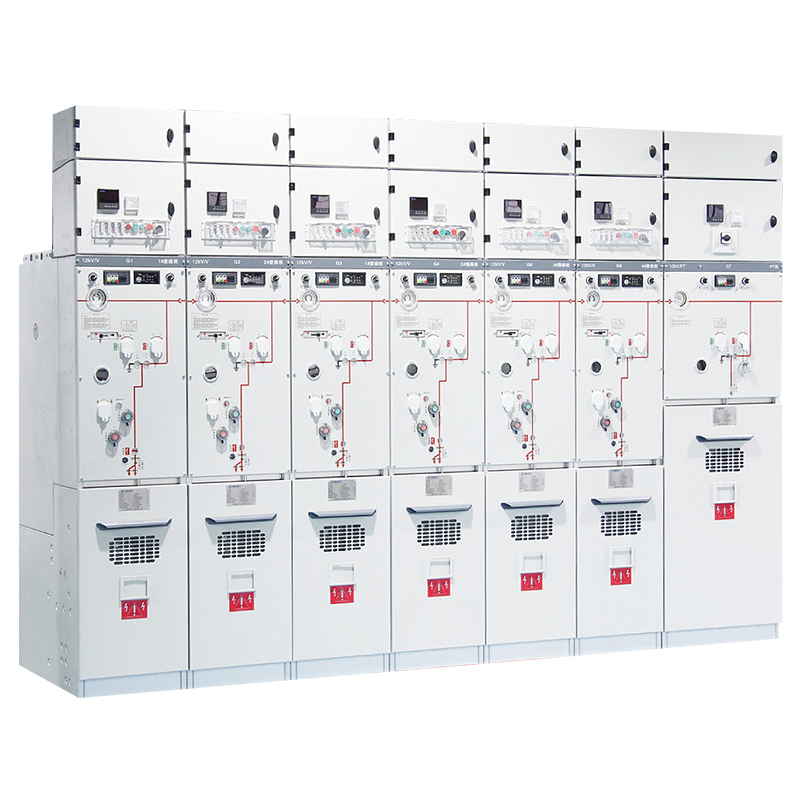
33kV Medium Voltage Switchgear — Metal Clad, RMU, Metal Enclosed and Air Insulated

33kV medium voltage switchgear distributes primary power between utility substations, wind and solar collector stations, and large industrial loads. Four types cover the range: metal clad switchgear with withdrawable vacuum breakers for utility-grade protection, ring main units for compact ring networks, metal enclosed switchgear for fixed low-cost panels, and air insulated ring main units where SF6 is not an option. Built on the 36kV/40.5kV equipment class, these panels carry 630A to 3150A with 25kA to 40kA short-circuit withstand, and they meet IEC 62271-200 segregation requirements for utility acceptance. Giant Electric builds all four types in one factory, for 33kV networks across the UK, the Middle East, Africa, and Southeast Asia.
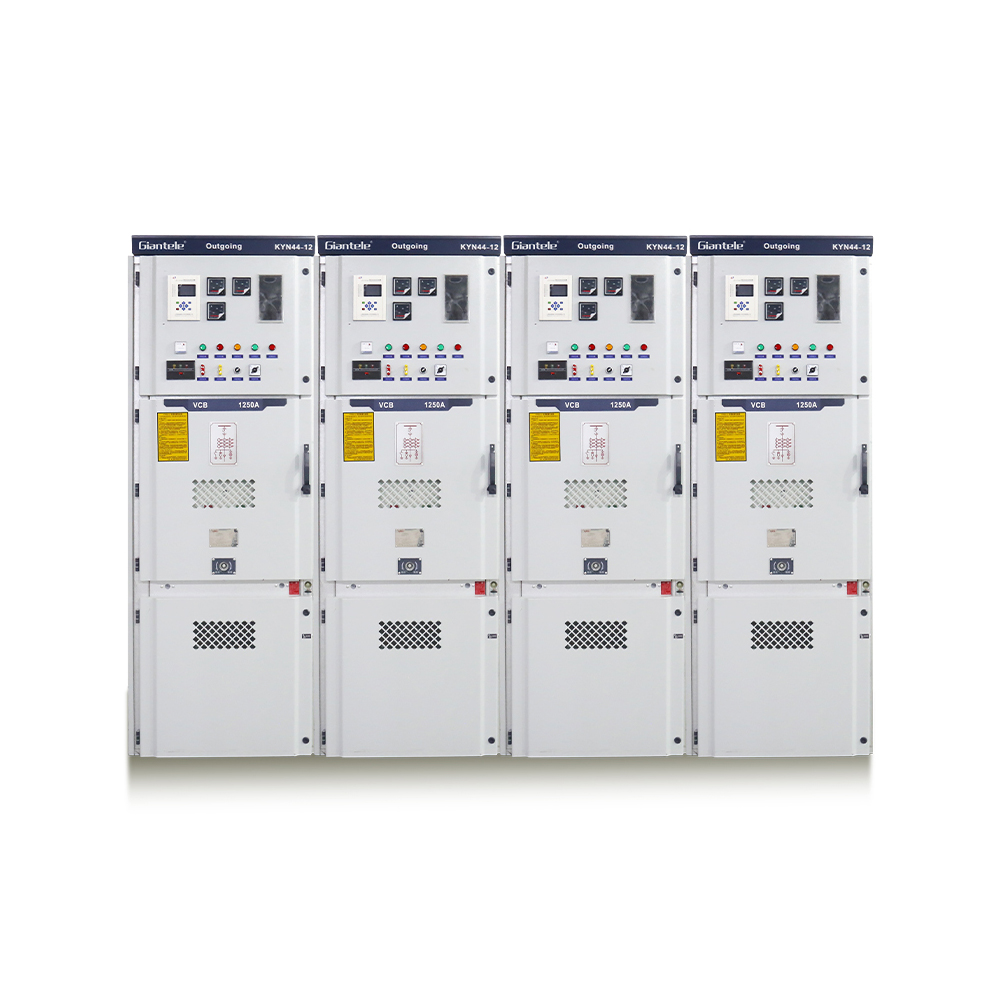
KYN28 metal clad switchgear — the 33kV workhorse

Metal clad switchgear is the backbone of 33kV primary distribution. Our KYN61 and KYN28 panels use withdrawable vacuum circuit breakers that roll out on guide rails, so operators inspect or swap a breaker in minutes without entering the busbar zone. IEC 62271-200 Form 3/4 segregation keeps busbar, breaker, and cable compartments in separate earthed partitions. Rated 630A to 3150A with 25kA to 40kA short-circuit withstand, this is the utility-grade choice for main incomers and feeders at substations, wind farm collector stations, and mine site primary feeders.

Ring main unit for 33kV ring networks

A ring main unit keeps 33kV loop networks simple. Two or three ways — load-break switches plus a fused or VCB way — sealed in SF6 for life and pad-mounted outdoors. It taps transformers off a live ring, links wind farm collector stations, and closes urban 33kV loops without building a full switchboard. 630A main busbar, 40kA short-time withstand, corrosion-treated enclosure for tropical and coastal sites.

XGN metal enclosed switchgear — fixed construction

Metal enclosed switchgear is the fixed-type panel for 33kV jobs where hot-swap is not required. XGN series construction is simpler than metal clad — no guide rails, no draw-out interlocks — which cuts cost by 20 to 30 percent while keeping the same breaker and busbar ratings. Load-break switches or vacuum circuit breakers, indoor installation, ideal for smaller substations and secondary 33kV nodes where maintenance means a scheduled outage.

Air insulated ring main unit — SF6 free

Air insulated ring main unit is the SF6-free answer for 33kV ring networks. HXGN series uses solid insulation and vacuum interrupters in air — same ring topology as a sealed RMU, no gas to report, no greenhouse potential. Built for EU and Australia projects, LEED-rated buildings, and coastal environments where salt air attacks conventional enclosures. 630A busbar, 40kA class, pad-mounted or indoor.

The 33kV equipment class: 40.5kV rated switchgear for primary distribution

Every 33kV network in this class runs on the 40.5kV equipment rating: 36kV and 40.5kV insulation levels, 630A to 3150A busbars, and 25kA to 40kA short-circuit withstand. The extra headroom is deliberate. A 40.5kV panel carries 185kV lightning impulse withstand and 75kV power-frequency withstand, with clearances and creepage distances sized for it. That is why 33kV gear is physically larger than 24kV panels. IEC 62271-200 lays down the segregation rules — Form 1 to Form 4 — that split busbar, breaker, and cable compartments with earthed partitions. Utility engineers check this before they check anything else. Buy from a factory that type-tests to the standard, not one that claims it on a brochure.

Four switchgear series cover 33kV primary distribution end to end

The lineup is straightforward. KYN28 metal clad switchgear carries the main incomers and feeders with withdrawable vacuum breakers. A sealed SF6 ring main unit handles ring taps and transformer points outdoors. XGN metal enclosed switchgear covers fixed panels at 20 to 30 percent lower cost. HXGN air insulated ring main units handle SF6-free sites. Utilities, renewable developers, EPC contractors, and mine operators all build from the same four series, out of one factory.
12kv Ring Main Unit Sf6 Gas Insulated Switchgear
The gas insulated switchgear powers reliable, automation-ready distribution for 12kV industrial and urban grid projects.This SF6 Ring Main Unit seals all live parts and switching devices inside a 3.0mm-thick stainless steel casing, achieving a lifetime maintenance-free design rated at IP67. Furthermore, this Medium Voltage Switchgear supports both fixed and expandable unit combinations, offering exceptional flexibility for substations with limited space or demanding environmental conditions.
View More
12kv 24kv Metal Clad Switchgear Metal Enclosed Switchgear
AC metal enclosed switchgear of the armored withdrawable type delivers reliable reception, distribution, control, and protection for three-phase AC 50Hz power systems. This medium voltage switchgear adopts an all-metal modular assembly structure with CNC-processed aluminum-zinc steel plates, achieving high precision, strong corrosion resistance, and lightweight construction. Furthermore, its four independently sealed compartments — bus chamber, circuit breaker chamber, cable chamber, and relay instrument chamber — give this metal clad switchgear exceptional safety and operational flexibility.
View More
12kv Sf6 Free Ring Main Unit Solid Insulated Switchgear Eco Friendly Environment Protection
The Ring Main Unit delivers a new generation of environmentally friendly power distribution for 12kV three-phase AC systems. This advanced solid insulated switchgear uses fully sealed epoxy resin encapsulation, eliminating SF6 gas entirely. As a result, this sf6 free rmu operates safely across extreme temperatures, coastal humidity, and high-altitude plateau environments. Furthermore, its modular architecture supports both indoor and outdoor deployment in a ring type distribution network, and is suitable for various application scenarios.
View More
12kV Sf6 Free Ring Main Unit Air Insulated Switchgear Eco Friendly Environment Protection
The air insulated switchgear (AIS) redefines eco-friendly power distribution for 12kV three-phase AC systems. This sf6 free switchgear replaces harmful greenhouse gases with zero-grade dry air or 99.99% pure nitrogen, achieving a material recycling rate exceeding 90%. Furthermore, this medium voltage switchgear design combines a compact footprint with strong environmental adaptability for both indoor and outdoor deployment. As a result, this ring main unit delivers maintenance-free, intelligent, and environmentally responsible distribution across a wide range of industrial and urban applications.
View More

Six details that separate a reliable 33kV panel

Open a 33kV panel and the story is in the details: how the cabinet is built, how the busbar is supported, how the breaker rolls out, how the load-break switch operates, how the cables terminate, and how the factory tests it. Below, six close-up views walk through each one, the way our engineers check them on the production line.

Why Giant Electric is the 33kV switchgear supplier to pick

Four series built in one factory, every panel routine-tested before it ships. Six reasons buyers come back for the next project, and the one after that.

IEC 62271-200 type-tested switchgear panels

Type tests at an accredited lab; reports ship with every panel.

Compact metal clad and RMU layout

Metal clad and RMU layouts sized for tight substation rooms without losing segregation.

Cost-effective fixed XGN switchgear panels

Fixed construction cuts cost by 20 to 30 percent with the same ratings.

IP54 rated for harsh sites

IP54 enclosures resist dust, humidity, and coastal salt air without upgrades.

Predictable lead times, six to eight weeks

Standard 33kV configs ship in six to eight weeks from order.

Full custom configuration for every project

Voltage, busbar, relays, protection, and branding configured from your single-line diagram.

OEM and ODM 33kV switchgear under your brand

We build 33kV switchgear to your spec and your nameplate. Your panel layouts, your relay selections, your cable terminations, your logo and colors. Multi-language documentation and region-specific compliance paperwork included. One project manager owns the job from design review to pre-shipment inspection — no handoffs. The photo shows our production floor; your order runs through the same bays.

ISO 9001 quality management on every 33kV panel

Our factory runs under an ISO 9001 quality management system. Incoming materials are checked against spec. Busbar, breakers, and enclosures move through documented process controls. Every weld, every torque setting, every interlock is recorded and traceable. Final routine testing happens on a dedicated high-voltage test bay, and the records stay on file for years. That system is why our panels behave the same way order after order.

IEC 62271-200 type-tested, ready for utility acceptance

Every 33kV panel we ship is designed to IEC 62271-200. Metal clad panels meet Form 3 or Form 4 segregation with earthed partitions between busbar, breaker, and cable compartments. Internal arc and short-circuit withstand are validated in type tests at accredited laboratories. Test reports and routine test certificates travel in the crate with the equipment, ready for your acceptance engineer.
bg
Catalog Download
Our company has nearly 60 million fixed assets, covering 20000 square meters.

Download →
bg
Service
OEM/ODM partner — engineering customization,
IEC-tested quality, full-lifecycle support.

View More →
MAKE AN ENQUIRY

Giant Electric, building 33kV switchgear since 2013

Giant Electric started in 2013 in Zhejiang, China, and grew into a 20,000 square meter factory with over 200 people. Medium voltage switchgear is our core business — metal clad panels, ring main units, and metal enclosed gear for 33kV networks. We ship to utilities, EPC contractors, and renewable developers across the Middle East, Africa, Southeast Asia, and the Commonwealth. Every order leaves with test reports and export paperwork in hand.

33kV switchgear for utility substations

Substation incomers and transformer feeders need switchgear that never gets in the way of the network. Our metal clad panels take the main 33kV bus with withdrawable vacuum breakers, Form 3/4 segregation, and protection relays wired for your scheme. Operators swap a breaker in minutes without touching the busbar. That is what utilities ask for when the outage window is measured in hours, not days.

33kV switchgear for wind and solar collector stations

A 50MW solar plant or a wind farm strings inverter and turbine groups onto 33kV collector lines that land at the substation. Ring main units tie each group into the ring, pad-mounted outdoors with corrosion-treated enclosures. The collector station itself runs a metal clad board with feeder protection. Both come out of our factory, matched to your single-line diagram.

Send your single-line diagram for a 33kV switchgear proposal

Send your single-line diagram, the fault level at the point of connection, and the ambient conditions. We reply within 48 hours with panel types, ratings, segregation forms, protection schemes, and pricing. Want to see the factory first? We will arrange it.
  • Why do 33kV panels cost more than 12kV panels?

    The 40.5kV equipment class needs larger clearances, longer creepage distances, and heavier busbar to carry 25kA to 40kA short-circuit. Withdrawable construction in metal clad switchgear adds precision parts and guide rails. That is why a 33kv switchgear panel typically costs 30-50 percent more than a 12kV equivalent.

  • What is ring main unit in a 33kV network?

    What is ring main unit? A ring main unit is a compact two- or three-way switchgear cabinet that taps a transformer off a live ring using load-break switches plus a fused or VCB way. At 33kV, RMUs sit pad-mounted outdoors at urban loops, wind farm collector stations, and solar string connection points.

  • Can 35kv switchgear be used for 33kV systems?

    Yes — 35kv switchgear and 33kv switchgear belong to the same 40.5kV equipment class. Panels rated 36kV or 40.5kV serve 33kV networks with margin for insulation. In compact outdoor applications, the same system also uses a ring main unit at transformer tap points, so a 33kV project frequently combines a 35kV-class switchboard with RMUs.

  • Is gis switchgear required for 33kV primary distribution?

    No — gis switchgear is one option, not a requirement. Many 33kV utility projects still use metal clad switchgear with air insulation indoors. The metal clad vs metal enclosed choice is separate from gas versus air: metal clad for withdrawable breakers, metal enclosed for fixed panels, and gis only when space or land cost forces a compact layout.

  • What is the difference between gas insulated switchgear and air insulated switchgear?

    Gas insulated switchgear seals busbar and breakers in SF6, shrinking the footprint by up to 60 percent — the standard for urban and indoor substations. Air insulated switchgear uses open clearance and solid insulation with vacuum interrupters, needs more room, but has no gas handling and suits coastal or LEED-tracked sites. For 33kV both are accepted at utility level.

  • Which is better, metal clad switchgear or metal enclosed switchgear?

    It depends on the substation role. Metal clad switchgear lets operators roll the vacuum breaker out on guide rails for inspection without touching the busbar. Metal enclosed switchgear keeps a simple fixed construction — cheaper and smaller, but the whole panel must be de-energized for breaker work. At 33kV, utility feeders normally spec metal clad.

  • What is 33kV switchgear used for?

    33kV switchgear handles primary distribution at utility substations, wind and solar collector stations, and large industrial plants. For indoor switchboards, buyers choose between metal clad switchgear, with withdrawable breakers and IEC 62271-200 Form 3/4 segregation, and metal enclosed switchgear, with fixed breakers at 20-30 percent lower cost.

Related Products

33kV MV Switchgear: Metal Clad, RMU, Enclosed, Air Insulated

What is 33kV switchgear?

33kV switchgear is medium voltage switchgear that controls and protects primary distribution circuits between utility substations, renewable collector stations, and large industrial loads. It carries 33kV system voltage on equipment rated for the 40.5kV class: 36kV and 40.5kV insulation levels, 630A to 3150A busbar ratings, and 25kA to 40kA short-circuit withstand. Four configurations cover most 33kV primary distribution jobs. Metal clad switchgear with withdrawable vacuum breakers is the utility standard. Ring main units handle compact loop networks. Metal enclosed switchgear covers fixed low-cost panels. Air insulated ring main units cover SF6-free sites. All four meet IEC 62271-200 compartmentalization — the first thing utility engineers check.

What types of 33kV switchgear are available?

Buyers on 33kV networks choose indoor or outdoor, withdrawable or fixed construction. Metal clad switchgear is the indoor workhorse — withdrawable vacuum breakers on guide rails, Form 3/4 segregation, used for main incomers and feeders at substations. A ring main unit seals two or three ways into one compact cabinet for loop or ring tee-offs, pad-mounted outdoors. Metal enclosed switchgear keeps construction simple and costs 20 to 30 percent less than metal clad. Air insulated ring main units swap SF6 for solid insulation and vacuum interrupters where gas is not welcome. Most 33kV projects use a mix: a metal clad switchboard plus ring main units at tap points.

Metal clad switchgear: the utility-grade workhorse at 33kV

Metal clad switchgear is the standard answer for 33kV primary distribution at utility substations and large industrial plants. Our KYN61 series covers the 40.5kV class, and the KYN28 family delivers the same withdrawable architecture at tighter budgets. Every panel separates busbar, breaker, and cable compartments with earthed metal partitions, meeting IEC 62271-200 Form 3 or Form 4 segregation per IEC 62271-200. The vacuum breaker rolls out on guide rails, so an operator inspects or replaces it in minutes without entering the busbar zone. Rated 630A to 3150A with 25kA to 40kA withstand, it covers incomers, feeders, and collector station duties.

Metal clad vs metal enclosed switchgear: what is the difference?

Buyers confuse these two because both are metal-boxed panels. The difference is internal segregation and breaker access. Metal clad switchgear uses earthed metal partitions between every live compartment and a withdrawable breaker — Form 3 or Form 4 under IEC 62271-200. Metal enclosed switchgear has a closed metal shell, but live parts share compartments and the breaker is fixed, not withdrawable. That simpler construction is why metal enclosed panels cost 20 to 30 percent less. The metal clad vs metal enclosed decision comes down to maintenance philosophy: do you need to swap breakers without de-energizing the busbar, or is a scheduled outage acceptable?

DimensionMetal Clad (KYN28 / KYN61)Metal Enclosed (XGN)
Breaker accessWithdrawable on guide railsFixed, bolted in place
Compartment separationEarthed partitions, Form 3/4Enclosure shell, Form 1/2 typical
Breaker swapMinutes, busbar stays livePanel de-energized first
Relative costPremium, utility reference20 to 30 percent lower
Typical roleSubstation incomers and feedersSecondary 33kV nodes, smaller substations

Gas insulated switchgear vs air insulated switchgear at 33kV

gas insulated switchgear seals the busbar, breaker, and disconnector inside SF6 at low pressure, shrinking a substation footprint by up to 60 percent — the default for urban sites and indoor substations where land costs money. air insulated switchgear uses open-air clearance and, in the HXGN-style RMU, solid insulation with vacuum interrupters — no gas at all. Air insulated panels are simpler to inspect, with no gas handling on site, at the cost of footprint. At 33kV, gis switchgear wins where space is scarce; air insulated wins on environmental rules, coastal sites, and maintenance budgets.

DimensionGas Insulated (SF6 RMU)Air Insulated (HXGN RMU)
Insulation mediumSF6 sealed for lifeSolid insulation plus air
FootprintCompact, up to 60 percent smallerLarger clearance required
MaintenanceNone on gas side, sealedVisual inspection, no gas handling
EnvironmentSF6 greenhouse gas, GWP 25200SF6-free, LEED-friendly
Best fitUrban, indoor, land-constrainedCoastal, humid, EU/Australia/LEED

What is ring main unit and where does it fit at 33kV?

What is ring main unit in practical terms? A ring main unit is a compact two- or three-way switchgear cabinet that connects a transformer to a live ring or loop network. Two load-break switches make or break the ring under load; the third way, fused or with a vacuum circuit breaker, protects the transformer. At 33kV it answers a simple question: how do you tap power from a live ring without building a full switchboard? RMUs sit pad-mounted outdoors, sealed for life in SF6 or built SF6-free with vacuum interrupters. They are the workhorse of urban 33kV loops and collector stations.

Ring main units for wind farm and solar collector stations

A 50MW solar plant runs one or more 33kV collector lines back to the grid substation. Each group of inverters lands on a ring main unit that ties into the collector ring. We spec RMUs by fault level first — 40kA short-time withstand — then by protection: fused ways up to about 1.25MVA, VCB ways above that. Sealed SF6 units run for decades in the field. Air insulated versions suit sites where SF6 reporting is a burden. Upgraded corrosion treatment on pad-mounted enclosures handles tropical and coastal collector stations.

35kV switchgear and the 40.5kV equipment rating

Internationally, buyers ask for 35kv switchgear and mean the same family as 33kV systems: the 40.5kV equipment class. The nameplate may say 36kV or 40.5kV; the network runs at 33kV. That margin is what gives engineers confidence — the 40.5kV class carries 185kV lightning impulse withstand and 75kV power-frequency withstand per IEC, with clearances, creepage distances, and busbar spacing sized for it. That is why 33kV panels are physically larger than 24kV gear. If you are quoted a 35kV panel, confirm the insulation level is the 40.5kV class and not a stretched 24kV design. Rating tables in IEC 62271-1 and IEEE guidance cover the rest.

How to choose between indoor metal clad and outdoor pad-mounted RMU?

Indoor metal clad and outdoor RMU are not competitors — they serve different points on the same network. Metal clad goes in the substation building or container where you need multiple feeders, protection relays, and breaker swap capability. The ring main unit goes at the load end: pad-mounted outdoors, no building, sealed against weather. Choose metal clad when you need feeder protection and relay coordination. Choose an RMU when you need a transformer tap point on a ring. Many 33kV projects order both together — a metal clad switchboard for the collector substation and ring main units at each turbine or inverter station. Confirm the outdoor RMU enclosure grade; coastal sites want upgraded corrosion treatment.

How we build and test 33kV switchgear at our factory

Inside our 20,000 square meter factory, every panel starts as CNC-folded steel plate, degreased and powder-coated before assembly. Busbar is high-conductivity copper, silver-plated at the joints, torqued to drawing values and torque-marked. Vacuum interrupters are batch-tested for contact travel and vacuum integrity before assembly. Every panel gets a full routine test: main circuit resistance, insulation resistance, 200 mechanical operations on the breaker, and an AC power-frequency withstand test. Test reports travel in the crate — that is what factory tested means here, not a sticker.

Why Giant Electric for 33kV primary distribution

Giant Electric has supplied 33kv switchgear to utility substations, wind farms, solar plants, and mine sites across the Middle East, Africa, Southeast Asia, and the Commonwealth. We build to the 40.5kV equipment class with IEC 62271-200 segregation, and we configure each order — voltage, busbar, protection relays, cable terminations, tropical treatment — from your single-line diagram. KYN28 and KYN61 metal clad panels, XGN metal enclosed panels, sealed SF6 ring main units, and air insulated ring main units come out of the same factory with the same test floor. Downstream of the 33kV/11kV or 33kV/0.4kV transformer, low voltage switchgear completes the chain. Export paperwork and third-party inspection support are included.

Send us your single-line diagram

Every 33kV project starts with a single-line diagram. Send yours with the fault level at the point of connection and the ambient conditions, and we reply with a technical proposal within 48 hours — panel types, ratings, segregation forms, protection schemes, and pricing. No guesswork.

MAKE AN ENQUIRY
We will work with other excellent partners to deliver more high-quality products to the world.

QUICK LINK

PRODUCT CATALOG

MAKE AN ENQUIRY

Copyright © Zhejiang Zhegui Electric Co., Ltd. is founded in Zhejiang, China.   SItemap