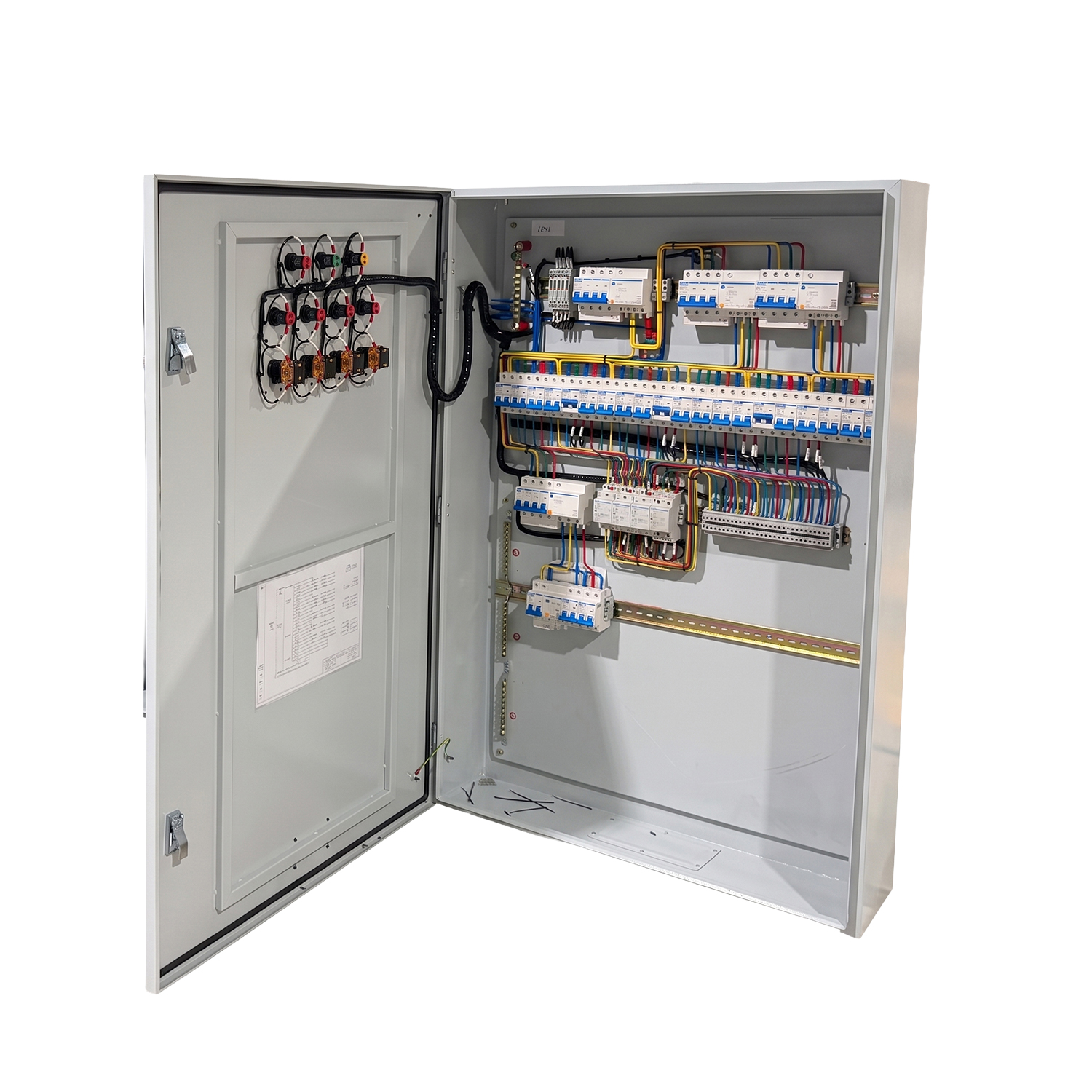
Power cuts cost money. A hospital loses life safety. A data center loses uptime. A factory loses production hours. An automatic transfer switch for generator backup catches the outage before your equipment even notices. You need one. The question is: which one.
What an ats panel actually does
An ATS panel sits between your mains supply and your standby generator. When utility voltage drops below a set threshold, the controller sees it. It sends a start signal to the generator. Once the generator reaches rated voltage and frequency, the motorized transfer switch moves. Your load is now on generator power.
When mains power returns and stays stable for a configurable period, the ATS switches back. The generator runs a cooldown cycle and stops. The whole sequence takes seconds. Nobody touches a button. Nobody runs to the electrical room in the dark.
An electrical panel transfer switch handles this sequence thousands of times over its service life. The contacts are silver-plated. The mechanism is motor-driven. The logic is microprocessor-controlled. It simply works.
Industrial ats panels handle heavy loads without drama
A small ATS for a shop is one thing. An industrial ATS for a factory is another. You need ratings from 63A to 3200A. Short-circuit withstand up to 85kA. Main incoming ACB with electronic trip unit. Branch MCCBs for outgoing feeders. ABB or Schneider components — not generic alternatives with questionable trip curves.
The enclosure matters too. IP41 is fine for a clean electrical room indoors. But a dusty factory floor or a coastal site with salt spray needs IP65. Powder-coated steel with sealed door gaskets. Anti-condensation heaters if humidity is a problem. Your supplier should ask about the environment before quoting.
ATS vs manual transfer switch: the comparison
A transfer switch for backup generator duty comes in two flavors. Automatic and manual. Here is how they compare.
| Dimension | ATS (Automatic) | Manual Transfer Switch |
| Response time | Under 100ms detection, seconds to transfer | Minutes — someone has to walk to the switch |
| Operator needed | None — fully automatic | Trained operator on site 24/7 |
| Generator starting | Auto-start signal from controller | Manual start — operator walks to generator |
| Return to mains | Automatic with adjustable delay | Manual — operator switches back |
| Interlocking safety | Mechanical + electrical interlocks | Mechanical only — depends on operator |
| Cost | Higher upfront cost | Lower upfront — higher risk cost |
For any facility where downtime costs money or risks lives, the choice is obvious. A generator transfer panel that works automatically pays for itself in the first real outage.
Generator power transfer switch: what the controller does
The controller is the brain. Deep Sea, ComAp, or SmartGen — all three do the same job. They watch mains voltage and frequency. When either drops below a configurable threshold, the controller starts a timer. If the outage persists past the delay, it sends a start signal to the generator.
Once generator voltage and frequency are stable, the controller commands the transfer switch to move. Load transfers from mains to generator. The controller keeps watching. When mains returns and holds steady for a configurable return delay, it transfers back. The generator runs a cooldown cycle and stops.
All three controller brands support Modbus RTU or TCP for remote monitoring. Your building management system can read ATS status, generator hours, and alarm history over a single cable. No extra hardware needed.
What a backup generator panel needs to be safe
An electrical transfer box that switches between two live sources must not connect both at the same time. That would back-feed into the grid and kill a line worker. Mechanical interlocking is the only acceptable protection. Steel rods and levers. Physical. Not software. Not a relay. Real metal between the mains breaker and generator breaker so they cannot both close.
Every backup generator panel we build gets a five-point interlock check before it ships. The test report documents each interlock test result. If a single point fails, the panel does not leave the factory. No exceptions. This is what IEC 60947-6-1 requires and what any responsible manufacturer delivers.
Where to deploy ATS panels
- Hospitals: life safety and critical care — zero downtime tolerance
- Data centers: server uptime, cooling — minutes of outage cost millions
- Factories: production lines, conveyors, processing — power cut stops revenue
- Commercial buildings: lifts, fire pumps, emergency lighting — occupant safety
- Telecom towers: remote sites, no operator on site — must be automatic
- Mining: ventilation, dewatering pumps — loss of power is a safety hazard
A generator transfer panel fits any site where an outage has consequences. The bigger the consequence, the faster the transfer time you need. Hospitals want under 100ms. Data centers too. An office building can tolerate a few seconds. Match the spec to the risk.
Picking the right generator transfer panel supplier
Not every factory that builds an electrical transfer box builds it right. Look for IEC 61439-1 and IEC 60947-6-1 compliance. Ask for test reports — factory function test, not just a certificate. A supplier that hesitates is a supplier that does not test properly.
Check what breakers and controllers they use. ABB and Schneider inside mean the panel will trip at the right current every time. Generic breakers mean unpredictable behavior. The controller brand matters too — Deep Sea, ComAp, and SmartGen are standards for a reason. They work.
Ask about lead times and buffer stock. A 20,000 square meter factory with 200 people should deliver standard ATS panels in 4 to 6 weeks. If the quote alone takes 3 weeks, expect production delays.
How to order an ATS panel for your generator
Send us three things. Your load list — how many amps and what type of load. Your single-line diagram — how the ATS fits into your distribution. Your site conditions — indoor or outdoor, dust, humidity, temperature. We will return a technical proposal, compliance documents, and pricing within 48 hours.
Every power distribution board and ATS panel we ship goes through factory function testing. You get the test report. You get the breaker calibration certs. You get a panel that works the first time. Standard configs leave the factory in 4 to 6 weeks. Get in touch and tell us what you need. We reply within 48 hours.
Frequently asked questions
How fast does an ATS panel transfer to generator?
The controller detects an outage in under 100ms. Generator start takes 5 to 15 seconds depending on engine size. Load transfer happens once generator voltage and frequency are stable. The full sequence from outage to load-on-generator takes 10 to 20 seconds for a typical diesel generator.
Does an ATS panel work with any generator brand?
Yes. The ATS controller sends a standard start signal — a set of dry contacts. Any generator with a two-wire auto-start input works. Caterpillar, Cummins, Perkins, SDMO, whatever brand runs your generator. No special interface. No proprietary protocol. Just two wires.
What is the difference between open and closed transition?
Open transition breaks the mains connection before making the generator connection. A brief power interruption. Closed transition briefly parallels both sources before switching — no interruption at all. Closed transition costs more and requires utility approval. Open transition covers 90 percent of applications.
Do I need a generator transfer panel with bypass?
If you service the ATS without shutting down the facility, yes. A bypass-isolation ATS lets you isolate the transfer switch for maintenance while the load stays on generator. Hospitals and data centers need this. Factories and commercial buildings usually do without.
How long does an ATS panel last?
Twenty years or more with routine inspection. The transfer switch mechanism is rated for thousands of operations. Silver-plated contacts. The controller is solid-state — no moving parts to wear. Annual maintenance: torque check busbar bolts, test contact resistance, scan with thermal camera. That covers it.
Final thoughts
An ATS panel with generator backup is the difference between an outage being an inconvenience and a disaster. ABB or Schneider breakers. Deep Sea, ComAp, or SmartGen controller. Factory tested. IEC 61439-1 and IEC 60947-6-1 compliant. Standard delivery in 4 to 6 weeks. Send us your load list and single-line diagram. We will get back to you with a technical proposal and pricing within 48 hours.