


You can find several main circuit breaker components inside each breaker. Every part helps keep electrical systems safe and working well. Here are some common types and what they do:
Component Type | Description |
|---|---|
Three pole circuit breakers | Used in three-phase systems |
Single pole circuit breakers | Used in single-phase systems |
Attachments | Includes bushings, current transformers, interlocks, shunt trips |
Auxiliary equipment | Includes closing relays and structural steel supports |
If one part stops working, the whole system can be unsafe. For example, circuit breakers older than 25 years fail 12% each year. Knowing about circuit breaker components helps you keep your electrical system safe.
Circuit breakers keep electrical systems safe by stopping electricity when there is a problem. This helps prevent damage and fires.
The main parts of circuit breakers are the frame, contacts, trip unit, and arc extinguisher. Each part is important for safety.
You should check circuit breakers often. This makes sure they work well and helps stop problems like overheating or electrical faults.
Picking the right circuit breaker for your house or business is very important. It keeps things safe and helps everything work better.
Knowing how circuit breaker parts work together helps you fix problems. It also helps you keep your electrical system working well.
A circuit breaker is a tool that stops electricity if there is a problem. It works like a safety switch for your house or building. When too much electricity goes through the wires, the circuit breaker opens the circuit. This stops the power from flowing. It helps keep your home or building safe from harm. You do not have to reset it every time you use power. The circuit breaker only trips when it finds something wrong, like too much current or a short circuit.
A circuit breaker helps protect your electrical system from damage. It keeps you and your things safe in different ways:
Stops too much current that can hurt wires.
Lowers the chance of fires by stopping dangerous currents.
Keeps your appliances safe and protects the wires.
Tip: Using circuit breakers with GFCIs and AFCIs makes you even safer.
Circuit breakers have important jobs at home or at work:
Role of Circuit Breakers | Benefit |
|---|---|
Stop electrical overloads | Lowers the chance of fires |
Shut off power by themselves | Protects wires and appliances |
Handle big currents (industrial) | Keeps things working well |
You can find circuit breakers in homes and factories. At home, they protect your lights, outlets, and appliances. In factories, they control bigger currents and keep machines safe. Using a circuit breaker helps everyone have a safe and steady electrical system.
When you look inside a circuit breaker, you will find several important parts. Each one has a special job to keep your electrical system safe. Here is a table that shows the main circuit breaker components and what they do:
Component | Function |
|---|---|
Frame | Holds and protects all the other parts. |
Contacts | Opens and closes to let electricity flow or stop. |
Operating Mechanism | Moves the contacts to turn the breaker on or off. |
Trip Unit | Detects problems and tells the breaker to open. |
Arc Extinguisher | Puts out dangerous electric arcs when the breaker opens. |
Terminal Connections | Connects the breaker to the wires in your system. |
Let’s look at each of these parts of a circuit breaker and see how they work.
The frame is the strong outer shell of the breaker. You can think of it as the body that holds everything together. It keeps the inside parts safe from dust, dirt, and damage. The frame also provides insulation, which means it stops electricity from leaking out. Most frames use molded plastic or metal for strength and safety. Without a good frame, the other circuit breaker components would not work well or last long.
Contacts are metal pieces inside the breaker. When you turn the breaker on, the contacts touch each other and let electricity flow. When the breaker trips, the contacts pull apart and stop the current. The contact assembly includes the main contacts, arcing contacts, and sometimes auxiliary contacts. These parts work together to control the flow of electricity.
Contacts must have good alignment and strong pressure to work right.
Manufacturers use metals like silver or copper for contacts because they conduct electricity well and last a long time.
The contacts open and close many times, so they need to be tough.
If the contacts do not work, the breaker cannot stop dangerous currents. This makes contacts one of the most important parts of a circuit breaker.
The operating mechanism is the part you move when you flip the breaker switch. It opens or closes the contacts inside. The actuator lever is the handle or switch you see on the outside. When you push or pull the lever, the operating mechanism moves the contacts to turn the breaker on or off.
The operating mechanism lets you control the breaker by hand.
It also works automatically when the trip unit sends a signal.
This part must move quickly and smoothly to keep you safe.
You use the actuator lever every time you reset a breaker after it trips.
The trip unit is the brain of the breaker. It watches for problems like too much current or a short circuit. When it finds a problem, it sends a signal to the operating mechanism to open the contacts and stop the flow of electricity.
The trip unit can sense overloads and short circuits.
It acts fast to protect your wires and devices.
Some trip units use simple thermal or magnetic parts. Others use electronic sensors for more accuracy.
You rely on the trip unit to keep your system safe. If it does not work, the breaker cannot protect you from electrical faults.
When the contacts open, a bright electric arc can jump between them. This arc is very hot and can damage the breaker or start a fire. The arc extinguisher puts out this arc quickly.
The arc extinguisher uses special methods to break the arc into smaller pieces or stretch it until it goes out.
In low voltage breakers, an arc chute splits the arc and cools it down.
In high voltage breakers, a vacuum interrupter can enclose the arc and stop it fast.
You need an arc extinguisher to make sure the breaker works safely every time it trips.
Note: Arcs are normal when contacts open, but the arc extinguisher keeps them from causing harm.
Terminal connections are the points where you attach the wires to the breaker. These connections make sure electricity flows from your system into the breaker and back out again.
Good terminal connections keep the breaker working safely.
Loose or dirty terminals can cause overheating or even fires.
You should always check that wires are tight and clean at the terminals.
Terminal connections are the last step in linking the circuit breaker parts to your electrical system.
You now know the main circuit breaker components and how each one helps protect your home or building. Each part works with the others to keep your electrical system safe and reliable.
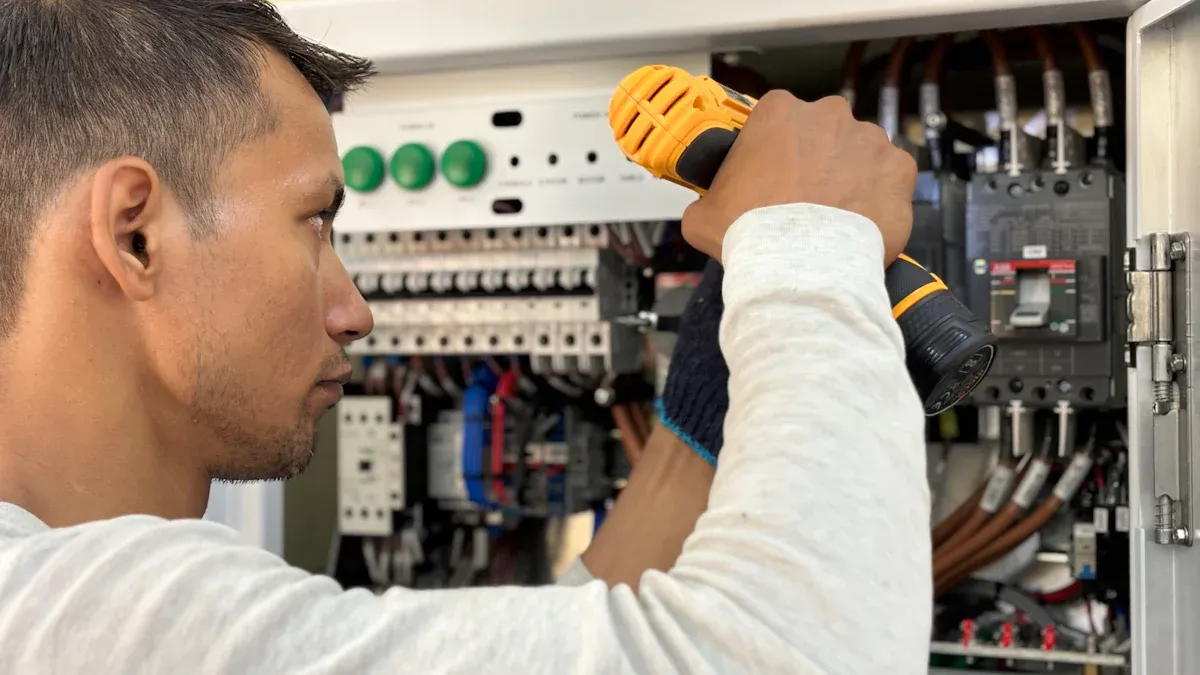
When you use a circuit breaker, all the parts work as a team. First, you flip the switch to turn it on. Electricity moves through the breaker and powers your things. Inside, the electromagnet and bimetallic strip watch the current. If the current is normal, the breaker lets electricity go through. If the current gets too high, the breaker acts fast. The electromagnet gets stronger and pulls a metal lever. This makes the moving contact pull away from the stationary contact. The circuit opens, and electricity stops flowing. Sometimes, the bimetallic strip bends when it gets hot from too much current. This bending also makes the contacts open. When the contacts open, an arc appears, but the arc extinguisher puts it out quickly. The trip unit finds the problem and tells the mechanism to trip the breaker. You will see the actuator lever move to the off spot. After a trip, you can reset the breaker after fixing the problem.
Remember: The trip process keeps your wires and devices safe. Each part must work at the right time for the breaker to trip safely.
Protection coordination helps keep your electrical system safe and working. This means each breaker and protection device works with the others. Only the breaker closest to the problem will trip. The rest of your system keeps working.
Selective coordination means only the nearest breaker trips during a problem.
Hospitals use this to keep power on for life support, even if one area has trouble.
In factories, this stops one problem from shutting down the whole line.
When you set up your breakers with good coordination, you avoid big power outages. You also make sure only the right breaker trips, so your important equipment keeps working.
Residential circuit breakers protect your home’s electrical system. These breakers work at lower voltages, from 120 to 240 volts. They keep your lights, outlets, and appliances safe from problems. Most homes use single-pole or double-pole breakers. Some places, like bathrooms and kitchens, need GFCI breakers. These help stop shocks near water.
Here is a table that shows how residential and industrial circuit breakers are different:
Type of Circuit Breaker | Common Types | Voltage Range | Safety Features |
|---|---|---|---|
Residential | Single-pole, Double-pole, GFCI, AFCI, Dual-function | Low (120-240 V) | GFCI, AFCI for extra protection |
Industrial | High-voltage, Low-voltage, Magnetic, Thermal magnetic, SF6 high-voltage | 1kV to 72kV | Built for high-demand systems |
Tip: GFCI breakers are needed in places with water, like bathrooms and kitchens.
Commercial and industrial circuit breakers handle bigger loads and higher voltages. You find these in offices, stores, and factories. They use stronger frames and better trip units. Some have special features like alarms and metering. These help you find problems early.
Key features of commercial and industrial circuit breakers are:
Protection from overloads, short circuits, and faults
Easy switching for repairs and maintenance
Monitoring tools for safety and performance
Here is a table that shows some important features:
Feature | Description |
|---|---|
Protection | Stops power during overloads and faults to prevent damage |
Switching | Lets you control power for repairs or changes |
Monitoring | Advanced models show alarms and meter readings for early problem detection |
Some popular models are Siemens ED63B040 Sentron Series and Square D Powerpact with Micrologic 5.0.
Power grid circuit breakers work at very high voltages and currents. Utility companies use these to protect the whole electrical grid. These breakers use special materials to put out electric arcs. Some use air, vacuum, oil, or SF6 gas.
Here is a table showing the types of power grid circuit breakers and how they stop arcs:
Type of Circuit Breaker | Medium for Arc Extinction and Insulation | Application |
|---|---|---|
Air Circuit Breakers | Air | High Voltage |
Vacuum Circuit Breakers | Vacuum | High Voltage |
Oil Circuit Breakers | Oil | High Voltage |
SF6 Gas Circuit Breakers | SF6 Gas | High Voltage |
Note: Power grid breakers are complex and cost much more than home or business types. They keep the whole power system safe and working well.
Understanding circuit breaker components helps you design safer electrical systems. When you know how each part works, you can choose the right breaker, install it correctly, and fix problems faster.
Proper wire connections and matching the breaker to your panel prevent fire hazards.
Each part, from the frame to the trip unit, plays a key role in protection and performance.
If you need to troubleshoot, follow these steps:
Find the tripped breaker and reset it.
Check for overloaded circuits and unplug devices.
Inspect for short circuits or ground faults.
Remember: A well-maintained breaker keeps your home or business safe and reliable.
Industrial circuit breakers work with higher voltages and currents. They are made with stronger materials and better trip units. Residential breakers are for homes. Industrial breakers protect factories and big buildings.
You need to check industrial circuit breaker components once every year. Regular checks help you spot wear, loose wires, or overheating. Finding problems early keeps your system safe and working well.
You should not use a residential breaker in an industrial place. Industrial systems need breakers for more power and tough jobs. Using the wrong breaker can cause safety problems and broken equipment.
Industrial circuit breakers have advanced monitoring, alarms, and remote control. These features help you handle big electrical loads and fix problems fast. They also use special arc extinguishers for strong circuits.
Industrial places use high currents that make strong electric arcs. Special arc extinguishers in industrial breakers stop these arcs fast. This keeps equipment safe and lowers the risk of fire.


