


Switchgear installation needs you to pay close attention. You must follow all rules and standards. This helps stop up to 30% of electrical problems in factories. You do this by using safe methods and following safety steps.
New safety tools, like arc flash protection and worker safety systems, are needed for every job.
Arc-resistant designs keep workers safe and stop faults from spreading. This makes work areas safer.
Careful steps cover design, installation, use, and upkeep.
Safety rules must help with daily jobs and emergencies.
New technology, like arc flash prevention and residual current devices, lowers risks. It helps protect everyone. Working together and following rules are important for good installation.
Key Takeaways
Follow safety rules to stop many electrical problems in factories. Use new safety tools like arc flash protection to stay safe.
Check the installation site carefully. Make sure it is clean and flat. Good airflow helps protect the equipment.
Do careful electrical tests after you finish installing. Check insulation and continuity. Also, check protective circuits to keep things safe.
Pick the right switchgear for your power needs. Choose medium or low voltage based on what you need.
Always use a checklist when you install. This helps you avoid mistakes and follow safety rules.
Key Steps in Switchgear Installation
Planning and Site Assessment
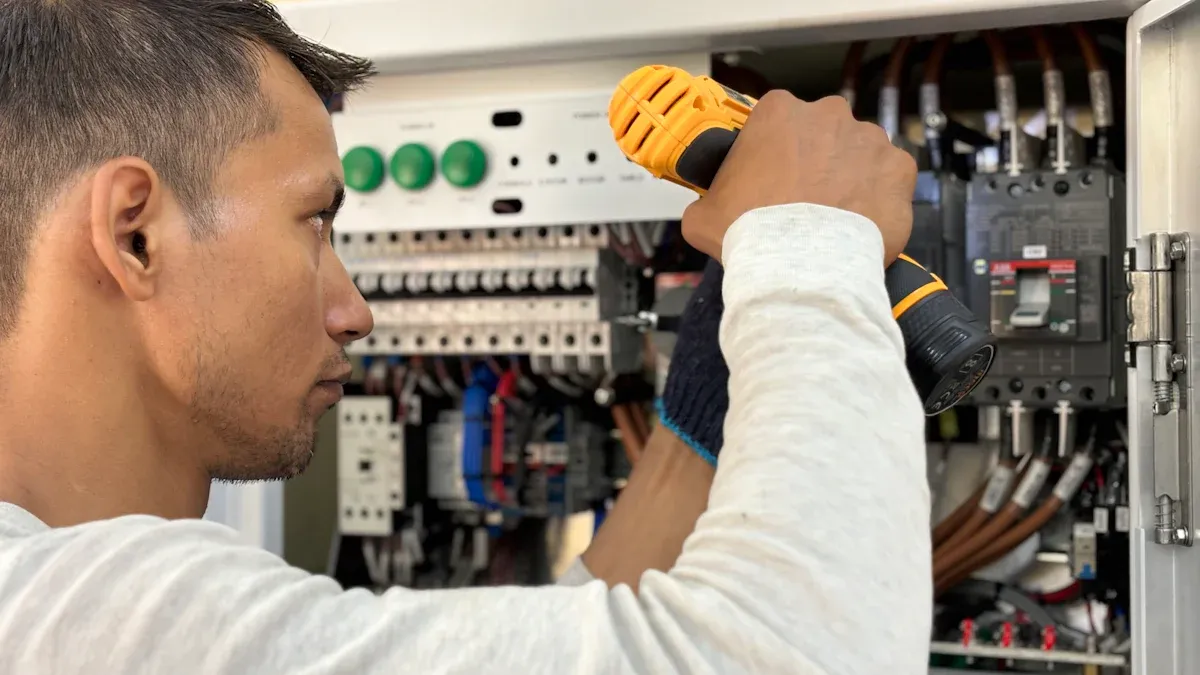
Every switchgear installation starts with planning. You need to look at the site first. This helps you avoid mistakes and keeps equipment safe. Check the area for dangers and make sure it meets rules. Look for a strong and flat base. Make sure there is good airflow. Watch out for dust, wetness, and hot or cold spots. These things can hurt the equipment. Only trained people should work on the equipment. They must follow safety steps.
Here is a table that shows common dangers and ways to fix them:
Hazard Type | Mistake Description | Recommended Fix |
|---|---|---|
Inadequate Site Preparation | Not making sure the ground is clean, flat, and strong. Not thinking about airflow. | Make sure the ground is strong and flat. Leave space for fixing and air to move. |
Poor Grounding Practices | Not doing grounding steps or doing them wrong. | Build a strong earthing system. Follow local rules and maker’s instructions. |
Neglecting Environmental Considerations | Putting equipment where there is too much dust, wetness, or heat. | Use enclosures that are rated for the area. Keep the area controlled for best use. |
Skipping Safety Protocols | Letting people who are not trained work on equipment. | Only trained people should install. Use safety gear and follow safety steps. |
You must also follow rules for checking the site. These rules help you meet all needs and avoid trouble. You need to look at the site, test insulation, and fill out reports. Give these reports to a Licensed Professional Engineer and the maker. You also need to check arc flash studies, update danger labels, and keep proof of fixing safety devices. Write down worker training and safety gear rules.
Inspection Requirements | Testing Protocols | Compliance Documentation |
|---|---|---|
Check the whole site to see if it meets design and installation needs | Test insulation with a Hi-Pot tester | Finish the report and give it to a Licensed Professional Engineer to look at |
No broken parts | Send the checked report to the maker with any questions | |
Everything put in the right way | Show the final report to the maker and the AHJ | |
No swapped parts | List the rules used and changes needed |
Tip: If you do not follow safety rules, you can get fines, lose insurance, or have delays. Always follow the latest rules for switchgear installation.
Equipment Positioning and Leveling
Put and level your equipment with care. This helps you avoid power problems and keeps switchgear safe. Put the equipment on a flat and steady spot. Check that it lines up with other machines. Make sure it meets all alignment needs.
Here are the leveling limits for equipment:
Foot flatness less than 0.4µ/mm (5 mils/ft)
Coplanarity less than 50 µm/mm (2 mils) between machines and drives for machines up to 400kW or 500 HP
ISO standard: surfaces in the same plane within 150 µm/m (0.15 mm per meter)
Levelness less than 0.8 µm/mm (10 mils/ft)
Use the right tools to measure these limits. Look for gaps under the equipment. Adjust the feet if you need to. Make sure the equipment is not leaning. If you skip these steps, you can break the switchgear or cause power loss.
Note: Pick the right switchgear for your needs and site. You avoid trouble by following all leveling rules.
Electrical Connections and Testing
Connect the electrical parts after you finish leveling. Follow all wiring and connection rules. Check that each wire is in the right spot. Make sure all connections are tight. Test the equipment to see if it works safely.
Here is a list of electrical tests you need to do:
Check insulation
Measure insulation resistance
Do a dielectric test
Check protective circuit continuity
Measure continuity resistance
Check continuity with a tester with signal
Inspect and do a final check
Check wiring accessories
Take steps to protect against electric shocks
Check clearances
Check mounting distances
Test electrical operation
Test mechanical parts
Check protection level
Check labels, marks, and info
Check info in technical papers
Test each bus section, phase-to-phase, and phase-to-ground. Do insulation-resistance tests on control wires and ground-resistance tests. Test metering devices and instrument transformers. Make sure the equipment meets all safety and working needs.
Tip: Always match your switchgear to your power needs. Test every part before you use it to avoid problems.
Keep records of all tests and checks. Use these records to show you followed the rules and help with fixing later. Avoid mistakes by following each step and checking your work.
How Switchgear Works in Industrial Settings
Power Control and Isolation
Switchgear helps control power in your facility. It turns circuits on or off when needed. This lets you decide where electricity goes. It stops overloads from happening. You can shut off parts for repairs. You do not need to stop everything. This is very helpful in places like mines or chemical plants. Stopping work can cost a lot of money.
Here is a table that shows how switchgear helps with power control and isolation:
Function | Description |
|---|---|
Control | Switchgear turns circuits on or off as needed to manage power flow. |
Protection | It safeguards systems against short circuits, overloads, and electrical faults. |
Isolation | Allows for safe maintenance by disconnecting specific parts of the system. |
Switchgear finds problems fast. You can fix things while most machines keep working. This means less time lost. You can handle changes in power easily. In big factories, switchgear keeps the grid safe. It helps keep everyone safe.
You use different parts to help with power isolation:
Circuit breakers stop current if there is a problem.
Disconnect switches let you turn off circuits for repairs.
Relays watch current and voltage and can trigger breakers.
Bus bars move electricity inside the switchgear.
Fuses melt if current is too high and protect from overloads.
Current and voltage transformers check system levels for safety.
Tip: Always make sure your switchgear fits your power needs before you start work.
Fault Interruption and Protection
Switchgear keeps your facility safe by stopping problems fast. If something goes wrong, it stops electricity from flowing. You use circuit breakers, fuses, and relays to protect your system.
Here is a table that explains how these components work:
Component | Function |
|---|---|
Circuit Breakers | Automatically interrupts fault currents and can be safely reclosed after clearing the fault. |
Fuses | Melts to break the circuit during overcurrent conditions, providing immediate protection. |
Protective Relays | Monitors electrical parameters to detect faults and initiate protection mechanisms. |
Switchgear is needed for strong power distribution. It protects against electrical problems. It keeps your work going without stops. Switchgear helps avoid damage and keeps equipment safe. You need these systems for safe and steady power every day.
Safety Protocols for Switchgear Installation
Installer Safety Measures
You must always think about safety first when installing switchgear. If you ignore safety rules, accidents can happen. The most common problems are arc flashes, electrical shocks, burns, and equipment failures. Arc flashes are very hot and can burn you or damage things. Electrical shocks can hurt you badly or even cause death. Burns can happen if you touch hot parts or if there is an explosion. Equipment can fail if insulation wears out, which can start fires or short circuits.
Safety Incident | Description |
|---|---|
Arc Flashes | Sudden bursts of energy causing burns and equipment damage, reaching up to 19,000°C. |
Electrical Shocks | Injuries or fatalities from contact with live parts. |
Burns | Resulting from hot surfaces or explosions near high-energy components. |
Equipment Failures | Issues like worn insulation leading to short circuits or fires. |
You need to follow OSHA safety rules to stop accidents. These rules help keep everyone safe at work. You must wear the right safety gear, use lockout/tagout steps, and check your tools often. All workers should learn about electrical safety and what to do in emergencies. Always look for ways to make things safer and keep circuits ready to turn off if needed.
Follow OSHA electrical safety rules for your job.
Give workers gloves, glasses, and other safety gear.
Use lockout/tagout steps to keep machines off during repairs.
Be careful in places where things can catch fire easily.
Teach workers how to be safe around electricity.
Check and fix electrical tools often.
Make sure circuits can turn off by themselves if there is a problem.
Train workers on what to do in electrical emergencies.
Always try to make safety better.
Each team member should have a clear job. One person should check safety steps. Another person should handle arc flash safety. Everyone must know what to do and follow the plan.
Lockout/Tagout and PPE
Lockout/tagout steps keep you safe from sudden energy releases. Here are the steps you need to follow:
Get ready and turn off all power. Tell everyone about the work.
Block energy points and put on lockout devices.
Check that all power is off before you start.
Do the work safely with no risk of sudden power.
Take away tools, tell everyone, and turn power back on the right way.
Go over what you did and write it down.
Personal protective equipment (PPE) keeps you safe from arc flashes and other dangers. Wear arc-rated clothes to protect from arc flashes. Insulated gloves keep you safe from shocks. Goggles and face shields protect your eyes and face from sparks. Hard hats keep your head safe from falling things. Safety boots protect your feet in dangerous places.
Tip: Always check your PPE before you start working. Replace any broken gear right away. Good PPE and strong arc flash safety steps help you stay safe.
Switchgear installation needs teamwork and strong safety rules. You must follow every step to keep yourself and others safe.
Types of Switchgear and Applications
Medium and Low Voltage Options
There are two main types of switchgear in factories. One is medium voltage. The other is low voltage. Each type does a different job. Low voltage switchgear works with up to 1,000 volts. Medium voltage switchgear handles 1,000 to 35,000 volts. Use low voltage switchgear for small systems. Medium voltage switchgear needs stronger insulation. It also needs higher breaking power for safety.
Here is a table that shows the main differences:
Feature | Low Voltage (LV) | Medium Voltage (MV) |
|---|---|---|
Voltage Range | Up to 1kV | 1kV to 35kV |
Design Complexity | More compact and simpler | Requires robust insulation |
Breaking Capacity | Short-circuit protection | Higher breaking capacity |
Applications | High current transmission | Extensive, higher voltage |
Low voltage switchgear is used in control panels. It is also used in small machines. Medium voltage switchgear is found in big factories. It is used in heavy industry. Both types help make your system work better. You need to pick the right type for your power needs. This helps your system last longer.
Space-Saving Designs
Factories can have small spaces. You need switchgear that fits well. Space-saving designs help you use space wisely. Compact switchgear, like gas insulated switchgear, works in tight rooms. Ring Main Units fit in city or underground places.
Indoor switchgear uses less space than outdoor types. You can get switchgear made just for your needs. These designs help your system work better, even in small areas. Picking the right switchgear makes your building safer and more efficient.
Note: Space-saving switchgear lets you improve your system. You do not need to change your building a lot.
Installation Checklist for Switchgear Projects
A checklist helps you put in switchgear the right way. It keeps you safe and helps your system work well. You can use this list to stop mistakes.
Pre-Installation Checklist
Check these things before you start:
Make sure doors and halls are big enough for switchgear.
Check if there is enough room inside for all parts.
Make sure cable entry matches your plan, top or bottom.
Turn off all power to stop accidents.
Look at safety codes from the maker and your area.
Get all papers, like site maps and safety steps.
Note: Problems happen if you skip these checks. Always look at space and cable spots to stop delays.
Installation Phase Checklist
Do these steps when you install:
Make sure you have all tools and the site is ready.
Put cabinets on a strong base. Line them up and level them.
Put in main parts like circuit breakers and busbars. Each circuit must be in the right place.
Add other parts like relays. Put labels on all wires.
Check level at both ends and the middle. Fix it if the error is more than 1mm/m.
Tighten and level all cabinets so they stay steady.
Step | Description |
|---|---|
1 | Check level at three spots. Use shims if needed. |
2 | Place cabinets in the right spot for good work. |
3 | Tighten and level for strong switchgear. |
Tip: If you rush or skip labels, you can make mistakes and have problems later.
Post-Installation Review
Check these things after you finish:
Testing Category | Description |
|---|---|
Dielectric Withstand Testing | Make sure switchgear can handle high voltage. |
Insulation Resistance Testing | Check insulation to stop leaks. |
Functional and Protection Testing | Test relays and circuit logic. |
Mechanical and Interlock Testing | Make sure parts line up and safety works. |
Short-Circuit and Load Path Check | Check bus and load paths for fault current. |
Test insulation and relays often.
Clean parts with soft brushes or vacuums.
Get more spare parts if you need them.
Note: If you skip these checks, you might miss problems or have unsafe circuits. Always write down what you find and get approval.
If you follow this checklist, you make things safer. You also help your switchgear last longer and work better.
You can keep switchgear safe if you follow every step. Use good safety steps to stop accidents. Working together helps everyone stay safe. Keep checking and fixing things to stop problems.
Preventive maintenance makes your system work well and keeps people safe.
Good planning and teamwork help you finish the job right.
Writing down steps helps you fix things later.
Use the checklist to help with each project. Keeping good records helps you not make mistakes and follow safety rules.
FAQ
What is the main purpose of switchgear in factories?
Switchgear helps you control and protect electrical circuits. You use it to turn power on or off and keep equipment safe from faults. It also lets you isolate parts for repairs.
How do you stay safe during switchgear installation?
You wear personal protective equipment like gloves and goggles. You follow lockout/tagout steps. You check tools before use. You learn emergency actions. You work with trained team members.
Which tests should you perform after installing switchgear?
You test insulation resistance. You check dielectric withstand. You run functional tests on relays and breakers. You inspect mechanical parts. You record all results for future reference.
Can you install switchgear in small spaces?
You can use compact switchgear designs. Gas-insulated switchgear and ring main units fit tight areas. These models save space and keep your system safe.
Why do you need a checklist for switchgear projects?
A checklist helps you follow each step. You avoid mistakes. You keep records. You make sure your installation meets safety rules. You improve teamwork and project results.