


Safety Incident Type | Description |
|---|---|
Short Circuits | When two wires touch, too much current and heat happen. Switchgear stops this to keep fires from starting. |
Overcurrent | Too much electricity flows and can hurt equipment. Switchgear turns off the power to keep it safe. |
Ground Faults | Electricity goes to the ground and can break systems. Switchgear quickly finds and stops the problem. |
Arc Faults | Electricity jumps between wires and can cause heat and fire. Switchgear finds this and stops it fast. |
Key Takeaways
Metal enclosed switchgear keeps electrical systems safe from dangers like short circuits and too much current. This helps keep people safe in places like schools, hospitals, and factories.
Important parts are circuit breakers, disconnect switches, and fuses. These parts work together to control and protect the electrical system.
It is very important to take care of switchgear. Check and clean it at least once every year. This helps stop problems and keeps it working well.
Pick the right switchgear for your voltage and safety needs. Think about if you need it inside or outside.
Always follow safety rules when working with switchgear. Use personal protective equipment and lockout/tagout steps.
What is metal enclosed switchgear
Definition and purpose
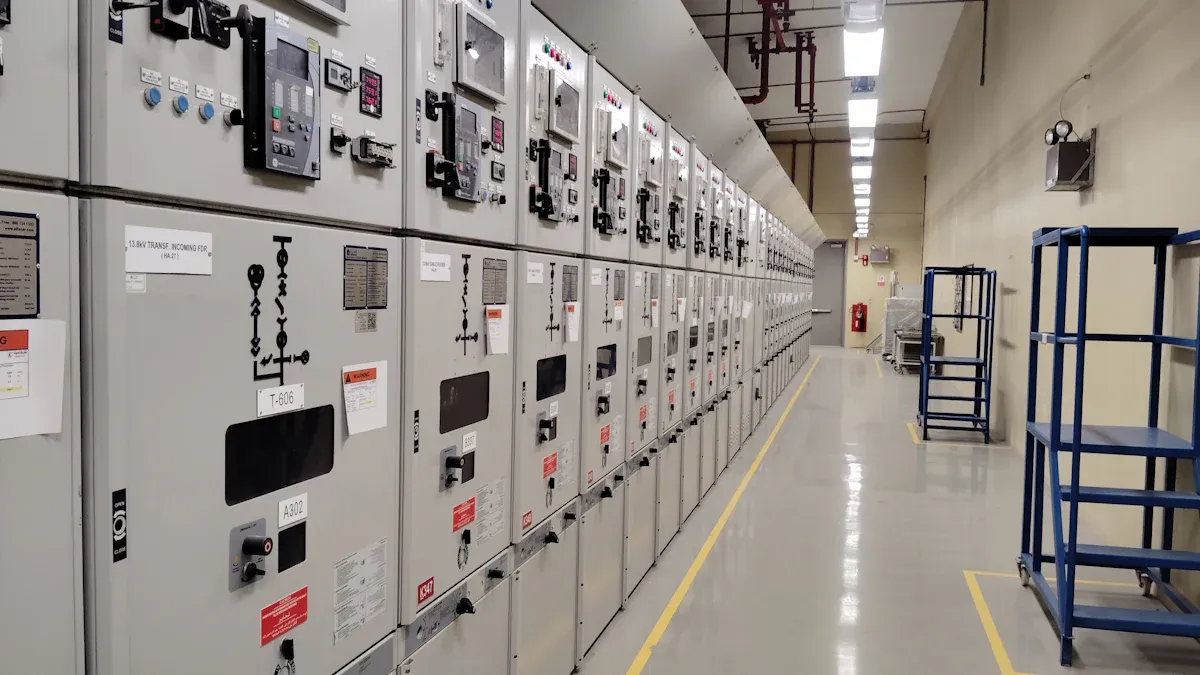
You use metal enclosed switchgear to keep electrical systems safe. It puts electrical parts inside a strong metal box. This metal box keeps people and buildings safe from electrical dangers. You see metal enclosed switchgear in places with medium-voltage circuits. These places include schools, hospitals, and factories.
The main job of metal enclosed switchgear is to control, protect, and separate electrical equipment. It helps stop problems before they cause harm. It lets you manage how power moves and keeps things running well.
Tip: Metal enclosed switchgear must follow strict rules for safety and how it works. For example, IEC 62271-200 gives rules for design, building, and testing for voltages above 1 kV up to 52 kV.
Standard | Description |
|---|---|
IEC 62271-200 | Lists what is needed for AC metal-enclosed switchgear and controlgear for voltages above 1 kV and up to 52 kV, including design, building, and testing. |
When you use metal enclosed switchgear, you get many important jobs:
Protection: Finds and stops fault currents before they cause harm
Control: Sends power to different parts of your building
Isolation: Lets you safely turn off equipment for repairs or emergencies
Monitoring: Checks how the system is working for better use
Key components
You find many important parts inside metal enclosed switchgear. Each part helps keep your system safe and working well.
Circuit breakers stop electricity if there is too much current or a short circuit. You need them to keep equipment safe.
Electrical disconnect switches let you turn off parts of the system. You use them for repairs or emergencies.
Fuses give extra safety. They melt and break the circuit if the current is too high, stopping problems from spreading.
The way metal enclosed switchgear is built helps you use it for medium-voltage jobs. It has separate spaces for each device, so each has its own breaker spot. This makes repairs safer and easier. You can also pick different setups, like one-high or two-high, to fit your space.
Feature | Description |
|---|---|
Voltage | 2400V to 38kV |
Ampacity | 600A to 3000A |
Compartmentalized Construction | Each device has its own breaker space, making safety and repairs easier. |
Configuration Flexibility | You can choose one-high or two-high setups for different places. |
Safety Standards | Follows ANSI, IEEE, and NEMA rules for good and safe use. |
You also see safety parts like back doors, tall barriers, and hardware that is hard to tamper with. These parts keep people and equipment safe from accidents and people who should not get in.
When you pick metal enclosed switchgear, you get something that keeps your electrical system safe, neat, and simple to take care of.
How metal enclosed switchgear works
Basic operation
You use metal enclosed switchgear to control and protect your electrical system. When you turn on the power, electricity flows through the switchgear. The equipment checks the current and voltage. If it finds a problem, like too much current or a short circuit, it acts fast. The circuit breaker opens and stops the flow of electricity. This action keeps your equipment and people safe.
You can also use the switchgear to turn off parts of your system for repairs. You flip a disconnect switch, and the power stops in that section. This makes it safe for you to work on the equipment. The switchgear also lets you check the system. You can see if everything works well or if you need to fix something.
Note: Always follow safety steps when you use switchgear. Wear the right protective gear and use lockout/tagout procedures to keep yourself safe.
Internal structure
The inside of metal enclosed switchgear has many parts that work together to keep you safe. Each part sits in its own space inside a strong metal box. This design helps stop accidents and makes repairs easier.
You find circuit breakers and disconnect switches in separate compartments. This setup keeps live parts away from you when you open a section.
The metal box has barriers and doors. These features stop you from touching live wires or busbars by mistake.
You must use lockout/tagout (LOTO) steps and wear personal protective equipment (PPE) when you open the switchgear. This is important because live cables and busbars can still carry electricity.
Some types, like metal clad switchgear, add extra safety. They use shutters and interlocks to block access to live parts. These features lower the risk of electric shock and make the system safer for you.
The structure of metal enclosed switchgear helps you work safely and keeps your electrical system running well.
Types of metal enclosed switchgear
Low voltage vs. medium voltage
There are two main types of switchgear by voltage. Low voltage switchgear works with up to 1,000 volts. You use it in small buildings or stores. Medium voltage switchgear handles 1,000 to 38,000 volts. You find it in big places like factories and power stations. Low voltage switchgear gives basic protection and control. It is simple to put in and costs less money. Medium voltage switchgear gives stronger protection and handles bigger loads. You need it for more complex systems.
Tip: Standards help you pick the right switchgear. ANSI NEMA C37.51-2018 is for low voltage switchgear. ANSI NEMA C37.55-2025 is for medium voltage metal-clad switchgear.
Metal enclosed vs. metal clad
It is important to know the difference between metal enclosed and metal clad switchgear. Metal clad switchgear has separate spaces for each part. This design keeps problems in one spot and protects you during repairs. Metal enclosed switchgear puts all parts in one box. It is smaller but does not protect as much.
Here is a table to help you compare:
Feature | Metal-Clad Switchgear | Metal-Enclosed Switchgear |
|---|---|---|
Safety and Protection | Higher safety with compartments, lower arc flash risk | Safe enclosure, but less protection during maintenance |
Maintenance | Easier with draw-out parts, no need to shut down fully | Harder, needs full power shut-off |
Cost | More expensive due to safety features | Less costly, simpler design |
Application Suitability | Best for high-safety places like factories | Good for smaller, budget-focused settings |
Metal clad switchgear keeps you safer and stops faults from spreading.
Metal enclosed switchgear is smaller and fits in tight spaces, but you must be careful when fixing it.
You use metal clad switchgear for medium voltage systems. You use metal enclosed switchgear for low voltage or simple setups.
Indoor and outdoor options
You can pick indoor or outdoor switchgear based on where you need it. Indoor switchgear goes inside buildings. It keeps your system safe from dust and people. Outdoor switchgear stands up to rain, sun, and weather. You use it for substations or places without a building.
You must check for certifications before you put in outdoor switchgear. ANSI NEMA C37.58-2020 gives rules for testing medium voltage switches outside. This standard makes sure your switchgear works safely in tough weather.
Indoor switchgear keeps your system clean and safe from people.
Outdoor switchgear protects against rain, heat, and cold.
Note: Always check the standards and certifications before you pick indoor or outdoor switchgear. This helps you keep your system safe and working well.
There are many choices for metal enclosed switchgear. You pick the type by voltage, safety needs, and where you want to put it. Standards like ANSI and NEMA help you choose the right one.
Features and benefits
Safety and protection
Metal enclosed switchgear has many safety features. The design helps protect you from electrical faults. It also keeps you safe from arc flashes. Arc-resistant models push dangerous energy away from people. Strong compartments can handle high pressure if something goes wrong. You also see grounded barriers and mechanical interlocks. These features stop you from touching live parts by accident. Mechanical shutters and automatic grounding give extra protection. They help during use and when you do maintenance. Compartments keep problems from spreading. One fault does not hurt the whole system.
Arc-resistant switchgear sends explosions away from people.
Strong compartments handle pressure from faults.
Grounded barriers and interlocks protect you from live parts.
Compartments keep faults from spreading.
Tip: Always follow safety rules and wear protective gear when you work with switchgear.
Reliability and maintenance
You want your electrical system to work well. Metal enclosed switchgear helps you reach this goal. You can check reliability with numbers like CEMI and CELID. These numbers show how well your system works.
Metric | Description |
|---|---|
CEMI | Customers Experiencing Multiple Interruptions |
CEMM | Customers Experiencing Multiple Momentaries |
CELID | Customers Experiencing Long Interruption Duration |
CEMSMI | Customers Experiencing Multiple Sustained and Momentary Interruptions |
To keep switchgear reliable, you should do these things:
Check the switchgear and the area around it often.
Follow the manufacturer’s steps for care, like oiling and tightening.
Make a plan for regular checks and cleaning.
Fix or update older systems.
Keep good records to track how things work and plan ahead.
You can also hire experts for maintenance if you want a special plan.
Compactness and space savings
Sometimes you need equipment that fits in small spaces. Metal enclosed switchgear has a compact design. You can use it where space is tight. Some models put breakers and disconnects in one box. This saves floor space and makes setup easier.
Feature | Metal-Enclosed Switchgear | Metal-Clad Switchgear |
|---|---|---|
Space Requirement | Small, fits in tight places | Needs more room |
Floor Area | Uses less space | Uses more space |
Installation | Easier, lighter, faster | Harder, bigger size |
You can pick metal enclosed switchgear for schools, hospitals, or factories with little space. The small size helps keep your electrical room neat.
Applications and selection tips
Common uses
Metal enclosed switchgear is used in many places. Utility substations use it to lower high-voltage power. This helps electricity move safely. Solar farms and wind plants use it too. It helps control changing power and keeps the grid steady. The small size lets you put it in tough places. You also see it in buildings, factories, hospitals, and schools.
Application Area | Description |
|---|---|
Utility Substations | MV switchgear lowers high-voltage power and helps transfer electricity safely. |
Renewable Energy Installations | It manages changing power levels and keeps the grid steady. |
Environmental Adaptability | Compact design works well in harsh conditions. |
Safety and maintenance
You must be careful when working with switchgear. Train yourself and your team to use it safely. Always use lockout/tagout steps before fixing anything. Check that all power is off with special tools. Wear gloves, safety glasses, boots, and flame-resistant clothes.
Teach all workers to use switchgear safely.
Show everyone how to do lockout/tagout.
Always wear PPE for every job.
Taking care of switchgear can be hard. About 30% of problems come from broken parts. This number gets bigger if you use it wrong. Wetness causes 30% of bus failures. Dust causes 19% of problems. Watch for partial discharge, which means insulation is getting weak. Clean and check your switchgear often to stop these problems.
Choosing the right switchgear
You need to pick switchgear that fits your needs. First, know your power needs like voltage, load, and current. Pick the type that matches your job, like high-voltage or low-voltage. Make sure you have space to add more later. Check that the switchgear meets safety rules and has good safety features. Pick a trusted company for good quality and help.
Know your power needs: voltage, load, current, fault rating.
Pick the right type: high-voltage, low-voltage, metal-enclosed.
Plan for future growth.
Check safety features and standards.
Choose a reliable manufacturer.
Look at ratings and standards before you decide. UL 891 is for commercial and light industrial jobs. UL 1558 is for big factories and important places.
Feature | UL 891 | UL 1558 |
|---|---|---|
Environment | Commercial, light industrial | Large industrial, critical infrastructure |
Compartmentalization | Fixed parts, basic safety | Draw-out breakers, advanced safety |
Busbar Configuration | Non-insulated, small clearances | Insulated, large clearances |
Overcurrent Protection | Molded-case breakers | Power circuit breakers |
Fault Current Ratings | Lower interrupting capacity | Higher interrupting capacity |
Safety Features | Basic safety | Arc flash protection, advanced safety |
You make a better choice when you match your needs with the right ratings and standards.
You use metal enclosed switchgear to keep your electrical system safe. It helps your system work well and not break down. The table below shows some important facts:
Key Points | Description |
|---|---|
Definition | It is a closed box with main power parts and strong safety features. |
Components | It has switches, fuses, breakers, and control wires inside. |
Applications | You use it for load-break switches, motor control, and other jobs. |
Picking the right switchgear makes things safer and more reliable. It also makes fixing things easier. Do not forget to check your equipment often and do not let it get overloaded. Always follow safety rules and ask experts if you need help.
FAQ
What is the main job of metal enclosed switchgear?
Metal enclosed switchgear helps protect your electrical system. It keeps you safe from things like short circuits and overcurrent. You can also use it to turn off power for repairs.
Can you use metal enclosed switchgear outdoors?
Yes, there are outdoor models you can use. These have weatherproof boxes. They keep out rain, dust, and sunlight. Always check if the switchgear is rated for outdoor use before you install it.
How often should you maintain metal enclosed switchgear?
You should check and take care of your switchgear at least once a year. Clean the inside, look for damage, and test all safety parts. Doing this often helps stop problems and keeps your system safe.
What is the difference between metal enclosed and metal clad switchgear?
Metal clad switchgear has each part in its own space. This makes it safer when you fix it. Metal enclosed switchgear puts all the parts together in one box. It takes up less space but does not protect as much.
Do you need special training to operate switchgear?
Yes, you need to learn how to use switchgear safely. You must know how to do lockout/tagout and wear the right safety gear. Training helps stop accidents and keeps everyone safe.