


If you manage a facility, a utility room, or even just a production line with a lot of motors, you’ve probably heard two very different opinions about power capacitor solutions for power factor correction (PFC). One side says, “Install capacitors and your bill drops.” The other says, “Capacitors cause problems—avoid them.” From our perspective as a manufacturer working with real projects, both statements can be true depending on why your power factor is low, what loads you run, and what is happening in your network (especially harmonics). A power capacitor is not magic—and it’s also not automatically risky. It’s a tool. When used in the right place, sized correctly, and protected properly, it can reduce reactive power flow, free up transformer capacity, reduce I²R losses, and help you meet utility requirements. When used in the wrong place, it can create overcorrection, switching transients, resonance with harmonics, overheating, nuisance tripping, and premature failure.
What power factor correction is really fixing
Most industrial and commercial low power factor comes from inductive loads—motors, transformers, inductors, welding equipment, and certain types of lighting ballasts. These loads draw reactive power (kvar) in addition to real power (kW). Reactive power doesn’t do useful work, but it still loads your cables, switchgear, and transformer.
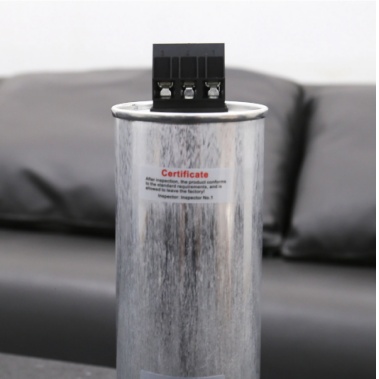
A power capacitor supplies reactive power locally (capacitive kvar), which offsets inductive kvar from the load. The goal is not to “create energy,” but to reduce unnecessary current in the upstream system.
Why low power factor can cost you
Utility penalties or higher demand charges in many regions
Higher current for the same kW → higher losses and heat
Reduced available capacity in transformers and feeders
Voltage drop issues on long runs
When you DO need a power capacitor for power factor correction
1 You have consistent inductive loads and PF is consistently low
If your site runs motors or transformers for many hours a day, and your measured PF (or kVAr demand) is consistently poor, a capacitor bank is often one of the simplest upgrades.
Typical signs:
PF frequently below common targets (often 0.90–0.95, depending on utility rules)
High reactive power flow (kvar) even when production is steady
Transformers and cables run warmer than expected at normal kW
2 You are paying PF penalties or missing contract requirements
This is the most direct business case. If your bill has a reactive energy charge or a PF penalty line item, correcting PF can pay back quickly—if harmonics are addressed properly.
3 Your electrical infrastructure is current-limited, not kW-limited
Sometimes the problem is not the electricity price—it’s capacity. If a transformer or feeder is close to its current limit, improving power factor can reduce current and effectively free capacity for expansion without upgrading upstream equipment.
4 You need voltage support at the load side
Capacitors can help improve local voltage, especially on long feeders with motor starts or heavy inductive loading. This can stabilize equipment operation. (Voltage support should be designed carefully—more is not always better.)
5 You want better system efficiency and lower losses
If your facility has long cable runs and high current, reducing reactive current can reduce copper losses. It won’t transform your energy bill alone, but it can be meaningful for large installations.
When you do NOT need a power capacitor (or should be cautious)
1 Your PF is already acceptable at the point of common coupling
If measurements show PF already near target under normal operation, adding capacitors may provide little benefit—and can even cause leading power factor (overcorrection), which some utilities also dislike.
2 Your load profile is highly variable or intermittent
If motors and inductive loads switch on/off frequently, a fixed capacitor can overcorrect when loads drop. In these cases, you typically need:
Automatic (step) capacitor banks with a controller, or
Localized correction at specific motors, or
Sometimes no correction if PF is only low for short intervals and no penalties apply
3 Your “low PF” is being driven by harmonics and non-linear loads
Modern facilities often include VFDs, UPS systems, rectifiers, EV chargers, and switching power supplies. These can distort current waveforms. In such cases, the meter might show poor power factor, but the issue is not purely reactive power—it’s distortion power factor.
Adding a standard capacitor bank without harmonic consideration can create:
Resonance (amplifying harmonics)
Capacitor overheating and swelling
Nuisance tripping and fuse failures
If you have significant harmonics, you may still use capacitors—but usually with detuned reactors (harmonic filters) and proper design.
4 You are correcting a short-lived condition (like brief motor starts)
Power factor during motor starting is not the same as steady running. Designing capacitors for transient start conditions can lead to oversizing and switching stress. Correct PF based on steady-state operational data.
5 You are trying to fix a voltage problem that’s caused by something else
If voltage dips are due to undersized transformers, poor connections, or heavy inrush events, capacitors may not solve the root cause. PF correction is not a universal voltage stabilizer.
A practical decision table: install, use automatic steps, or skip
Situation | What you typically see | Best approach |
Steady motors/transformers | PF low most of the day | Fixed or stepped capacitor bank |
Variable production lines | PF swings with load | Automatic step capacitor bank |
High VFD/UPS/rectifier use | Harmonics present, heating/trips | Capacitors + detuned reactors (engineered PFC) |
No PF penalties + PF acceptable | Little billing impact | Often skip; monitor only |
PF low only during starts | Short transient PF dips | Don’t size to starts; evaluate steady operation |
Small single motor far from panel | Local PF correction improves feeder current | Motor-mounted/nearby capacitors (with care) |
How we recommend deciding (without guesswork)
Step 1: Measure at the right location
Use a power quality analyzer at:
Main incomer (what the utility “sees”)
Key distribution panels (where big inductive loads are)
Panels feeding VFDs/UPS if present
Step 2: Separate “reactive PF” from “distortion PF”
If harmonics are high (e.g., elevated THD), standard capacitors may need detuning or filtering. A quick check is to look for:
Overheating in transformers/cables at moderate kW
Frequent capacitor failures (if any exist already)
Audible noise in transformers
UPS/VFD heavy penetration
Step 3: Define the target
Common targets are around 0.95, but the “right” target depends on:
Utility requirements
Risk of overcorrection at light load
Harmonic environment
Step 4: Choose the architecture
Central bank at main panel: easy to manage, common choice
Distributed banks at subpanels: better local current reduction
Motor-level correction: effective for fixed motors, but must coordinate with contactors and motor control strategy
Closing thoughts: when to use a power capacitor—and when to skip it
A power capacitor is the right tool when low power factor is driven by steady inductive loads, when there are measurable penalties or capacity issues, and when the network is designed to handle switching and harmonics properly. It’s not the right tool when PF is already fine, when the problem is mostly distortion from non-linear loads without proper detuning, or when PF issues are only transient and not economically meaningful. The best outcome comes from a simple sequence: measure → diagnose (reactive vs distortion) → choose architecture (fixed vs stepped) → design for harmonics → install with proper protection.
If you’re evaluating a PFC upgrade and want a straightforward discussion based on your load profile (motors, VFDs, transformers, operating shifts, and any harmonic concerns), you can learn more from Zhejiang Zhegui Electric Co., Ltd.. Our recommendation is always to start from real measurements and select the capacitor solution that fits your operating reality—whether that’s a fixed bank, an automatic stepped system, or a detuned design for harmonic environments. If you share your basic system details, we can point you toward a practical direction and the right specification path.
FAQ
1) When do you need a power capacitor for power factor correction in a factory?
You typically need a power capacitor when you have steady inductive loads (motors/transformers), consistently low PF at the main incomer, and either utility penalties or current/capacity constraints. In these cases, PFC can reduce reactive current and improve system efficiency.
2) When should you NOT install a power capacitor bank?
You should often avoid or delay installation if PF is already acceptable, if low PF appears mainly during brief transients, or if the site has significant harmonics and you’re not using a detuned/harmonic-aware design—because a standard capacitor bank may overheat or cause resonance.
3) Is a fixed power capacitor or an automatic stepped bank better?
A fixed solution is best for stable loads. An automatic stepped capacitor bank is better when loads vary across shifts or machines cycle frequently, because it reduces overcorrection risk and maintains PF near the target setpoint.
4) Can power capacitors cause problems with VFDs and harmonics?
They can—if harmonics are significant and the design is not detuned. In VFD/UPS-heavy sites, power capacitors often need detuned reactors and proper ratings to prevent resonance, overheating, and nuisance tripping while still achieving power factor correction.