


When people first enter medium-voltage power distribution, we often hear the same assumption: “A ring main unit and a transformer are both electrical boxes in a substation, so they must do similar things.” From our day-to-day conversations with EPC teams, facility engineers, and utility partners, we’ve learned that this confusion is completely normal—because the ring main unit and the transformer usually sit close to each other, sometimes inside the same compact kiosk or packaged substation. But they serve fundamentally different purposes. If you mix up their roles, you can easily end up with the wrong equipment specification, missing protection, or a layout that looks fine on paper but becomes difficult to operate safely. In this article, we’ll explain the difference in plain engineering terms, show how both devices fit into a typical MV-to-LV supply chain, and share the practical questions we use internally when reviewing a single-line diagram. Our goal is not to “sell a box,” but to help you make a more reliable and operable distribution system—because clarity at the design stage saves a lot of time and risk later.
Start with the simplest definition
What is a ring main unit?
A ring main unit is medium-voltage switchgear designed to connect, isolate, and protect parts of an MV distribution network—especially in ring or loop configurations. In practical terms, it gives operators a safe way to:
switch loads on/off,
isolate a faulty section,
maintain service continuity (feed from the other side of the ring),
protect downstream equipment using fuses or circuit breakers (depending on the feeder type).
Think of the ring main unit as the traffic controller for MV power flow.
What is a transformer?
A transformer is an electrical machine that changes voltage levels by electromagnetic induction. In distribution systems, it typically steps MV down to LV (for example, 11 kV or 24 kV down to 400 V). It does not “switch the network” in the operational sense. It does not replace switchgear. Its primary job is to transform voltage and provide the capacity needed by loads.
Think of the transformer as the voltage converter and capacity provider between MV and LV.
What each device does in a typical MV distribution setup
A common arrangement for a commercial facility, residential development, or industrial site looks like this:
MV incoming feeders from the utility (often two directions in a ring)
Ring main unit (switching + isolation + protection for transformer feeder)
Transformer (MV to LV)
LV switchboard (distribution to building loads)
If the site is fed by a ring, the ring main unit is the device that allows the ring to stay energized while isolating faults, maintaining supply, and enabling safe maintenance.
Side-by-side comparison table
Here’s the comparison we use to help non-specialists quickly separate the two.
Aspect | Ring main unit | Transformer |
Primary function | Switching, isolation, and protection in MV network | Voltage conversion (MV ↔ LV) |
Typical voltage level | Medium voltage (e.g., 6–36 kV range depending on system) | MV on primary, LV on secondary |
What problem it solves | Network control and fault isolation | Deliver usable voltage and capacity to loads |
Main internal elements | Load break switches, earthing switch, fuse switch or circuit breaker, busbars, interlocks | Core, windings, insulation system, cooling system |
Operation | Frequently operated (switching, isolation, earthing procedures) | Normally not “operated” daily; runs continuously |
Protection role | Provides feeder protection (fuses/CB + relay depending on design) | Depends on external protection; may have internal protections (temperature, gas relay in oil units) |
Location | MV switchgear room, kiosk substation, compact RMU cabinet | Adjacent to RMU in substation; can be in same kiosk |
What happens if you remove it | MV network becomes hard/unsafe to isolate and protect | You cannot supply correct LV voltage to loads |
Why they are placed together and often confused
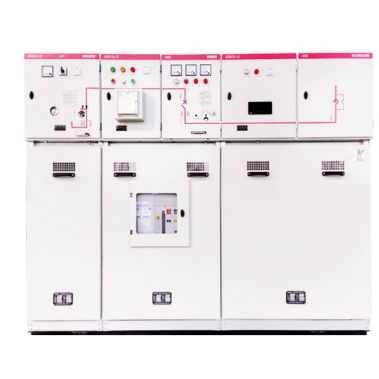
In compact substations, the RMU and transformer may be housed side-by-side:
The RMU handles incoming MV feeders and the transformer feeder.
The transformer sits immediately downstream, feeding the LV switchboard.
From the outside, both can look like “metal cabinets,” but the internal purpose is completely different: one is switchgear, the other is a power conversion machine.
How protection differs between a ring main unit and a transformer
This is one of the most practical differences.
Protection in a ring main unit
A ring main unit typically protects:
ring feeders (often with load break switches + earthing switches for sectionalizing),
the transformer feeder (commonly with fused switch or circuit breaker module).
Depending on the design, transformer feeder protection can be:
fuse-based (simple, robust, commonly used),
circuit breaker + relay (more adjustable and selective, often preferred when coordination is complex).
Protection in a transformer
Transformers are protected by:
upstream protection (often in the RMU transformer feeder),
internal monitoring/protection devices (depending on type), such as temperature sensors, oil level, pressure relief devices, gas relays (for certain oil designs), etc.
In other words: the transformer is often protected by the RMU, not the other way around.
Switching and safety responsibilities are not the same
When we review an MV operating procedure, the ring main unit is usually central to safety steps:
open switch,
verify isolation,
apply earthing,
lock-out/tag-out,
test for absence of voltage (as required by the procedure),
then access downstream equipment.
A transformer is not a switching device; you don’t “open the transformer” to isolate the network. You isolate the transformer using switchgear (often the RMU).
How both appear in a one-line diagram
A helpful way to understand the difference is to see how each is represented.
One-line diagram element | Typical symbol meaning | Practical meaning |
Ring main unit (MV switchgear) | Switch/fuse/CB modules on MV bus | MV control point for ring feeders and transformer feeder |
Transformer | Two windings with ratio label | Voltage step-down or step-up between MV and LV |
LV switchboard | Breakers and outgoing feeders | Distributes LV power to loads |
If your one-line diagram has a ring supply, the RMU is usually the “node” that allows ring continuity and safe isolation.
What questions help you choose the right ring main unit
When selecting a ring main unit, we recommend focusing on the system needs, not just a generic “11 kV RMU” label:
Network topology: ring or radial? How many feeders?
Configuration: 2-in 1-out? 3-in 1-out? More?
Rated voltage and insulation level: based on system requirements
Rated current and short-circuit withstand: aligned with fault levels
Protection approach: fused switch vs circuit breaker + relay
Insulation technology: gas insulated, solid insulated, or other designs
Operational safety: interlocks, earthing switch arrangement, cable test access, indicators
Environment: temperature, humidity, altitude, indoor/outdoor, corrosion risk
These considerations are unrelated to what makes a transformer “right,” which is largely about kVA, impedance, cooling, insulation class, and loss performance.
Closing thoughts and next steps
From our perspective as a manufacturer-focused team working around MV distribution equipment, the most reliable projects are the ones where everyone shares the same basic mental model: the ring main unit is the MV control and protection point, and the transformer is the MV-to-LV energy bridge. When that’s clear, decisions become easier—how many MV ways you need, what protection philosophy fits your network, where isolation and earthing must happen, and how to coordinate with the transformer’s kVA rating and LV switchboard design. If you’re developing a new substation, upgrading an existing MV network, or simply trying to confirm whether your single-line diagram is logically complete, learning the difference between these two devices is a great place to start. For more engineering references, configuration options, and project discussion support related to ring main unit applications in medium-voltage distribution, you can reach out to Zhejiang Zhegui Electric Co., Ltd. to learn more. If you share your voltage level, feeder arrangement, and protection preference, we can help you think through a practical RMU configuration and how it integrates with the transformer and the rest of the station—without turning the conversation into a hard sell.
FAQ
1) Can a ring main unit be used without a transformer in an MV network?
Yes, a ring main unit can operate in MV networks for switching and sectionalizing even when no MV-to-LV transformation is needed, such as MV-only distribution nodes or cable sectionalizing points.
2) Where is the ring main unit installed relative to the transformer in a compact substation?
In many compact substations, the ring main unit is installed on the MV side upstream of the transformer, controlling incoming MV feeders and the transformer feeder, while the transformer feeds the LV switchboard.
3) What ratings should be coordinated between a ring main unit and a transformer feeder?
You should coordinate MV rated voltage/insulation level, feeder protection method (fuse or CB+relay), cable terminations, and fault-level withstand capability so the transformer feeder is properly protected and operable.
4) Is a transformer feeder in a ring main unit typically protected by fuses or a circuit breaker?
Both are used. Fused transformer feeders are common for simplicity and robustness, while circuit breaker + relay solutions are often preferred when protection selectivity, adjustability, and advanced coordination are required.