


In many industrial and utility projects we support, the conversation about reactive power starts simple—“We need to improve power factor”—and then quickly becomes confusing when different teams use the same words to mean different things. Some people say “capacitor” when they mean an entire cabinet with steps, contactors, fuses, and a controller. Others say “capacitor bank” when they actually need only a single power capacitor installed near a motor control center, a transformer secondary, or an MV feeder. From our perspective as a manufacturer working across medium-voltage and low-voltage compensation applications, the difference is straightforward: a power capacitor is the core reactive power component, while a capacitor bank is an engineered system that uses multiple capacitors plus switching, protection, and controls to deliver compensation in a coordinated way. Understanding this difference helps you specify the right solution, avoid overbuying, and improve reliability—especially in networks with harmonics, frequent switching, or uneven load profiles.
First: What is a power capacitor?
A power capacitor is a capacitor designed specifically for power systems (as opposed to small electronic capacitors in circuits). Its purpose in AC networks is typically to provide reactive power (kvar) to:
Improve power factor
Reduce reactive current flow
Reduce losses and voltage drop
Release capacity in transformers and feeders
Support voltage stability (in some applications)
Power capacitors are built and tested to handle:
Continuous AC voltage and current
Temperature rise
Harmonic currents (depending on design and application)
Switching events and system transients (within specified limits)
Power capacitors can be used at:
LV (e.g., 400/415/480 V)
MV (e.g., 6 kV, 10 kV, 11 kV, 12 kV, etc.)
Sometimes higher voltages in utility applications
What is a capacitor bank?
A capacitor bank is a system made from multiple power capacitors arranged to provide the required kvar—often in steps—and combined with the equipment needed for safe, controlled operation. A capacitor bank typically includes:
Multiple power capacitor units (the kvar “building blocks”)
Switching devices (contactors, vacuum contactors, breakers, thyristor switches)
Protection (fuses, overload, unbalance, discharge resistors, surge protection)
Enclosure/cabinet or structure
Controller (automatic power factor controller, relay logic, or SCADA integration)
Reactors (detuned reactors or harmonic filters when needed)
So the capacitor bank is the “package,” while the power capacitors are the “active reactive-power elements” inside.
The simplest way to remember the difference
Power capacitor = a single capacitor unit designed for power systems, rated in kvar and voltage.
Capacitor bank = multiple power capacitors + switching + protection + control, designed as a coordinated compensation system.
Quick comparison table: power capacitor vs capacitor bank
Aspect | Power Capacitor | Capacitor Bank |
What it is | A single reactive power component | A complete compensation system |
Main purpose | Provide kvar at one point | Provide kvar in steps, centrally or automatically |
Typical location | Near loads (motors, MCCs), transformers, MV feeders | Substations, main distribution boards, plant PCC |
Scaling | Limited (single unit size) | Flexible (multiple steps, expandable) |
Switching complexity | Often fixed or simple switching | Can be manual, automatic, or fast switching |
Protection | Basic per-unit protection | Coordinated protection and monitoring |
Best for | Stable load, local correction, targeted improvement | Variable load, plant-wide correction, automation needs |
Why we often recommend starting with the “power capacitor” mindset
Even when a customer asks for a “capacitor bank,” we usually begin by confirming the correct power capacitor fundamentals—because bank performance depends heavily on capacitor selection.
1 Correct kvar at the correct voltage level
A capacitor must be rated appropriately for the system voltage and the kvar target. Over- or under-sizing leads to:
Under-correction (still paying penalties or running high reactive current)
Over-correction (leading power factor, possible voltage rise issues)
Unstable control behavior in automatic banks
2 Correct duty for harmonics and switching
If a system has significant harmonics (common with VFDs, rectifiers, UPS systems, EV chargers, and arc furnaces), capacitor current can increase beyond what basic sizing calculations suggest. In those cases:
A power capacitor must be selected with suitable current capability and thermal margin
A bank may require detuned reactors or filtering
Protection and switching must be adapted accordingly
3 Correct installation point
A single power capacitor installed at the right node can reduce reactive current through upstream cables and transformers—sometimes delivering more benefit than a centralized bank alone.
Where a single power capacitor is the best fit
From what we see in the field, power capacitors are often the most practical choice when:
A The load is stable and predictable
If a load runs consistently (e.g., a motor group that operates most of the day), a fixed power capacitor near the load can:
Raise local power factor
Reduce feeder current
Improve voltage stability at the load point
B You need targeted correction at a specific feeder or transformer
If one part of a plant causes a low power factor, adding a power capacitor at that feeder can reduce reactive flow across the rest of the network.
C Space and simplicity matter
A single unit (or a few units) can be installed with minimal controls—especially in retrofit projects where a large cabinet is impractical.
D You want an incremental approach
Many customers prefer to improve power factor step-by-step:
Install power capacitors in the worst areas
Measure improvement
Decide whether a full capacitor bank is still necessary at the PCC
This approach reduces the risk of buying a system larger than needed.
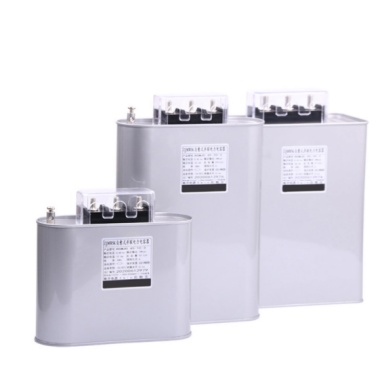
Where a capacitor bank makes more sense
A capacitor bank is usually the best option when:
A Loads vary significantly
If plant load changes throughout the day, automatic banks can switch kvar steps in and out to maintain a target power factor.
B You have a central compensation strategy
At a main distribution board or plant PCC, a capacitor bank can manage the facility’s reactive power requirement in one location.
C You need staged control
Instead of one big capacitor, banks use steps (e.g., 25 kvar × 10 steps, or 200 kvar × 6 steps, etc.) to match reactive demand without overcompensation.
D Monitoring and coordination are required
Banks can include alarms, status signals, temperature monitoring, unbalance detection, and integration to broader energy management.
System design differences that affect performance
1 Switching method (and why it matters)
A power capacitor can be fixed, or switched by a contactor/breaker. A bank may use:
Contactor switching (common in LV)
Vacuum contactors (common in MV steps)
Thyristor (static) switching for fast, frequent changes
Circuit breakers for some MV/utility applications
Frequent switching requires more robust design—both in capacitors and switching components.
2 Discharge and safety
Power capacitors retain charge after disconnect. Banks generally implement coordinated discharge resistors and safety interlocks, while a single capacitor installation must still follow safe discharge practices and relevant standards.
3 Unbalance detection and failure management
In MV capacitor banks (especially in utility/substation environments), unbalance protection is a major reliability topic. A single power capacitor is simpler, but less monitored unless the system includes additional sensors.
Closing thoughts (our perspective)
In most medium- and low-voltage power factor correction projects, the difference between a “power capacitor” and a “capacitor bank” is not a matter of terminology—it’s a matter of architecture. A power capacitor is the essential kvar-producing element used to correct reactive power locally or at a specific node. A capacitor bank is a coordinated system that combines multiple power capacitors with switching, protection, and control so the compensation can be staged, monitored, and adapted to changing load conditions. In practice, we often see the best results when projects start with the right power capacitor selection—correct kvar, correct voltage rating, suitable harmonic duty—and then scale into a bank only when variability, monitoring, or centralized control truly requires it. That approach tends to deliver cleaner performance, easier commissioning, and fewer surprises during operation.
If you are planning a reactive power solution and want to validate whether a single power capacitor can solve the issue—or whether a stepped capacitor bank is the more appropriate path—we welcome technical discussions based on your load profile, network diagram, and harmonic environment. You can learn more through Zhejiang Zhegui Electric Co., Ltd., and our team can support you in selecting practical configurations that fit real site conditions rather than forcing a one-size-fits-all cabinet.
FAQ
1) What is a power capacitor used for in power factor correction?
A power capacitor supplies reactive power (kvar) to offset inductive loads, improving power factor, reducing current, and lowering losses in cables and transformers.
2) What is the main difference between a power capacitor and a capacitor bank?
A power capacitor is a single kvar component. A capacitor bank is a system that combines multiple power capacitors with switching, protection, and control to provide staged or automatic compensation.
3) Can I use a power capacitor instead of a capacitor bank?
Yes, if the load is stable or the reactive power problem is localized. A properly sized power capacitor near the load or feeder can be simpler and highly effective without a full bank.
4) Do capacitor banks always need reactors for harmonics?
Not always. If harmonic distortion is significant (often due to VFDs/rectifiers), banks may need detuned reactors to avoid overheating and resonance. Harmonic assessment is the right first step.