


In AC power systems, many of the loads that keep modern industry running—motors, pumps, compressors, welding machines, HVAC units, and induction furnaces—don’t just consume “useful” power. They also demand reactive power to build magnetic fields, and that reactive demand quietly increases current in cables and transformers. In day-to-day operation, the result shows up as low power factor, higher losses, reduced capacity, and sometimes higher utility charges. When customers come to us asking how to “fix power factor,” they’re rarely looking for a theoretical explanation—they want a practical solution that improves efficiency without redesigning their entire network. This is exactly why power capacitors remain one of the most effective and widely adopted tools in AC networks. A properly selected power capacitor doesn’t create energy out of nothing; instead, it locally supplies reactive power that inductive loads would otherwise pull from the grid. That single change reduces unnecessary current flow, stabilizes voltage, and frees up capacity across the system.
Power factor in plain language: what’s really happening?
In an AC network, your meters and bills are influenced by three key quantities:
Active power (kW): the power that performs useful work (turning shafts, heating, lighting).
Reactive power (kvar): the power that oscillates between source and load to support magnetic and electric fields (common in motors and transformers).
Apparent power (kVA): the combined “total” power the network must deliver, linked to current and equipment loading.
When a site has lots of inductive equipment, kvar rises, kVA rises, and PF drops. That’s when the same useful kW requires more current to deliver—creating avoidable stress on cables, breakers, transformers, and generators.
Why low power factor is a real operational problem
We often explain low PF as “hidden current.” Your production may still run, but the network pays the price:
Higher current and higher losses
Copper loss is proportional to I²R. Even a moderate current increase can raise heat and losses noticeably.Less usable capacity
Transformers and generators are rated in kVA. If kVA is consumed by reactive demand, less capacity remains for real kW expansion.More voltage drop
Higher current can amplify voltage drop along feeders, affecting motor performance and process stability.Utility penalties or higher tariffs
Many utilities charge for poor PF or excessive reactive energy, particularly for industrial customers.
This is why power factor correction is not only an “electrical engineer topic”—it’s often a cost and reliability decision.
What a power capacitor does in an AC network
A power capacitor provides leading reactive power (capacitive kvar). Inductive loads require lagging reactive power (inductive kvar). When a capacitor is installed, it supplies part (or most) of the reactive power locally, reducing what must come from the upstream grid.
The core idea
Without capacitors: Reactive power flows from the utility → through transformer → through cables → into inductive loads.
With capacitors: A portion of reactive power is supplied near the load, so the upstream network carries less reactive current.
This reduces kVA demand for the same kW load, which increases PF.
How power capacitors improve power factor (step-by-step)
Let’s break the improvement mechanism into clear steps:
Step 1: Capacitor generates capacitive reactive power
A capacitor in AC stores and releases energy each cycle, producing reactive power that leads the voltage.
Step 2: Reactive power balance improves at the load point
Inductive equipment (motors, transformers) creates lagging reactive demand. The capacitor offsets part of this demand.
Step 3: Line current decreases
Because kVA demand decreases, the current drawn from upstream decreases for the same kW. That reduction improves:
Cable heating
Voltage profile
Transformer loading
Overall losses
Step 4: Power factor increases
As kvar decreases, the ratio kW/kVA increases. That’s the PF improvement.
A quick example to make the effect intuitive
Imagine a site that needs 500 kW of active power and has 375 kvar of inductive reactive power demand:
kVA = √(500² + 375²) = √(250000 + 140625) = √390625 = 625 kVA
PF = 500 / 625 = 0.80
If we install power capacitors supplying 250 kvar:
Net kvar = 375 – 250 = 125 kvar
kVA = √(500² + 125²) = √(250000 + 15625) = √265625 ≈ 515.4 kVA
PF = 500 / 515.4 ≈ 0.97
Same 500 kW output, but lower kVA and lower current. That difference is what operators feel as “more capacity” and “less heating.”
What changes in your system after power capacitor installation
Here’s a practical summary of system-level changes we commonly observe:
Network Aspect | Before Capacitor (Low PF) | After Capacitor (Corrected PF) |
Line current | Higher | Lower |
Cable & busbar heating | Higher I²R loss | Reduced loss |
Transformer loading (kVA) | Consumed by kvar + kW | More capacity available |
Voltage drop | More pronounced | Improved stability |
Breaker stress | Higher current stress | Lower stress |
Utility PF penalties | Possible | Often reduced/avoided |
Where power capacitors are typically applied
From project experience, capacitor placement matters as much as capacitor size. In general, there are three common strategies:
1 Individual correction (at the motor/load)
A capacitor installed close to an inductive load (like a motor) corrects reactive demand locally.
Best when: the load operates steadily and independently.
2 Group correction (at a sub-distribution board)
Capacitors correct multiple loads in a section.
Best when: loads vary, but the group stays relatively consistent.
3 Central correction (at the main bus)
A capacitor bank corrects the whole facility.
Best when: you want simplified management and monitoring at one point, often paired with automatic switching.
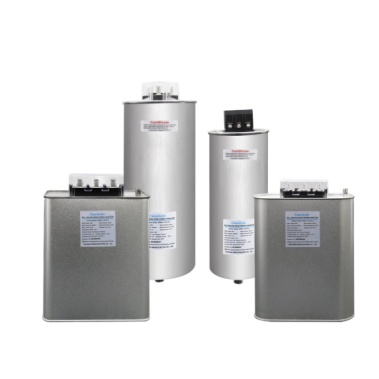
Fixed capacitor vs automatic capacitor bank: which fits better?
Many facilities start with a fixed capacitor and later upgrade to an automatic capacitor bank. Here’s a simple decision guide:
Option | What it is | Best fit | Typical caution |
Fixed power capacitor | Constant kvar output | Stable loads, single motor correction | Risk of overcompensation at light load |
Automatic capacitor bank | Step-switched capacitors based on PF | Variable loads, whole-plant PF control | Requires controller + switching design |
In real production environments, loads rarely stay constant all day. That’s why automatic solutions are common in industrial distribution.
Key selection points we focus on with customers
1 Target power factor and reactive power requirement
You need to define where you want PF to land—many sites aim around 0.95–0.99 depending on tariff structures and operating philosophy.
2 Network voltage and installation level
Capacitors exist for LV and MV applications. Proper voltage class selection is essential.
3 Harmonics and resonance risk
If your network has significant harmonics (VFDs, UPS, arc furnaces), capacitors can interact with the system impedance. In those cases, detuning reactors or filtering strategies may be needed. This isn’t something to ignore—harmonics can shorten capacitor life if not addressed.
4 Temperature, ventilation, and duty cycle
Capacitors generate heat. Enclosure design and ambient conditions matter for service life.
5 Switching method and inrush control
Automatic banks require switching. Poor switching design can cause inrush currents and stress components, so correct switching devices and step sizing are important.
Closing thoughts
A power capacitor improves power factor in AC networks by doing one essential job exceptionally well: it supplies reactive power locally so inductive loads don’t have to pull as much reactive energy from upstream equipment. That reduction in reactive flow lowers kVA demand, reduces current, cuts losses, and stabilizes voltage—without changing the useful kW your facility needs for production. From our perspective, the most successful power factor correction projects begin with accurate measurements (load profile, PF trends, harmonics), then apply a capacitor solution that fits how the site actually operates—fixed where loads are steady, automatic where loads vary, and detuned where harmonics are present. If you’re planning a new distribution upgrade or correcting persistent PF issues, we recommend treating capacitor selection as a system design decision, not a quick “add-on.” To learn more about power capacitor options, capacitor bank configurations, and practical application guidance for industrial AC networks, you can visit Zhejiang Zhegui Electric Co., Ltd. for additional information, or contact our team to discuss your operating conditions and correction targets.
FAQ
1) How does a power capacitor improve power factor in an AC network?
A power capacitor supplies capacitive reactive power (kvar) locally, offsetting the lagging reactive power demanded by inductive loads. This reduces kVA and current from the grid, increasing power factor.
2) Where should power capacitors be installed for best power factor correction?
They can be installed at individual motors, at a distribution panel for a load group, or centrally at the main bus. The best location depends on load stability, network layout, and operational needs.
3) Can power capacitors cause problems in systems with harmonics?
Yes. In networks with many VFDs or nonlinear loads, capacitors can interact with system impedance and increase resonance risk. Detuning reactors or filtering strategies may be required for reliable operation.
4) What is the difference between a fixed power capacitor and an automatic capacitor bank?
A fixed capacitor provides constant kvar, suitable for steady loads. An automatic capacitor bank switches capacitor steps based on measured PF, making it better for variable industrial loads and shift-based operations.