


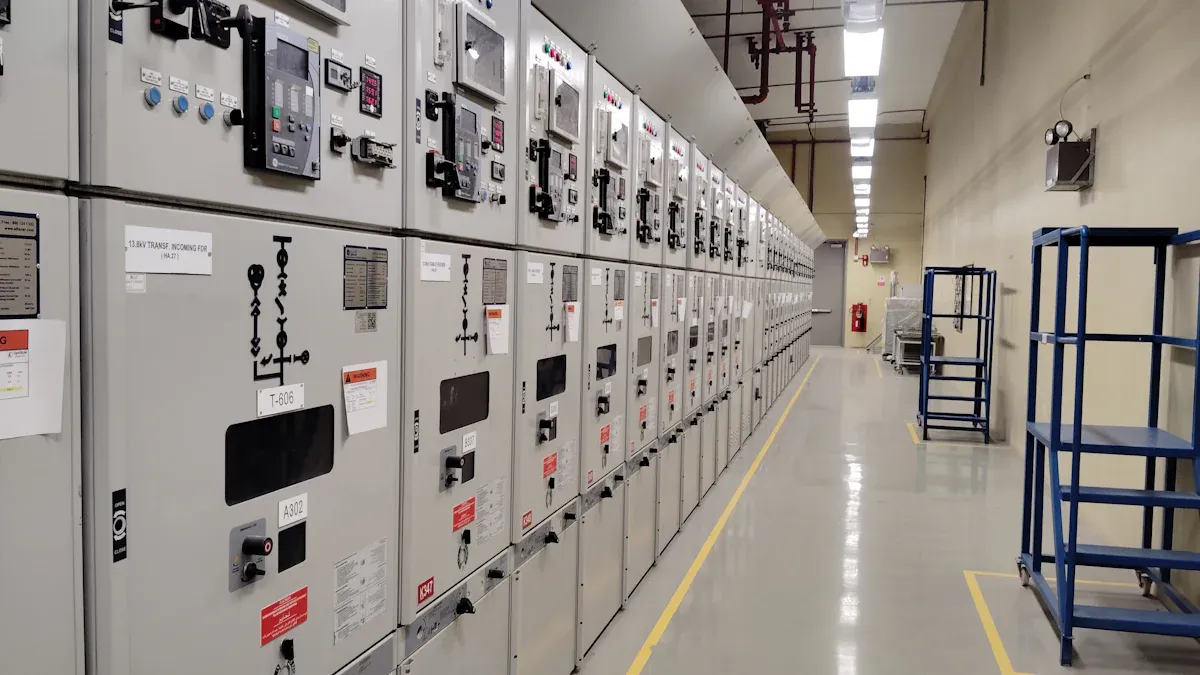
Gas insulated switchgear solutions help control and protect power systems. You see them in places with little space and high voltage. These systems use a special gas to keep equipment safe. The gas also helps make the equipment smaller. The table below shows how their voltage range compares to other types:
Type of Switchgear | Voltage Range |
|---|---|
Medium-voltage switchgear | 1 kV to 36 kV |
High-voltage switchgear | Exceeds 36 kV |
Gas Insulated Switchgear | 1 kV to 36 kV (typically) |
Their small size helps them work well in modern power networks. You can trust them to be reliable.
Key Takeaways
Gas insulated switchgear (GIS) uses less space. It fits well in busy places. This makes it good for city substations. It also works well underground.
GIS is safer because it uses sulfur hexafluoride (SF₆) gas. This gas keeps electrical parts safe from dust. It also protects them from moisture. This lowers the chance of electrical fires.
GIS does not need much maintenance. You only need to check it every four years. This helps save money over time. It costs less than air insulated switchgear.
GIS works well and does not fail often. It has a failure rate of just 1.46%. This means it gives steady power in tough places.
Picking the right GIS means you must look at your power needs. You should also think about your site and budget. Talk to experts to find the best choice.
What are gas insulated switchgear solutions
Main features and components
Gas insulated switchgear solutions are small and easy to fit. They use special gases to keep electrical parts safe. The most used gas is called sulfur hexafluoride, or SF₆. This gas helps make the equipment safe and not too big.
Inside these systems, you find some main parts:
Circuit breakers
Disconnectors
Busbars
Instrument transformers
Earthing switches
All these parts work together to control electricity. They also help protect the system. You can look at the table to see how gas insulated switchgear and air insulated switchgear are different:
Component Type | Air Insulated Switchgear (AIS) | Gas Insulated Switchgear (GIS) |
|---|---|---|
Size | Larger space requirements | Compact, requires less space |
Risk of Electrical Arcs and Fires | Higher risk | Lower risk |
Maintenance Requirements | Easier access for maintenance | More complex, harder access |
Initial Cost | Lower initial cost | Higher initial cost |
Environmental Impact | More environmentally friendly | Gas can be harmful if mishandled |
Gas insulated switchgear solutions do not need much space. They also protect better against electrical arcs. They cost more at first and need careful gas handling.
The SF₆ gas has special things that make it useful:
Property | Description |
|---|---|
High Dielectric Strength | SF₆ can handle high voltages and is a great insulator. |
High Thermal Electric flow ability | It helps cool the inside parts by moving heat away. |
High Electron Affinity | SF₆ grabs free electrons, so it stops charge buildup and arcs. |
These things help the switchgear stay safe and work well.
How GIS operates
Gas insulated switchgear solutions use SF₆ gas to keep electrical parts safe. When you turn on the system, the gas covers the live parts. This stops electricity from leaking and keeps arcs from happening.
Gas insulated switchgear is different from air insulated switchgear. SF₆ gas can handle higher voltages without breaking down. The gas also puts out arcs fast. This makes the system smaller and more reliable.
Tip: Gas insulated switchgear solutions work well in tough places. The gas keeps out water and dust from the parts.
You might wonder if these systems are reliable. Studies show gas insulated switchgear solutions fail only 1.46% of the time. This is better than many other switchgear types. You get a system that works well and lasts long.
Using gas insulated switchgear solutions makes your power system safer. It also saves space and lowers the chance of electrical fires.
Key advantages of GIS
Compactness and space savings
Sometimes, you have to put equipment in small spaces. Gas insulated switchgear solutions help with this problem. These systems use a special gas and are closed up tight. You can put them where air insulated switchgear cannot fit.
GIS takes up only 10% to 30% of the space that air insulated switchgear needs.
Small GIS units can save up to 70% more space than AIS.
GIS is used in underground substations and busy city areas.
In 2024, more than 41% of GIS systems were put in city substations in places like China, India, Brazil, and the UAE.
Note: The small design helps you use space better. You can fit more equipment in crowded places.
Safety and reliability
You want your power system to be safe and work well. GIS helps make this happen. The gas inside keeps the electrical parts safe. It stops water and dust from getting in. The closed design lowers the chance of electrical arcs and fires.
GIS works well in tough places.
You get fewer problems and the equipment lasts longer.
GIS is chosen in busy cities because it works well and needs less fixing.
Maintenance and durability
You need equipment that lasts a long time and does not break often. GIS is strong and lasts long. The sealed system keeps out water and dirt. You do not have to fix it as much.
The table below shows what can go wrong and how GIS helps stop these problems:
Cause of Failure | Description |
|---|---|
Partial Discharge (PD) | Electrical discharge in insulation gaps, can cause breakdown. |
SF6 Gas Leaks | Losing or dirty gas makes insulation weaker. |
Thermal Overstress | Too much heat from heavy use ages insulation. |
Mechanical Failures | Worn or misaligned parts can stop the system. |
Gas Quality Issues | Bad gas makes harmful stuff that hurts insulation. |
You can lower these problems by checking and fixing things often. GIS needs careful gas handling, but it lasts longer and needs fewer repairs than other types.
Applications in power systems
Substations and utilities
Gas insulated switchgear solutions are used in many substations. Utilities use them to control and protect electricity. These systems work well where there is not much space. GIS is chosen for medium- and high-voltage jobs. You can find GIS in city centers and underground substations. They are also used on offshore platforms. The small size lets you put equipment under roads or inside buildings. Utilities want power that is steady and safe. GIS helps lower the risk of power loss.
Location Type | GIS Benefit |
|---|---|
Urban substations | Saves space, easy to hide |
Underground stations | Protects from water, dust |
Offshore platforms | Handles harsh conditions |
Industrial and commercial use
Factories and big buildings need steady power. GIS helps meet special power needs in these places. Heavy industries like petrochemical plants use GIS. They need power all the time and do not have much space. Hydroelectric stations in the mountains use GIS near dams and water. In busy cities, GIS is put underground or inside tall buildings. As cities get more crowded, GIS helps give safe power with small ring main units.
GIS keeps power on in petrochemical plants with little space.
Hydroelectric stations use GIS for smart setups near water.
City centers put GIS underground to save space.
Tall buildings use GIS for safe power in small areas.
Tip: GIS lets you build flexible substations almost anywhere. It works even in crowded or tough places.
Renewable energy integration
More solar and wind power is added to grids each year. GIS makes this easier for everyone. These systems handle high-voltage loads from solar and wind. GIS keeps power steady, even when the sun or wind changes. You can put GIS in small places like wind farms or city rooftops. GIS protects parts from bad weather, rust, and dirt. This helps renewable projects work well.
GIS handles high-voltage loads from solar and wind.
GIS keeps power steady when energy changes.
You can put GIS in small or hard places.
GIS protects equipment from bad weather and dirt.
Offshore wind farms use GIS to stop salt and water damage.
Note: Many renewable energy projects use GIS to keep power safe and steady.
Types and configurations
Medium and high voltage GIS
Gas insulated switchgear solutions have different voltage levels. Each level is made for a certain job. Medium voltage GIS works for motors and feeder circuits. It also helps with distribution lines. High voltage GIS is used for bigger systems. It has more safety features. Look at the table to see the differences:
Voltage Classification | Voltage Range | Applications |
|---|---|---|
Medium Voltage | 1 kV to 75 kV | Motors, feeder circuits, generators, transmission and distribution lines |
High Voltage | 75 kV and above | High-voltage systems, improved safety features |
Medium voltage GIS is found in factories and city substations. High voltage GIS is used in large power plants and networks. Pick the right type for your system’s needs.
Tip: Always choose the voltage class that fits your job. This helps your system work well and stay safe.
Metal-enclosed vs. metal-clad
There are two main types: metal-enclosed and metal-clad GIS. Each type has special features for safety and maintenance. The table below shows how they compare:
Characteristic | Metal-Enclosed Switchgear | Metal-Clad Switchgear |
|---|---|---|
Enclosure Configuration | Single enclosure for all components | Separate enclosures for each component |
Compartmentalization | Accessible once the panel is opened | Individual access to components in different compartments |
Accessibility | Easy access to all components when the panel is opened | Access to individual compartments, enhancing safety |
Service Continuity | LSC-2A classification allows energized compartments | LSC-2B classification requires multiple compartments for maintenance |
Available Fault Current | Suitable for smaller loads and lower fault currents | Designed for higher available fault currents |
Safety Aspects | Protection against accidental contact with live parts | Additional safety features due to compartmentalization |
Metal-enclosed GIS lets you reach all parts at once. This makes fixing things faster. Metal-clad GIS keeps each part in its own space. This gives you more safety. Pick the type that matches your safety needs and load size.
Note: Knowing these types helps you use gas insulated switchgear solutions better.
Choosing gas insulated switchgear solutions
Assessing requirements
When you choose gas insulated switchgear solutions, you need to look at your needs first. You want your system to work safely and last a long time. Start by thinking about the size of your power system and how much electricity you need to control. You also need to check if your team has the right training and tools. Here are some important steps to follow:
Know the safety procedures for working with high-voltage equipment.
Use good judgment when planning your installation.
Make sure your team has enough training.
Prepare the site before bringing in equipment.
Check all components for damage before installation.
Look for any signs of damage during delivery.
Follow the right steps for installation and commissioning.
Tip: Careful planning helps you avoid problems later. Always check your site and equipment before you start.
Environmental and site factors
The place where you install your switchgear can change how long it lasts. Some sites have more dust, water, or pollution. These things can hurt your equipment. Gas insulated switchgear solutions work well in tough places because they keep out dirt and water. The table below shows how different factors affect the lifespan of switchgear:
Factor | GIS Lifespan | AIS Lifespan |
|---|---|---|
Reduced exposure to pollution | Up to 50 years | 25-30 years |
Reduced humidity impact | Up to 50 years | 25-30 years |
Lower temperature fluctuations | Up to 50 years | 25-30 years |
You can see that gas insulated switchgear solutions last longer in places with less pollution, less humidity, and steady temperatures. If your site has harsh weather or lots of dust, GIS is a smart choice.
Note: Always think about your local weather and site conditions before you pick your switchgear.
Cost and lifecycle analysis
You want to get the best value for your money. Gas insulated switchgear solutions cost more at first. The price can be 10% to 40% higher than air insulated switchgear. But you save money over time. GIS needs less maintenance. You only need to check it every four years. Air insulated switchgear needs checks every year or two. Over 20 years, GIS can cost less because you spend less on repairs and checks.
GIS has a higher upfront cost.
GIS needs fewer inspections and less maintenance.
Lower maintenance costs can make GIS cheaper over its life.
Tip: Think about the total cost, not just the price you pay at the start. GIS can save you money in the long run.
When you choose your switchgear, talk to experts. They can help you match your needs, your site, and your budget. Every project is different. An expert can help you pick the right type and size for your job.
You get many good things when you pick gas insulated switchgear solutions for your power system. These systems work well even in tough places and help you use less space. You do not have to fix them as much, and they keep your system safer. The table below shows how GIS helps make your power network strong and easy to change:
Benefit | Description |
|---|---|
Superior Performance in Harsh Environments | GIS keeps parts safe from dust and water, so your system works well. |
Reduced Maintenance and Life Cycle Costs | You do not need to repair as often, so you save money over time. |
Enhanced Reliability and Safety | GIS uses special insulation to keep your equipment safe and working. |
Increased System Flexibility and Expansion Capacity | You can add more units easily if you need more power. |
You also get new things like smart grid features and real-time checks. These updates help your system work better and be more reliable. When you learn about the types and how to choose, you can make better choices for your site. Think about GIS if you want a power system that will last and work well in the future.
FAQ
What is the main benefit of gas insulated switchgear?
You save space with gas insulated switchgear. The system protects electrical parts from dust and water. You get better safety and reliability in busy or harsh environments.
How often do you need to maintain GIS?
You check GIS every four years. The sealed design keeps out dirt and moisture. You spend less time and money on repairs compared to air insulated switchgear.
Can you use GIS outdoors?
Yes, you can use GIS outdoors. The system works well in places with rain, dust, or pollution. You get strong protection for your equipment.
Is SF₆ gas safe for the environment?
SF₆ gas can harm the environment if you do not handle it properly. You must follow safety rules and recycle the gas. Many companies now use eco-friendly alternatives.
How do you choose the right GIS for your site?
You look at your power needs, space, and local weather. You talk to experts for advice. You pick a system that fits your budget and safety goals.