


When we talk with utilities, EPC contractors, and industrial park owners, we notice the same pattern: people often use “switchgear” as a catch-all term for medium-voltage equipment, then later discover that a ring main unit (RMU) is a specific solution with its own logic, footprint, and operational advantages. In practical projects—especially where space is tight, reliability matters, and the network must remain energizable during maintenance—choosing between an RMU and broader switchgear lineups changes the entire layout of a substation or kiosk. And just as importantly, many teams also mix up what an RMU does versus what a transformer does. In this article, we’ll explain the real differences in clear engineering terms, share how we evaluate these choices from a manufacturer’s perspective, and highlight where an RMU makes the most sense in modern medium-voltage distribution.
Start with definitions (so the comparison is fair)
What is a ring main unit (RMU)?
A ring main unit is a compact, factory-assembled medium-voltage switchgear package designed for ring (or loop) distribution networks. It typically includes:
Two or more load break switches (for incoming/outgoing ring feeders)
One or more tee-off ways (often protected by a circuit breaker or fuse switch)
An enclosed, insulated design (commonly gas-insulated or solid-insulated, depending on technology)
In our projects, RMUs are most often deployed in:
Urban distribution networks
Industrial parks and campuses
Commercial complexes
Wind/solar collection networks (depending on topology)
Compact substations (kiosks/pad-mounted)
What is “switchgear”?
“Switchgear” is a broader category: it refers to assemblies used to switch, protect, and control electrical circuits. Switchgear can be:
Low voltage (LV)
Medium voltage (MV)
High voltage (HV)
Switchgear can be compact like an RMU—or it can be a large lineup of withdrawable circuit breaker panels with extensive relaying, metering, and busbar systems.
Key point: An RMU is a type of MV switchgear solution, but not all switchgear is an RMU.
RMU vs switchgear: the core difference is purpose and packaging
From how we design product families, we separate the decision into two questions:
What is the network function you need? (ring continuity, feeder switching, transformer protection, sectionalizing, etc.)
How much flexibility and room do you have? (site footprint, number of feeders, protection complexity, upgrade plans)
Practical differences at a glance
Here’s a comparison we use to align expectations early:
Item | Ring Main Unit (RMU) | General MV Switchgear Lineup |
Primary purpose | Compact ring/loop distribution switching + simple protection | Broader applications: feeders, bus couplers, incomers, complex protection schemes |
Typical layout | Small, integrated cubicles (often sealed/insulated) | Larger multi-panel lineups; more customization |
Footprint | Very compact | Usually larger |
Expandability | Limited ways (fixed structure) | High expandability (additional panels, bus extensions) |
Protection complexity | Moderate (depends on breaker way) | Can be very high (advanced relays, automation, busbar protection) |
Installation style | Fast deployment (often kiosk/substation) | More site work, more wiring and commissioning steps |
Best fit | Urban networks, compact substations, ring feeders + transformer tee-off | Substations, plants needing many feeders, complex control & protection |
So why do many MV projects prefer an RMU?
Many MV projects prefer an RMU for one simple reason: it packages reliability, safety, and speed into a standard unit that’s easy to deploy. We’ll be honest—not every site needs an RMU. If you have plenty of space, low reliability requirements, and a simple radial feeder, a conventional lineup may be enough. But when continuity matters, space is limited, and schedules are tight, RMU advantages are hard to ignore.
Ring network continuity (keep customers energized)
The “ring” concept is not marketing—it’s operational resilience. In a ring network, you can isolate a faulted cable section and restore supply by back-feeding from the other side. That means smaller outage scope, faster restoration, and better reliability indices. An RMU is purpose-built for this scheme: two ring switches for incoming/outgoing feeders plus a protected branch (typically a transformer feeder or spur). Operators can reconfigure the network quickly without rebuilding the station.Compactness without sacrificing MV discipline
Space constraints are real, especially in urban areas and commercial compounds. RMUs enable compact substations while keeping MV practices disciplined—clear switching functions, interlocks, and defined cable terminations—without a “field-assembled” feel.Faster site execution and repeatability
A standardized RMU reduces site wiring, commissioning variability, and civil footprint. That consistency is why owners often choose RMUs for multi-site rollouts where every installation needs to behave the same way.
Where switchgear lineups are still the better choice
We also regularly advise customers not to use an RMU when the project clearly needs a broader switchgear solution. Switchgear lineups are usually better when you have:
Many outgoing feeders
Bus sectionalizing / bus coupler requirements
Complex relaying and automation
Frequent future expansions
Higher short-circuit duties requiring specific configurations
In those cases, an RMU can become a constraint rather than a convenience.
Now the common confusion: RMU vs transformer (they do totally different jobs)
Because RMUs are often installed next to transformers in compact substations, people sometimes assume the RMU is “part of” the transformer. Functionally, they are separate:
What does a transformer do?
A transformer changes voltage levels (e.g., MV to LV) and provides electrical isolation characteristics based on design. It is not primarily a switching device.
What does an RMU do?
An RMU switches and protects MV circuits feeding the transformer and/or ring network. It allows:
Isolation for maintenance
Network sectionalizing
Protection coordination on the transformer branch (breaker or fused way)
In simple terms:
The transformer converts voltage.
The RMU controls and protects the MV supply path to that transformer (and keeps the ring network manageable).
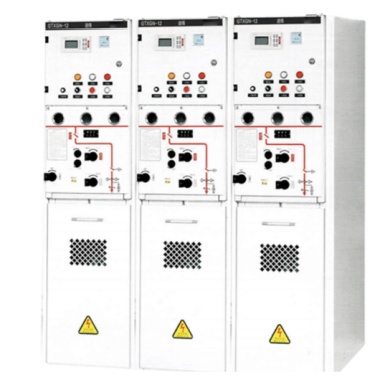
Why we recommend focusing on RMU selection when planning MV/LV substations
In many compact substation projects, the transformer is often chosen based on:
kVA rating
impedance
losses/efficiency
temperature rise / insulation class
noise and enclosure requirements
But the RMU decision affects:
How you sectionalize the network
How you restore supply after a fault
How safely you isolate the transformer for service
How much space and site work you need
How protection is coordinated
So while the transformer is the “power converter,” the RMU often becomes the “operational brain” of the MV supply arrangement.
A practical selection guide we use with customers
Choose an RMU when:
The site is part of (or planned for) a ring/loop MV network
Space is limited and you want a compact solution
You have a typical pattern: in + out + transformer tee-off
You value standardized deployment across multiple sites
Choose a broader MV switchgear lineup when:
You need many feeder panels or complex bus arrangements
Protection and automation requirements are extensive
You anticipate frequent expansions
The substation is a primary distribution node rather than a compact local node
Choose the transformer based on:
Load profile and future growth
Voltage ratio (MV/LV)
Efficiency/loss requirements
Environmental installation conditions
Final thoughts from our engineering team
In our day-to-day work, the most useful way to avoid confusion is to remember this hierarchy:
Switchgear is the broad family (switching + protection + control).
Ring main unit is a compact MV switchgear solution optimized for ring networks.
Transformer is a power device for voltage conversion, not switching.
If your application is a compact MV node—feeding local loads through a transformer while maintaining ring continuity—an RMU-based design is often the cleanest and most reliable approach. If your application is a larger substation with multiple feeders and complex control, a full switchgear lineup is usually the right answer. And if your question is “RMU or transformer,” it’s usually a sign the project team needs to separate conversion (transformer) from control and protection (RMU/switchgear) in the single-line diagram.
If you’d like product guidance, configuration suggestions (ways, protection options, and typical compact substation arrangements), or help aligning your specification with practical site conditions, you can learn more through Zhejiang Zhegui Electric Co., Ltd.. Our team can also support you with technical discussions based on your network topology, voltage level, and installation environment—so the solution fits the project rather than forcing the project to fit the equipment.
FAQ
1) Is a ring main unit the same as switchgear?
A ring main unit is a type of MV switchgear, but “switchgear” is a broader category that includes many configurations beyond ring networks, including large lineups with complex protection.
2) What is the difference between a ring main unit and a transformer?
A ring main unit performs MV switching, isolation, and protection, while a transformer performs voltage conversion (MV to LV or vice versa). They work together but serve different functions.
3) When should I specify an RMU instead of a full switchgear lineup?
Specify an RMU when you need compact ring distribution switching (in/out + tee-off) and fast deployment. Specify full switchgear when you need many feeders, bus couplers, or advanced protection/automation.
4) Does an RMU improve reliability in a ring network?
Yes. In a ring topology, an RMU helps sectionalize and isolate faults so supply can often be restored from the other side of the ring, reducing outage impact.